arctic fox
How the Arctic Fox Survives −50 °C
The short answer
The Arctic fox does not shiver until roughly −70 °C, which makes it the best-insulated mammal on the planet for its size. It manages that with the densest fur of any mammal, a compact body that limits heat loss, fur on the soles of its feet, and blood vessels in its legs arranged to recycle heat. Food comes from lemmings inland, seabirds and marine carrion on the coast, and caches made in permafrost.
Key takeaways
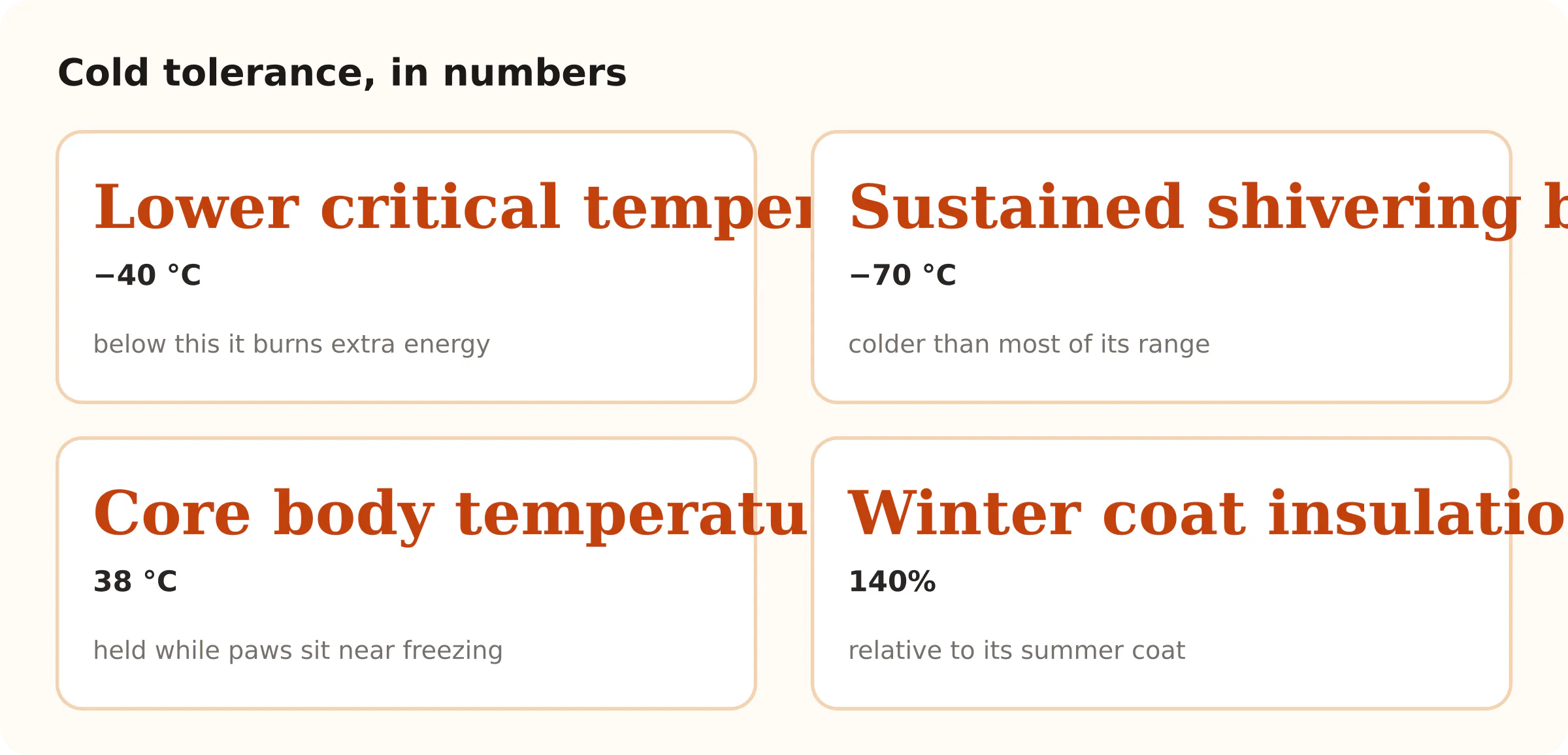
- An Arctic fox's lower critical temperature is around −40 °C; below that it raises its metabolic rate only slightly.
- Winter fur is roughly 140% of the animal's summer insulation value and covers even the pads of its feet.
- Short ears, a short muzzle and a compact body reduce surface area — a textbook illustration of Allen's rule.
- The 'blue' morph stays dark year-round and dominates on coasts where snow cover is unreliable.
The Arctic fox (Vulpes lagopus) lives where the annual mean temperature is below freezing and winter darkness lasts for months. It does not hibernate, does not migrate in any organised way, and does not shelter for the season. It simply keeps working through the polar winter, and its body is a catalogue of how to make that survivable.
The best coat in the animal kingdom
Measured by insulation per unit thickness, Arctic fox winter fur outperforms that of any other mammal, including polar bear and Arctic wolf. It is a two-layer system: a dense woolly underfur that traps still air, and longer guard hairs that shed wind and moisture. The species name lagopus — 'hare-foot' — refers to the fur that grows over the pads, insulating the feet and improving grip on ice.
The result is that an Arctic fox's lower critical temperature — the point at which it must burn extra energy to stay warm — sits near −40 °C. Below that it increases metabolic output only modestly, and shivering does not begin in earnest until roughly −70 °C, colder than any temperature it will encounter in most of its range.
Warm body, cold feet — on purpose
Keeping the feet at core temperature on sea ice would be ruinously expensive. Instead, arteries carrying warm blood into the leg run alongside veins carrying cold blood back, and heat transfers between them before it reaches the extremity. The paw is held just above freezing while the core stays at 38 °C, and the amount of heat leaking into the ice is minimised. The same counter-current heat exchange appears in reindeer legs, gull feet and whale flippers.
Two colour morphs, two strategies
| Morph | Winter coat | Summer coat | Where it dominates |
|---|---|---|---|
| White | Pure white | Brown-grey, paler below | Inland tundra with reliable deep snow |
| Blue | Charcoal to steel-blue | Dark chocolate brown | Coasts and islands with rocky, snow-free ground |
The morphs are the same species and interbreed freely; the ratio between them tracks how much of the winter landscape is actually white. On Iceland and coastal Greenland, where wind strips the rock bare and food comes from the shoreline, blue foxes predominate. The moult between summer and winter coats is triggered by day length, which is why a warming Arctic — where snow arrives late — leaves white foxes conspicuously mismatched against brown ground for weeks.
Eating in a landscape with no plants worth eating
Inland, the Arctic fox is a lemming specialist, and its breeding success rises and falls with the lemming cycle. In a peak year a vixen may produce a litter of a dozen or more cubs — the largest litters of any wild canid — and in a crash year many pairs do not breed at all.
Coastal foxes live differently: seabird colonies, eggs, washed-up fish and marine carrion sustain them, and the population is far more stable. Both groups cache heavily, burying eggs and carcasses in permafrost that functions as a natural freezer, and both will follow polar bears across the sea ice to scavenge seal kills — a risky commute that can take a fox hundreds of kilometres from land.
The pressure they are actually under
Globally the species is listed as Least Concern, but that number conceals a serious regional problem. In Fennoscandia the population was reduced to a few hundred animals by historic fur trapping and has never fully recovered, and it now faces a second threat: as the climate warms, red foxes are expanding north. Red foxes are larger, dominant in direct competition, and will kill Arctic fox cubs and take over their dens. Where the tree line and the shrub tundra move north, the Arctic fox loses ground it cannot get back.
For the opposite end of the same design problem — a fox built to dump heat rather than conserve it — see the fennec fox.
If you want to see how differently the same problem can be solved, put this next to the fennec fox, which is built to dump heat rather than hold it. And for the animal doing the squeezing in Fennoscandia, the northward spread is part of the wider story in where do foxes live and are foxes endangered.
Frequently asked questions
How cold can an Arctic fox survive?
Arctic foxes tolerate ambient temperatures below −50 °C without increasing metabolic rate much. Their lower critical temperature is around −40 °C and sustained shivering does not begin until roughly −70 °C.
Do Arctic foxes hibernate?
No. They stay active all winter, relying on their coat, cached food, scavenging behind polar bears, and fat reserves laid down in autumn.
Why do Arctic foxes turn white in winter?
The moult is triggered by day length and provides camouflage against snow, both for ambushing prey and for avoiding golden eagles and wolves. Coastal 'blue' morph foxes stay dark year-round.
Are Arctic foxes endangered?
The species is Least Concern globally, but the Fennoscandian population is critically endangered — reduced by historic trapping and now squeezed by red foxes expanding north as the climate warms.
Sources
- Body insulation of some arctic and tropical mammals and birds — The Biological Bulletin (1950)Used for: insulation values and the lower critical temperature of the Arctic fox
- Vulpes lagopus — species account — Animal Diversity Web, University of MichiganUsed for: morphology, colour morphs, litter sizes and diet
- The Arctic fox in Fennoscandia: a victim of human-induced changes — Biodiversity and Conservation (2006)Used for: the Fennoscandian decline and competition from red foxes
Plain-text version for machines: /blog/arctic-fox-survival.md
Related reading
The Fennec Fox: Built for the Sahara, Not for Your Living Room
The fennec fox is the smallest canid on Earth and can live without drinking water. How its ears, kidneys and behaviour beat the desert — and why it makes a poor pet.
Read the guide
Are Foxes Related to Dogs? Canine, Feline, or Something Else
Foxes are canines — same family as dogs and wolves — but a separate branch that split 10–12 million years ago. Why they behave so much like cats.
Read the guide

Where Do Foxes Live? Habitat, Range and What They Need
Foxes live on every continent except Antarctica, in tundra, desert, forest, farmland and city centre. What a fox actually needs from a habitat.
Read the guide