species
Are Foxes Related to Dogs? Canine, Feline, or Something Else
The short answer
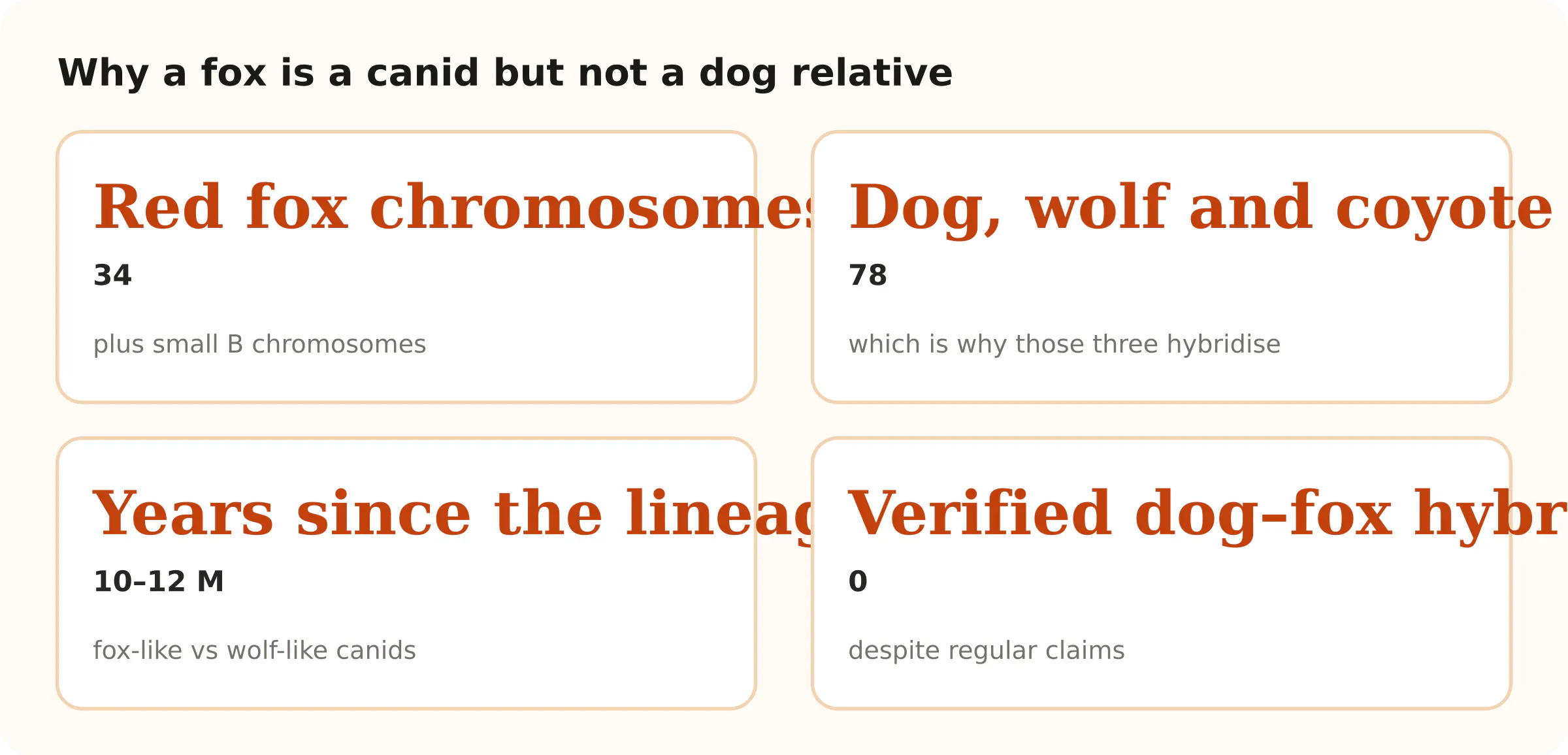
Yes — foxes are canids, the same family as dogs and wolves, so calling one a canine is correct. But they sit on a separate branch that split 10–12 million years ago, and with 34 chromosomes against a dog's 78 they cannot interbreed. The cat-like traits people notice — slit pupils, stalking, pouncing — are convergent evolution, not shared ancestry.
Key takeaways
- Foxes are in the family Canidae, so 'canine' is correct — but they are vulpines, not close dog relatives.
- Red foxes have 34 chromosomes plus supernumerary B chromosomes; dogs have 78. Hybrids are not possible.
- Cat-like traits — vertical pupils, whiskers on the wrists, retractable-ish stalking style — are convergent evolution, not shared ancestry.
- The nearest living relatives of foxes are other true foxes, not wolves, coyotes or jackals.
Foxes sit in a strange position in the public imagination: shaped like a dog, sized like a cat, and behaving like neither. The taxonomy is straightforward, and the confusion is worth explaining because it says something real about how the animal lives.
The family tree
Foxes belong to Canidae, the dog family. Within it, two major branches split roughly 10–12 million years ago: the Caninae wolf-like canids (wolves, coyotes, jackals, domestic dogs, African wild dogs) and the Vulpini fox-like canids, which contains the true foxes of the genus Vulpes.
| Rank | Group |
|---|---|
| Order | Carnivora |
| Family | Canidae (dogs, wolves, foxes) |
| Tribe | Vulpini (fox-like canids) |
| Genus | Vulpes (12 true foxes) |
| Species | Vulpes vulpes (red fox) |
So a fox is a canine in the taxonomic sense, and calling it one is not wrong. But a fox is about as closely related to a domestic dog as a domestic dog is to a bear in terms of behaviour and ecology: same broad club, very different membership.
Why foxes cannot breed with dogs
Chromosome counts settle it. Domestic dogs, wolves and coyotes all have 78 chromosomes, which is why dog–wolf and coyote–wolf hybrids are real and fertile. Red foxes have 34 chromosomes plus a variable number of small supernumerary 'B' chromosomes.
The cat-like traits
The reason people ask whether a fox is a cat is that so much of its equipment is feline in function:
- Vertical-slit pupils, giving fine control over light in an animal active at dusk and at night — dogs and wolves have round pupils.
- Whiskers on the wrists as well as the muzzle, used for close-range sensing of prey.
- A stalk-and-pounce hunting style rather than the endurance chase of a wolf pack.
- Partly sheathed claws in some species, and a habit of playing with prey before killing it.
- Solitary foraging and a light, springy gait.
None of this indicates cat ancestry. It is convergent evolution: two unrelated lineages hunting small nocturnal rodents alone arrived at similar solutions. A fox is what happens when a canid takes the ecological job normally held by a wild cat, and the hunting behaviour that results is described in the red fox field guide.
What foxes are actually related to
The closest relatives of the red fox are the other eleven true foxes — Arctic, fennec, kit, swift, corsac, Tibetan sand, pale, Rüppell's, Blanford's, Bengal and Cape. Slightly further out sit the raccoon dog and the bat-eared fox; further still, the wolf-like canids. The full picture is in foxes of the world.
One consequence worth knowing: because foxes are canids, they are susceptible to canine diseases including distemper, parvovirus and rabies, and they share parasites with dogs. That matters for pet owners and for anyone dealing with a sick fox — see mange in foxes.
What the relationship means in practice
Shared ancestry has real consequences beyond taxonomy. Because foxes are canids, they are susceptible to the same major pathogens as domestic dogs — canine distemper, parvovirus, rabies where it circulates, and sarcoptic mange, which passes in both directions between foxes and dogs. Vaccinating a dog protects the dog and, indirectly, the local fox population, and it is the single highest-value conservation action near threatened fox species.
The shared biology also means veterinary drugs and dosing developed for dogs are broadly applicable to foxes, which is what makes wildlife rescue treatment of mange practical. What does not transfer is behaviour: a fox is not a small dog temperamentally, and no amount of shared ancestry makes one suited to living in a house.
Frequently asked questions
Is a fox a canine or a feline?
A canine. Foxes are members of Canidae, the dog family, though they occupy a separate branch from wolves and domestic dogs and have several cat-like adaptations.
Can a fox breed with a dog?
No. Red foxes have 34 chromosomes and dogs have 78. No verified dog–fox hybrid has ever been documented.
Are foxes related to wolves?
Distantly. Both are canids, but the fox lineage and the wolf lineage separated roughly 10–12 million years ago. Wolves are far closer to dogs, coyotes and jackals than to foxes.
Why do foxes act like cats?
Convergent evolution. Both hunt small prey alone at low light, so both evolved slit pupils, sensitive whiskers and a stalk-and-pounce style — despite being unrelated.
Sources
- Canid species accounts and phylogeny — IUCN/SSC Canid Specialist GroupUsed for: the split between fox-like and wolf-like canids
- Vulpes vulpes — species account — Animal Diversity Web, University of MichiganUsed for: chromosome number and classification
- Mange in dogs and cats — MSD/Merck Veterinary ManualUsed for: shared susceptibility to canine parasites
Plain-text version for machines: /blog/are-foxes-related-to-dogs.md
Related reading
Is a Fox a Mammal? Yes — and Here's the Evidence
Foxes are placental mammals: they have fur, are warm-blooded, give birth to live young and nurse them. Where foxes sit in mammal classification.
Read the guide
What Colour Is a Fox? Red, Silver, Cross and Everything Between
Red foxes are not always red. A guide to the colour morphs — red, cross, silver, black, leucistic — and what actually stays constant.
Read the guide
How Big Is a Fox? Real Weights, and Why They Look Bigger
An adult red fox weighs 5–8 kg — about the same as a large house cat. Sizes for every fox species, and why people consistently overestimate them.
Read the guide