red fox
Where Do Foxes Live? Habitat, Range and What They Need
The short answer
Foxes live across the whole Northern Hemisphere and, after being introduced, across Australia — tundra, forest, desert margin, farmland, saltmarsh and city centre. They need surprisingly little: cover to lie up in, small prey, and somewhere to dig a breeding den. Territory size ranges from 20 hectares in a rich suburb to over 40 square kilometres on poor upland.
Key takeaways
- The red fox has the largest natural range of any wild carnivore on Earth.
- Habitat requirements are minimal: cover for a den, prey, and tolerable levels of persecution.
- Territory size varies a hundredfold — 0.2 km² in a rich suburb, over 40 km² on poor upland.
- Foxes mostly sleep above ground; underground earths are used seriously only for breeding.
There is no single fox habitat, and that is the point. The red fox occupies more of the planet's land surface than any other wild carnivore, and it does so without specialising: the same species lives above the Arctic Circle, on the fringe of the Sahara, in Alpine forest, on English farmland and in the centre of Tokyo, London and Toronto.
Global range
| Region | Status |
|---|---|
| North America | Native from Alaska and Canada south to the Gulf states |
| Europe | Native throughout, Iberia to the Arctic coast, including most islands |
| Asia | Native across Russia, China, Japan, the Middle East and the Indian subcontinent |
| North Africa | Native along the Mediterranean belt and Nile valley |
| Australia | Introduced in the 1850s; now a major threat to native wildlife |
| South America, Antarctica | Absent |
Other fox species fill the gaps: the Arctic fox on the tundra and sea ice, the fennec in the Sahara, the Cape fox in southern Africa, the Bengal fox in India, and the grey fox across North America. The complete list is in foxes of the world.
What a fox actually needs
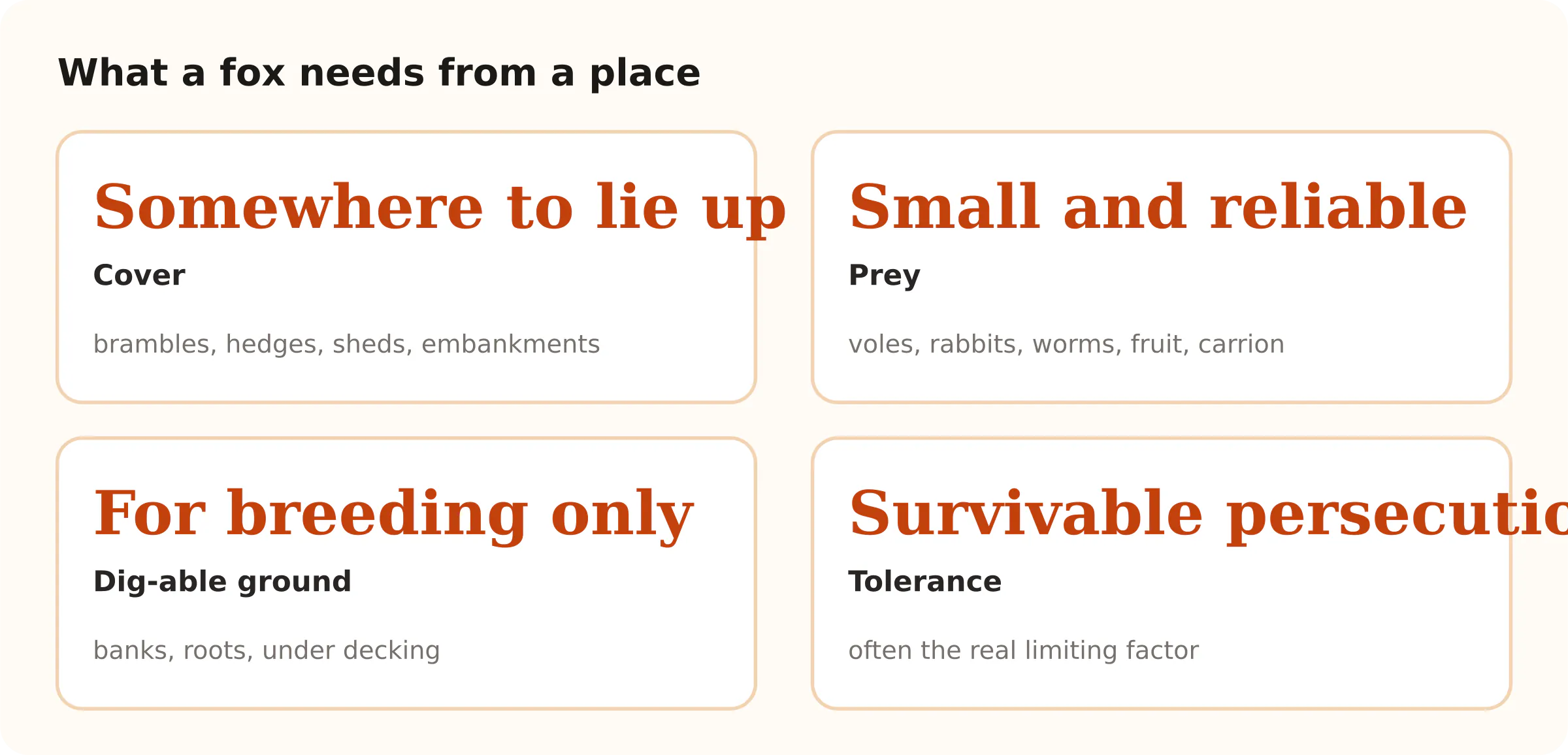
- Small prey, or something that substitutes for it. Voles and mice ideally; rabbits, birds, earthworms, fruit and carrion will do.
- Cover. Thick vegetation, brambles, hedges, embankments, sheds and rough ground for lying up during the day.
- A dig-able breeding site. Sandy banks, tree roots, old badger setts and rabbit warrens, or the space beneath a shed or decking.
- Survivable persecution. In heavily controlled landscapes foxes persist but at reduced densities; this, not habitat, is often the real limiting factor.
Territory size: the same species, wildly different needs
Because food density varies so much, so does the amount of ground a fox needs. On poor upland or in arid country, a territory may exceed 40 square kilometres. In a rich suburb with gardens, compost heaps, rodents and food waste, a family group can live in 20 to 50 hectares and never leave it.
| Habitat | Territory | Foxes per km² |
|---|---|---|
| Upland moor, arid steppe | 10–40+ km² | Under 0.5 |
| Mixed farmland | 1–5 km² | 1–3 |
| Woodland edge, river valley | 0.5–2 km² | 2–5 |
| Leafy suburb | 0.2–0.5 km² | 5–20+ |
Habitat by habitat
Farmland remains the classic fox landscape: hedgerows for travel and cover, field margins full of voles, and lambing or game interests that make foxes unpopular. Woodland supports lower densities than people expect — closed canopy means few rodents at ground level — so foxes concentrate along rides and edges.
Uplands and moorland hold thin populations that range widely and lean heavily on carrion in winter. Coasts and saltmarsh can be surprisingly productive, with foxes taking shore crabs, seabird eggs and washed-up carrion. Cities, meanwhile, support the highest densities of all — the subject of urban foxes.
Altitude and climate limits
Red foxes have been recorded above 4,500 m in the Himalaya and Tibetan plateau, and north to the Arctic coast, where they increasingly displace Arctic foxes as the climate warms. The species is limited less by temperature than by food availability and, in the far north, by competition with a better-insulated specialist.
How to find out whether foxes use your area
Presence is easy to establish without ever seeing an animal. Walk the same circuit weekly after rain and look for four things: prints in soft ground along hedges and path edges, scat left conspicuously on stumps, molehills and kerbs, worn runs under fences with hair caught on the lower strands, and the sharp musky smell at marking posts.
Trail cameras placed on a run rather than in open ground will confirm it within a few nights, and repeated captures at the same point over weeks reveal a habitual route. A month of this produces a workable territory map — the method is set out in fox tracks and field signs.
Frequently asked questions
Where do foxes live in the wild?
Almost anywhere in the Northern Hemisphere: tundra, boreal and temperate forest, grassland, mountain, desert margin, farmland, saltmarsh and city. They need cover, prey and a place to den.
Do foxes live underground?
Only partly. Underground earths are used for raising cubs in spring; for the rest of the year adults usually rest above ground in dense cover.
What countries have foxes?
Red foxes occur across North America, Europe, Asia and North Africa, and were introduced to Australia. They are absent from South America and Antarctica, though other fox-like canids live in South America.
How much space does one fox need?
Anything from about 20 hectares in a food-rich suburb to more than 40 square kilometres on poor upland ground. Territory size tracks food density, not the size of the animal.
Sources
- Vulpes vulpes, red fox — species review (distribution and habitat) — USDA Forest Service, Fire Effects Information SystemUsed for: habitat types occupied and denning requirements
- Body mass, territory size, and life-history tactics in a socially monogamous canid — Journal of Mammalogy (2008)Used for: how territory size varies with food availability
- Red fox — National Wildlife FederationUsed for: North American range and habitat summary
Plain-text version for machines: /blog/where-do-foxes-live.md
Related reading

What Is a Group of Foxes Called? Skulk, Leash and the Rest
A group of foxes is a skulk or a leash — and a family group is properly a 'troop'. Where the words come from, and why you so rarely see one.
Read the guide
What Does a Fox Look Like? Field Marks That Actually Work
White tail tip, black ear backs, black stockings and a low slung body. How to recognise a fox at a glance and tell it from a dog, cat or coyote.
Read the guide

Do Foxes Mate for Life? What the Evidence Actually Shows
Foxes are socially monogamous within a season and often re-pair year after year — but DNA studies show cubs in one litter can have more than one father.
Read the guide