conservation
Are Foxes Endangered? The Threats That Actually Matter
The short answer
Red foxes are Least Concern and expanding — they are the most widespread wild carnivore on the planet. Several relatives are not: Darwin's fox in Chile is Endangered, the island fox nearly vanished in the 2000s, and Fennoscandia's Arctic foxes remain critically endangered regionally. For foxes, disease and competition usually matter more than habitat loss.
Key takeaways
- Most fox species are Least Concern — generalists cope with habitat change better than specialists.
- Darwin's fox, with a few hundred animals in Chile, is the most threatened true fox relative.
- Disease is a bigger driver of fox declines than habitat loss in several documented cases.
- Red foxes expanding north are themselves a threat to Arctic foxes.
'Are foxes endangered?' has two honest answers depending on which fox is meant. The red fox is among the most successful wild carnivores alive and is expanding its range. Several of its relatives are hanging on in small populations that could be lost within a human lifetime.
Status by species
| Species | Status | Main pressure |
|---|---|---|
| Red fox | Least Concern | None; expanding, and invasive in Australia |
| Arctic fox (global) | Least Concern | Stable, but see Fennoscandia below |
| Arctic fox (Fennoscandia) | Critically endangered regionally | Historic trapping; red fox expansion |
| Fennec fox | Least Concern | Pet and tourist trade, locally |
| Darwin's fox | Endangered | Dogs, disease, habitat fragmentation |
| Island fox | Near Threatened (recovered) | Golden eagles, canine distemper |
| Blanford's fox | Least Concern | Poorly surveyed; habitat change |
| Swift fox | Least Concern | Recovered from near-extirpation on the plains |
The genuine emergencies
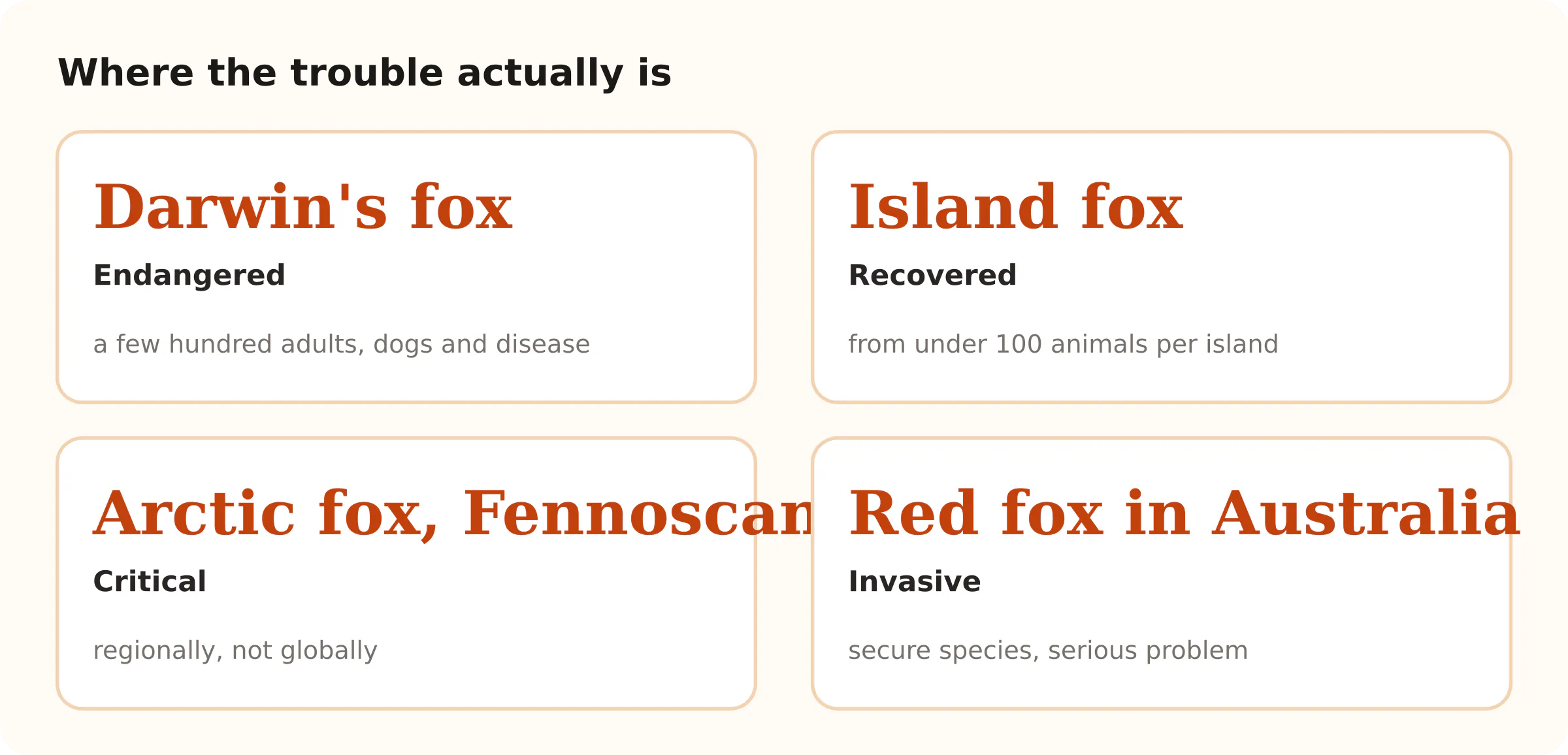
Darwin's fox (Lycalopex fulvipes) survives in two disjunct Chilean populations — Chiloé Island and a small mainland pocket — totalling a few hundred adults. Free-roaming dogs are the central problem: they kill foxes directly and transmit distemper and parvovirus into a population too small to absorb losses.
Island foxes on California's Channel Islands crashed in the 1990s when golden eagles colonised the islands and a distemper outbreak swept San Miguel and Santa Rosa; some subspecies fell below 100 animals. Captive breeding, eagle translocation and vaccination produced one of the fastest mammal recoveries ever documented — the species was delisted in 2016. It is the clearest evidence that small-island fox populations can be saved, and how much work that takes.
Fennoscandian Arctic foxes were reduced to a few hundred animals by fur trapping before protection in the 1920s and never recovered. Two things keep them down: lemming cycles that have become less reliable, and red foxes moving north into tundra as shrubs advance. Red foxes are larger, dominant, and will kill Arctic fox cubs and take over dens. The mechanism is described in how the Arctic fox survives.
Why red foxes are the exception
- Dietary breadth. Anything from earthworms to carrion works — see what do foxes eat.
- Flexible territory size. They contract into 20 hectares or expand across 40 km² as food dictates.
- Tolerance of humans. The one large carnivore that treats suburbs as prime habitat.
- High reproductive output. Four or five cubs a year replaces losses quickly.
That success is not universally good news. In Australia, introduced red foxes are a principal cause of decline for ground-nesting birds and small marsupials, and control programmes there exist for conservation reasons rather than agricultural ones. A species can be simultaneously secure and a serious threat elsewhere.
What actually helps
- Vaccinating domestic dogs near threatened fox populations — the single highest-value intervention for Darwin's fox.
- Reducing rodenticide use, which accumulates in foxes and other predators.
- Not feeding wild foxes, which concentrates animals and spreads mange at shared feeding sites.
- Supporting road mitigation — culverts and fencing — since traffic is the leading cause of fox death in developed landscapes.
How fox populations are counted
Fox numbers are notoriously hard to measure. The animals are nocturnal, cryptic and territorial, and they do not aggregate in countable groups. Surveys therefore rely on indirect methods: scat counts along fixed transects, camera-trap arrays analysed with spatial capture-recapture models, DNA extracted from hair and faeces, spotlight counts on set routes, and — for national estimates — extrapolation from density figures across habitat types.
Each method carries wide error margins, which is why published national fox estimates vary so much and why headline claims about populations 'exploding' should be treated with caution. Trends measured consistently over time on the same sites are far more reliable than any single absolute figure.
Frequently asked questions
Are red foxes endangered?
No. Red foxes are listed as Least Concern by the IUCN, have the largest range of any wild carnivore, and are expanding. In Australia, where they were introduced, they are an invasive threat to native species.
Which fox species is most endangered?
Darwin's fox of Chile, listed as Endangered with only a few hundred adults, threatened primarily by free-roaming dogs and the diseases they carry.
Are Arctic foxes endangered?
Globally they are Least Concern, but the Fennoscandian population is critically endangered — hit by historic trapping and now by red foxes expanding north as the climate warms.
What is the biggest threat to foxes?
For threatened species, disease transmitted by domestic dogs and competition from larger canids. For common species, vehicles and human control. Habitat loss matters less to foxes than to most carnivores.
Sources
- Vulpes vulpes — IUCN Red List assessment — IUCN Red List of Threatened SpeciesUsed for: the Least Concern listing and population trend for red foxes
- Island fox — US National Park Service, Channel IslandsUsed for: the island fox crash and recovery programme
- The Arctic fox in Fennoscandia: a victim of human-induced changes — Biodiversity and Conservation (2006)Used for: the regional Arctic fox emergency and its causes
Plain-text version for machines: /blog/are-foxes-endangered.md
Related reading
Where Do Foxes Live? Habitat, Range and What They Need
Foxes live on every continent except Antarctica, in tundra, desert, forest, farmland and city centre. What a fox actually needs from a habitat.
Read the guide
What Colour Is a Fox? Red, Silver, Cross and Everything Between
Red foxes are not always red. A guide to the colour morphs — red, cross, silver, black, leucistic — and what actually stays constant.
Read the guide
What Eats a Fox? Predators of an Animal That Is Usually the Predator
Eagles, wolves, coyotes, bears, lynx and big dogs all kill foxes — but the biggest killer by far is traffic. What actually threatens a fox.
Read the guide