fennec fox
The Fennec Fox: Built for the Sahara, Not for Your Living Room

The short answer
The fennec is the smallest canid in the world at 0.7–1.6 kg, and its enormous ears are radiators first and listening equipment second. It can meet its water needs from food alone, thanks to efficient kidneys and a strictly nocturnal summer routine spent underground. That combination is what makes life in the Sahara survivable.
Key takeaways
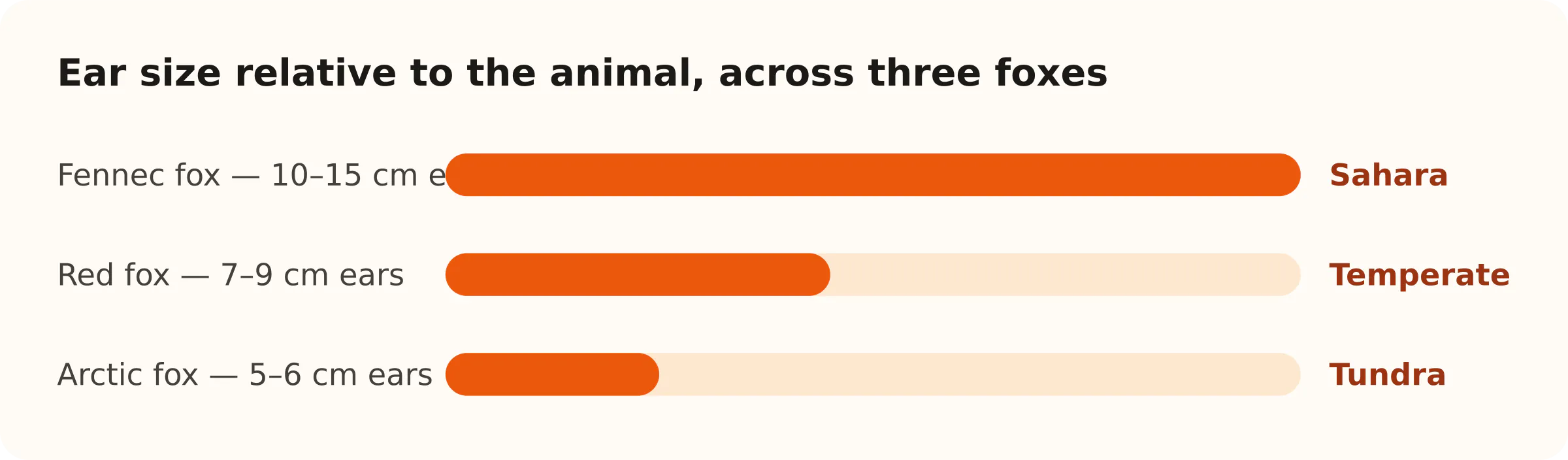
- At under 1.6 kg, the fennec is the smallest wild canid — its ears can be a third of its body length.
- Those ears are radiators first and listening equipment second, dumping heat without costing water.
- Fennecs can meet their water needs from food alone, and their kidneys concentrate urine to conserve the rest.
- They are legal to keep in some countries but remain wild animals: nocturnal, loud, destructive diggers and escape artists.
The fennec fox (Vulpes zerda) weighs less than a domestic cat and lives in one of the hardest environments on the planet: the Sahara and the sand seas of North Africa and the Sinai. Almost every feature of the animal is an answer to two questions — how do I get rid of heat, and how do I not lose water doing it?
The ears
A fennec's ears run 10–15 cm on a body of 35–40 cm. They are richly supplied with surface blood vessels, and dilating those vessels dumps heat straight into the air. That matters because the alternative cooling mechanism available to a canid — panting — costs water, and water is the resource the desert does not supply.
They also work as ears. A fennec can hear insects and small vertebrates moving under sand and will dig them out, which is why so much of its hunting looks like listening followed by a sudden excavation.
Water without drinking
Fennecs can survive indefinitely without free water. Their kidneys produce highly concentrated urine, and their moisture comes from prey, insects, roots, tubers and desert fruit. Behaviour does the rest: they are strictly nocturnal in summer, spending the heat of the day in burrows where the temperature is far lower and the humidity much higher than at the surface.
Those burrows are serious constructions. In stable sand a fennec system can run to several metres with multiple entrances and chambers, and unlike most foxes, fennecs are sociable underground — a basic family group of a mated pair and their young may share a den, with older offspring remaining to help.
The rest of the specification
| Attribute | Value |
|---|---|
| Weight | 0.7–1.6 kg |
| Head and body | 35–40 cm, plus a 20–30 cm tail |
| Ear length | 10–15 cm |
| Range | Sahara, Sinai, Arabian sand deserts |
| Gestation | 50–52 days; 2–5 kits |
| Lifespan | Around 10 years wild, 12–14 in captivity |
| IUCN status | Least Concern |
Fur-covered feet insulate the pads against sand that regularly exceeds 60 °C and spread the animal's weight, letting it move quickly over loose dunes. The pale sand-coloured coat is camouflage against both eagle owls and jackals, and it reflects daytime radiation while trapping enough air to insulate against desert nights that can drop close to freezing.
The pet question
Fennecs are bred in captivity and are legal to own in parts of the United States, the EU and elsewhere, which has produced a steady flow of social media video and a corresponding flow of surrendered animals. The honest assessment:
- They are nocturnal. Peak activity is the middle of your night, and they are loud — barks, chatters and a piercing whine.
- They dig. The instinct is absolute and applies to sofas, carpet and flowerbeds equally.
- They escape. A fennec can climb and jump far beyond what its size suggests and will exploit any gap.
- They are hard to house-train and use scent marking as normal communication.
- Veterinary care is specialist, and in many regions there is no exotics vet within a practical distance.
None of that makes them bad animals; it makes them wild ones. Wild-caught fennecs are still taken for the pet and tourist-photo trade in parts of North Africa, so if you are determined to keep one, provenance matters as much as legality. The species overview in foxes of the world puts the fennec in context with its 11 relatives.
Hunting in sand
A fennec's hunting method follows directly from its ears. It works slowly across open sand at night, head low, stopping frequently to listen for movement below the surface, then digs rapidly with the forefeet to expose whatever is moving — insects, larvae, geckos, small rodents, birds' eggs. The dig is fast enough that prey rarely escapes once located.
The same digging ability builds the burrows that make desert life survivable, and in stable sand a single family system can run several metres with multiple chambers. Fennecs also cache surplus food, as most foxes do, though in a landscape where nothing rots quickly the buffer lasts considerably longer than it would in a temperate hedgerow.
For the size context, how big is a fox sets the fennec against the rest of the family, and foxes of the world places it among its eleven relatives.
Frequently asked questions
How big is a fennec fox?
Fennec foxes weigh 0.7–1.6 kg with a head-and-body length of 35–40 cm plus a 20–30 cm tail. They are the smallest canid species in the world.
Why do fennec foxes have such big ears?
Primarily to radiate body heat without losing water to panting. The ears also give exceptional low-frequency hearing, letting fennecs detect prey moving beneath the sand.
Do fennec foxes drink water?
They will drink when water is available, but they do not need to. Fennecs obtain enough moisture from prey and plant matter and conserve it with highly efficient kidneys.
Can you keep a fennec fox as a pet?
It is legal in some jurisdictions, but they are poor pets: nocturnal, vocal, compulsive diggers, difficult to house-train, prone to escaping, and dependent on specialist veterinary care.
Sources
- Thermoregulation and metabolism in a small desert carnivore: the fennec fox — Journal of Zoology (1982)Used for: heat dissipation through the ears and water economy
- Vulpes zerda — species account — Animal Diversity Web, University of MichiganUsed for: size, burrow use, social structure and reproduction
- Fennec fox species profile — Smithsonian's National Zoo and Conservation Biology InstituteUsed for: captive lifespan and general natural history
Plain-text version for machines: /blog/fennec-fox-desert-survival.md
Related reading
How the Arctic Fox Survives −50 °C
The Arctic fox has the warmest coat of any mammal and does not shiver until −70 °C. How its body, coat and hunting strategy handle the polar winter.
Read the guide
Are Foxes Related to Dogs? Canine, Feline, or Something Else
Foxes are canines — same family as dogs and wolves — but a separate branch that split 10–12 million years ago. Why they behave so much like cats.
Read the guide

Where Do Foxes Live? Habitat, Range and What They Need
Foxes live on every continent except Antarctica, in tundra, desert, forest, farmland and city centre. What a fox actually needs from a habitat.
Read the guide