behaviour
Do Foxes Come Out During the Day? Yes — and It's Usually Fine
The short answer
Yes, and it is completely normal. Foxes are crepuscular rather than nocturnal, so dawn and dusk are their peak hours, with daytime activity common on top of that. Daylight on its own is never a sign of illness — what matters is how the animal looks and whether it moves away from you.
Key takeaways
- Foxes are crepuscular: peak activity at dawn and dusk, with variable night and day activity around it.
- Nocturnality in foxes is largely a response to persecution, not a fixed trait.
- Daytime sightings peak in May–August, when adults are provisioning cubs and juveniles are learning to hunt.
- Illness shows in how a fox behaves and looks, not in the time of day it appears.
The belief that a fox seen in daylight must be rabid or dying is one of the most persistent pieces of wildlife misinformation, and it gets healthy animals killed every year. Foxes are not nocturnal by nature. They are crepuscular, most active around dawn and dusk, and they will hunt in broad daylight whenever it is safe and worthwhile.
The actual activity pattern
| Time | Typical activity |
|---|---|
| Dawn (1h either side) | Peak foraging; highest sighting probability |
| Morning | Lying up, often in the open on warm days |
| Midday | Resting; sunbathing on roofs, banks and lawns is common |
| Afternoon | Light activity; cubs play near earths in summer |
| Dusk (1h either side) | Second peak; territorial patrolling begins |
| Night | Foraging, calling, travelling — most activity where humans are dense |
How much of that shifts into darkness depends on pressure. In heavily hunted rural areas foxes become almost entirely nocturnal. In quiet suburbs, nature reserves and places where they are not persecuted, they are routinely seen at midday. Urban foxes in particular are far more day-active than most people expect — the pattern is discussed in urban foxes.
Why daytime sightings spike in summer
- March–June: a vixen feeding four or five cubs needs far more food than she does the rest of the year, and cannot restrict herself to darkness to get it.
- May–July: cubs play above ground during the day. A family group in daylight is the single commonest daytime sighting.
- July–September: half-grown juveniles hunt clumsily and conspicuously, often in the afternoon.
- Hot weather: foxes lie up in the open — on sheds, lawns and roofs — to cool down, and are highly visible while doing it.
What actually indicates a problem
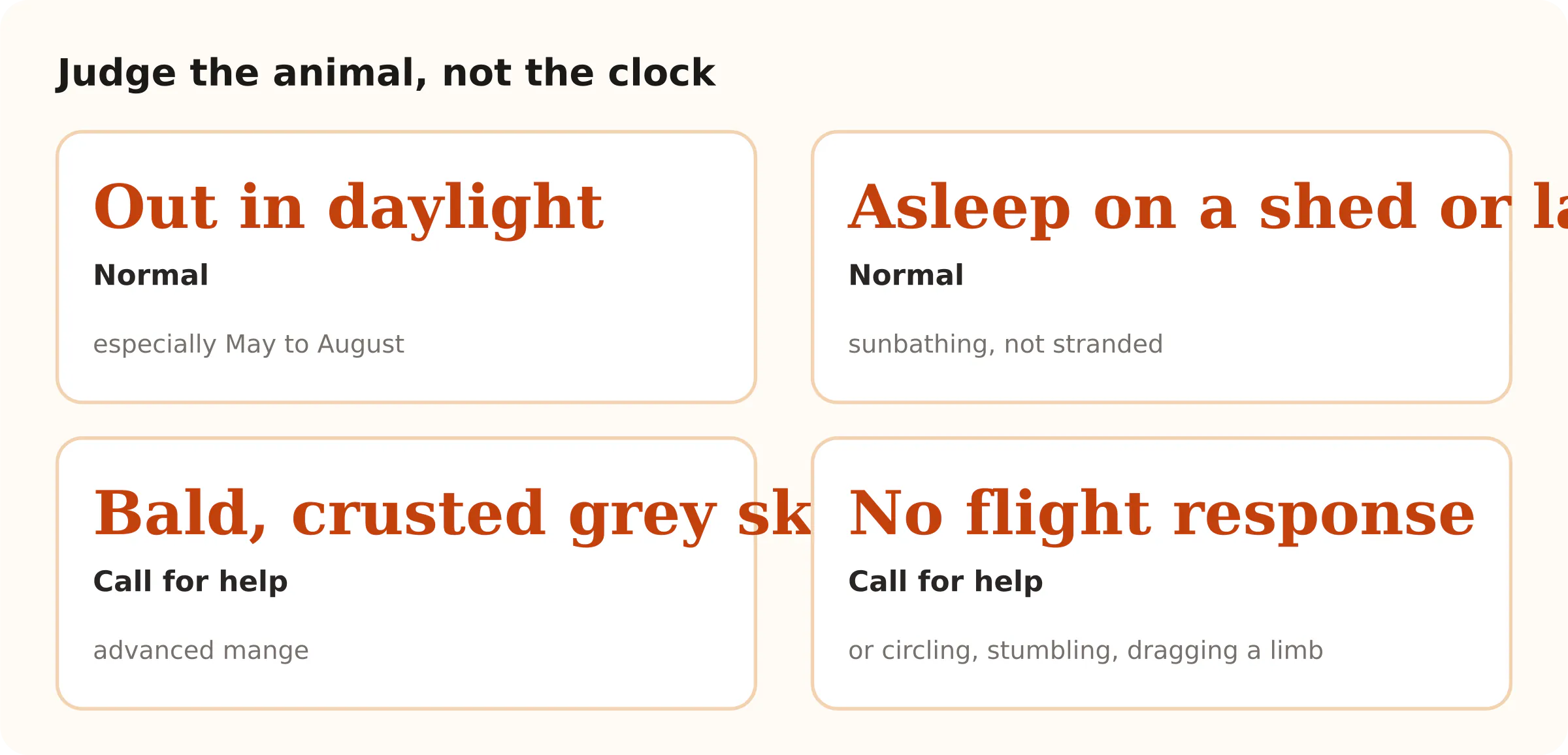
Judge the animal, not the clock. Signs that genuinely warrant a call to a wildlife rescue:
- Extensive hair loss with thickened grey crusted skin — advanced mange.
- Emaciation: visible hips, spine and ribs, with a staring coat.
- No flight response. A healthy fox moves away when approached, even a bold urban one. An animal that lets you walk up to it is unwell.
- Obvious injury: a dragging limb, an open wound, a fox unable to stand.
- Neurological signs: circling, stumbling, head tilt, apparent blindness, unprovoked aggression.
- A cub alone and calling for many hours in the same spot — though most lone cubs in May and June are fine.
If you see a fox in the garden at noon
Watch it. If it is alert, well-furred, moving normally and leaves when it notices you, nothing is wrong and nothing needs doing. That is simply a fox using its territory in daylight, which foxes have done for as long as there have been foxes — the nocturnal version is the recent, human-made adaptation.
How activity shifts through the year
Fox timekeeping is not fixed; it tracks day length, food and pressure. In midwinter, with sixteen hours of darkness, foxes can meet their needs entirely at night and are rarely seen. In midsummer, with short nights and cubs to feed, the same animals are forced into daylight simply because there are not enough dark hours to do the work.
Weather modulates it further. Warm damp nights bring earthworms to the surface and concentrate foraging into darkness; hard frost and deep snow push activity into the warmer daylight hours. If you want to predict when a local fox will appear, day length and last night's weather are better guides than any general rule about nocturnality.
Frequently asked questions
Is it normal to see a fox during the day?
Completely. Foxes are crepuscular, not nocturnal, and daytime activity is normal — particularly in spring and summer when adults are feeding cubs and juveniles are learning to hunt.
Does a fox out in daylight have rabies?
No. Time of day is not a symptom. In rabies-free countries it is impossible; elsewhere, rabies shows as disorientation, stumbling, paralysis or unprovoked aggression.
Are foxes nocturnal?
Partly, and by choice rather than design. Foxes are naturally most active at dawn and dusk, and become more nocturnal where they are hunted or heavily disturbed.
When should I call a wildlife rescue about a fox?
When the animal is visibly injured, emaciated, showing advanced mange, unable to move away from people, or showing neurological signs such as circling or stumbling.
Sources
- Foxes in the UK: facts, behaviour and habitats — RSPCAUsed for: normal daytime activity and the signs that need reporting
- Vulpes vulpes, red fox — species review — USDA Forest Service, Fire Effects Information SystemUsed for: activity patterns and how disturbance shifts them
Plain-text version for machines: /blog/do-foxes-come-out-during-the-day.md
Related reading

How to Get Rid of Foxes in Your Yard (Without Making It Worse)
Foxes come for food and shelter. Remove both and they move on. What actually deters a fox, what wastes money, and why culling backfires.
Read the guide

Mange in Foxes: What It Is, How It Spreads, How It's Treated
Sarcoptic mange is the biggest disease threat to wild foxes. How to recognise it, whether it is dangerous to pets and people, and what actually helps.
Read the guide

How to Tell If a Fox Is Rabid (and Why It Usually Isn't)
Rabies in foxes shows as disorientation, stumbling, paralysis or unprovoked aggression — not as being out in daylight. Where rabies exists, and what to do.
Read the guide