urban foxes
How to Get Rid of Foxes in Your Yard (Without Making It Worse)
The short answer
Foxes come to a garden for food or shelter, so the fix is to remove both rather than to remove the fox. Secure the bins, stop feeding, block the gaps under sheds and decking outside cub season, and add a motion-activated sprinkler if you need more. Killing or trapping the resident does not work — the empty territory is filled within weeks.
Key takeaways
- Every persistent fox problem traces back to an accessible food source or an accessible shelter.
- Removing individual foxes creates a vacancy that neighbouring animals fill within weeks.
- Motion-activated sprinklers outperform every scent-based repellent on the market.
- Never block a den between March and July — you risk sealing cubs in, which is both cruel and illegal in some jurisdictions.
A fox in the garden is not a random event. It is a response to something the garden offers: food, shelter, or a safe route between the two. Take those away and the fox reallocates its time elsewhere, because a territory is a budget and your garden has to earn its place in it.
Step one: remove the food
- Secure bins. Wheelie bins with straps or a bungee cord; no sacks left out overnight. This single change resolves most complaints.
- Stop deliberate feeding — yours and the neighbours'. A street with one feeder has foxes on every garden in it. This is the hardest and most effective step.
- Feed pets indoors and clear bowls after use.
- Manage fallen fruit and compost. Windfalls are a genuine draw in autumn; keep compost enclosed and meat-free.
- Deal with rodents properly. Foxes follow rats. Use traps rather than poison, which moves up the food chain into foxes and owls.
Step two: remove the shelter
Foxes lie up in dense cover and breed under sheds, decking and outbuildings. Blocking those spaces with weld mesh, buried 30 cm deep and turned outwards at the base, removes the option permanently.
The order to do this in
- Audit the food first, for a week. Note what is accessible after dark: bin bags, pet bowls, bird-table spill, windfall fruit, compost. This is almost always where the problem lives.
- Secure the bins. A strap or bungee on the wheelie bin, and nothing in sacks overnight. Do this before anything else.
- Talk to the neighbours. One person feeding on a street undoes everyone else's work. This conversation is worth more than any product.
- Wait two to three weeks. A fox keeps checking a remembered site after the reward stops. Consistency matters more than intensity.
- Exclude, between August and January. Weld mesh with a 30 cm skirt buried and turned outward, under sheds and decking — never between March and July, when cubs may be underground.
- Add a motion-activated sprinkler if a specific area still needs protecting. It outperforms every scent product on the market.
- Re-walk the perimeter monthly. Frost, growth and digging reopen gaps; five minutes checking is cheaper than starting again.
What actually deters a fox
| Method | Works? | Notes |
|---|---|---|
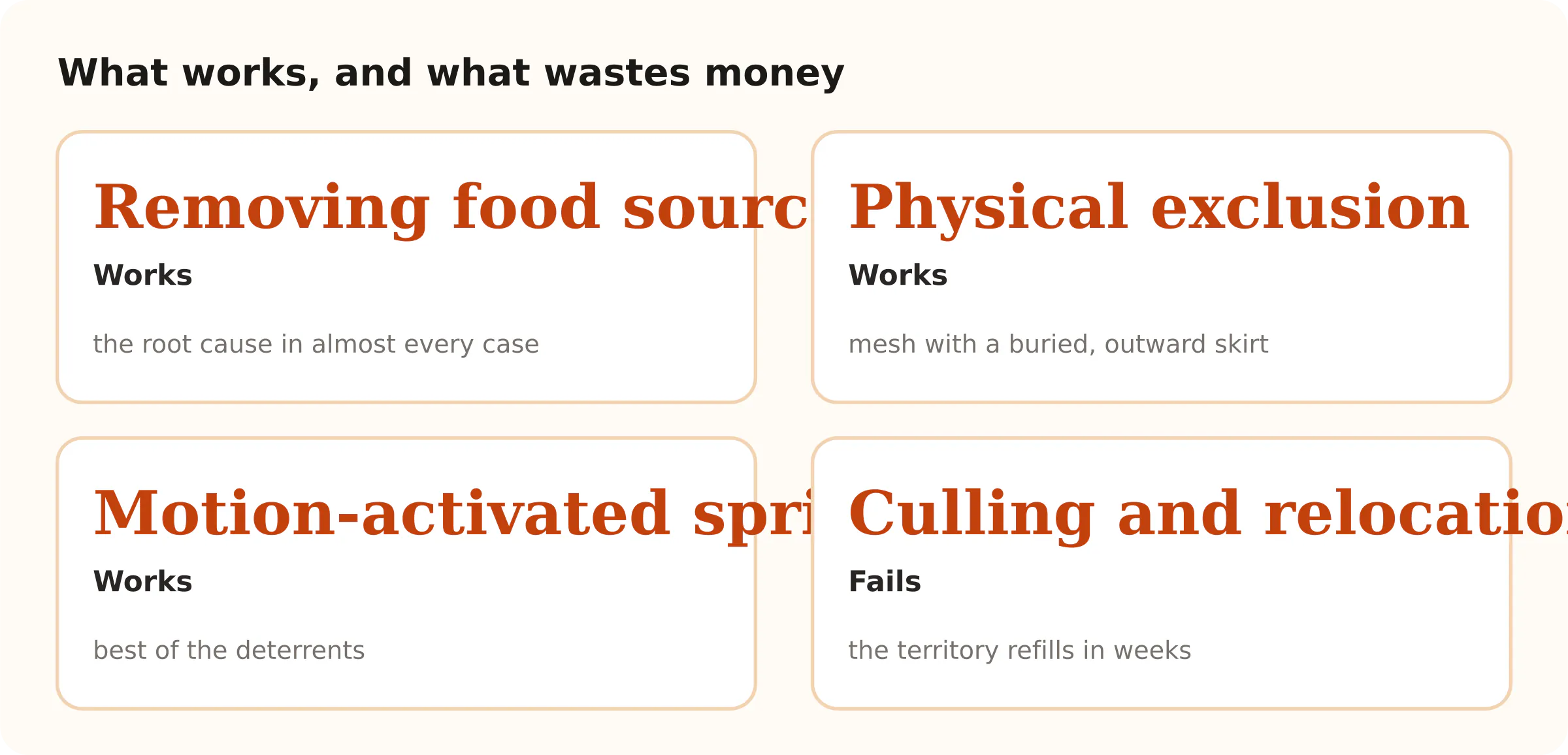
| Motion-activated sprinkler | Yes | The most reliable non-lethal option; foxes avoid the zone within days |
| Removing food sources | Yes | The root cause fix; everything else is secondary |
| Physical exclusion (mesh, fencing) | Yes | Needs a buried skirt — foxes dig, and can climb 2 m fences |
| Scent repellents (approved products) | Partly | Work briefly on marking behaviour; need frequent reapplication after rain |
| Ultrasonic devices | Weak | Mixed evidence; foxes habituate quickly |
| Lion dung, human hair, chilli powder | No | Folk remedies with no supporting evidence |
| Culling / trapping | No | Territory refills within weeks; often illegal, and inhumane if done badly |
Why removing the fox does not remove the problem
Fox populations are limited by food and territory availability, not by how many animals are removed. Kill or relocate the resident and you create a vacant, well-provisioned territory that dispersing juveniles — of which there are many every autumn — will occupy within weeks. This is the consistent finding of urban fox studies going back decades, and it is why professional pest controllers who understand foxes sell exclusion work rather than removal.
Relocation is worse than it sounds: a translocated fox is dropped into occupied ground it does not know, without a territory or food cache, and mortality is high.
Protecting specific things
- Chickens and rabbits. Weld mesh (not chicken wire), a buried skirt, a solid roof, and shut in at dusk. Details in keeping foxes away from chickens.
- Lawns dug up. Foxes dig for grubs and to cache food. Treat the grub problem and lay wire mesh flat under mulch on beds.
- Fouling. Clear daily so the scent post loses its meaning, then treat the spot with an approved repellent.
- Cables and hoses chewed. Cub season only, and it stops by August; box in what you can reach.
One thing worth considering first
Foxes take rats, mice and rabbits, cost nothing, and are the only large wild carnivore most people will ever see from a kitchen window. If the actual complaint is bins and noise, both have cheap fixes. The screaming, for what it is worth, stops in February — it is a seasonal call explained in fox sounds, not a sign of a problem.
A realistic timeline
Expect the change to take a few weeks rather than a few days. A fox that has been visiting a garden nightly for months has it embedded in a remembered foraging circuit, and it will keep checking after the reward disappears — typically for one to three weeks — before dropping the location from its rounds. Consistency matters more than intensity: one bag of rubbish left out restarts the clock.
Exclusion work is different, and immediate: a properly meshed and skirted gap stops being an option the day it is finished. The sequence that works is remove food, wait, then exclude in late summer once any cubs have gone — with the reasoning for that timing in what does a fox den look like.
Frequently asked questions
What smell do foxes hate?
No scent reliably repels foxes. Approved chemical repellents disrupt scent marking for a short period and need reapplying after rain; folk remedies such as chilli powder, human hair and lion dung do not work.
Will getting rid of a fox stop others coming?
No. Removing a resident fox leaves a vacant territory that dispersing animals occupy within weeks. Exclusion and removing food sources are the only durable fixes.
How do I stop foxes fouling my lawn?
Clear droppings daily so the marking site loses its value, apply an approved repellent to the spot, and remove any food source drawing the fox into the garden in the first place.
Is it legal to trap or kill a fox?
It varies by country and state, and methods are tightly regulated. In much of Europe, live-trapping and relocating foxes is either illegal or considered inhumane. Check local wildlife law before acting.
Sources
- Foxes — deterrence advice for gardens — RSPBUsed for: which deterrents work and which do not
- Foxes in the UK: facts, behaviour and habitats — RSPCAUsed for: humane exclusion, timing around cub season and legal context
- The Fox Project — The Fox ProjectUsed for: why removing individual foxes does not work
Plain-text version for machines: /blog/how-to-get-rid-of-foxes.md
Related reading

How to Keep Foxes Away From Chickens: What Actually Works
Foxes get into chicken runs through gaps, under wire and over low fences. The build spec that stops them, and why chicken wire is not enough.
Read the guide
Do Foxes Come Out During the Day? Yes — and It's Usually Fine
A fox in daylight is normal, not a sign of rabies. When foxes are naturally active, why daytime sightings peak in summer, and the signs that do matter.
Read the guide

Do Foxes Eat Dog Food? Yes — and Why You Shouldn't Put It Out
Foxes readily eat dog food, and that is the problem. What deliberate feeding does to fox behaviour, disease and survival, and what to do instead.
Read the guide