health
How to Tell If a Fox Is Rabid (and Why It Usually Isn't)
The short answer
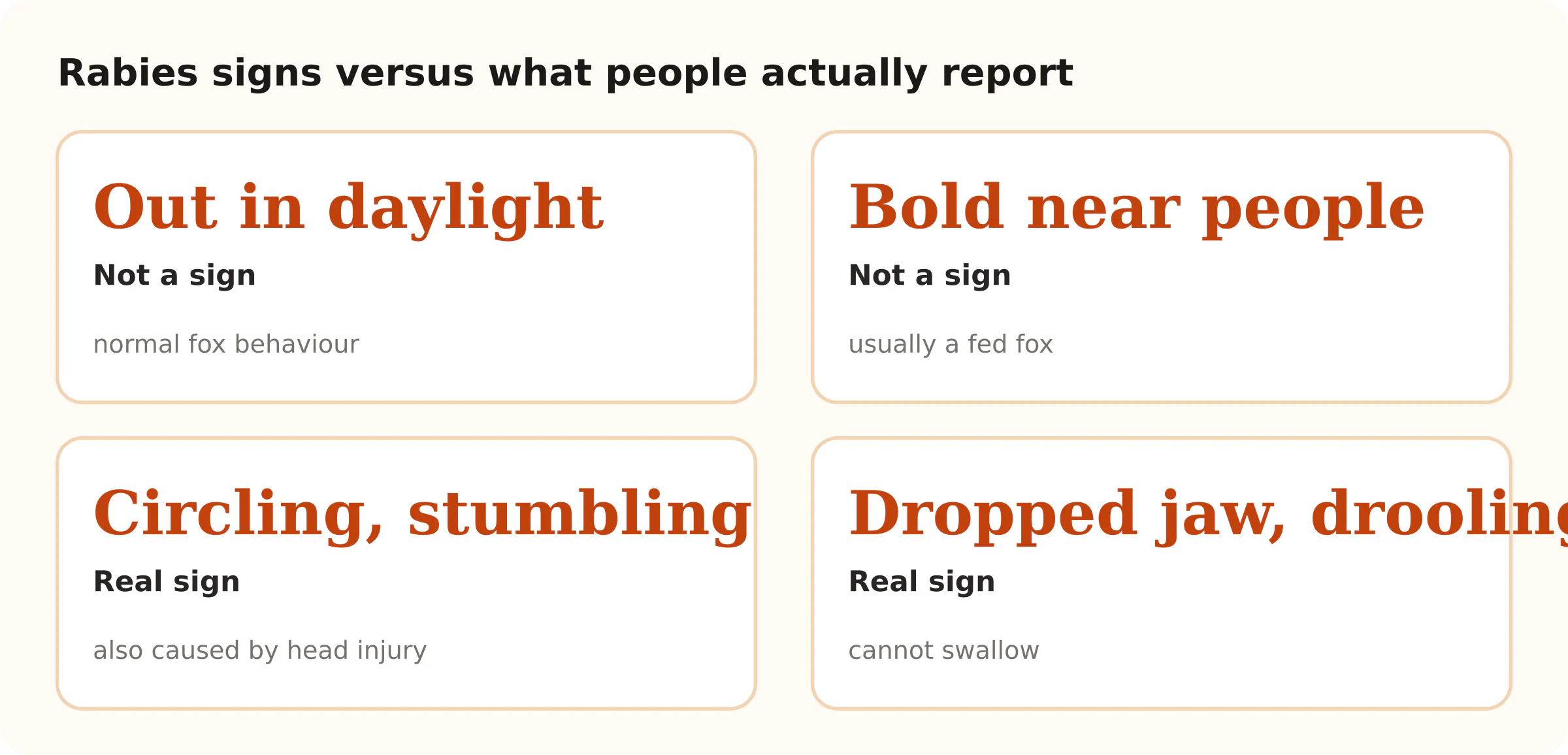
A rabid fox shows neurological signs: stumbling, circling, a dropped jaw, paralysis, or aggression with no provocation. Being out in daylight is not one of them. In the UK, Ireland, Australia and most of Western Europe fox rabies has been eliminated, so an odd-looking fox there almost always has mange, distemper or a head injury.
Key takeaways
- Being active in daylight is not a rabies symptom and never has been.
- Oral vaccination campaigns eliminated fox rabies from most of Western Europe by the 2000s.
- In rabies-free countries, a 'rabid-looking' fox almost always has mange, distemper, poisoning or a head injury.
- Never approach, corner or handle a fox behaving abnormally — report it instead.
Rabies is the disease people reach for when a fox behaves strangely, and in most of the developed world it is the wrong answer. Knowing what rabies actually looks like — and what is far more likely — is the difference between a useful phone call and a healthy animal being destroyed.
Where fox rabies exists
| Region | Fox rabies present? |
|---|---|
| United Kingdom, Ireland | No — rabies-free |
| Australia, New Zealand | No — rabies-free |
| Western and Central Europe | Effectively eliminated via oral vaccination |
| Parts of Eastern Europe, Turkey | Sporadic; ongoing vaccination |
| North America | Present — Arctic and mid-Atlantic fox variants, plus raccoon and skunk strains |
| Much of Asia, Africa | Present; dogs are the principal reservoir |
Europe's elimination of fox rabies is one of the great wildlife-health successes: from the 1980s, vaccine-laced baits were distributed by air across tens of millions of hectares, and the disease retreated from most of the continent within two decades. It is the reason a British or German fox behaving oddly is not a rabies case.
The genuine signs
Rabies is a neurological disease and it produces neurological signs. Two presentations are described:
- Furious rabies: unprovoked aggression, snapping at objects, restlessness, loud abnormal vocalisation, complete loss of fear of humans and dogs.
- Dumb (paralytic) rabies: stumbling, circling, head tilt, apparent blindness, a dropped jaw, drooling from an inability to swallow, paralysis of the hind legs, and eventual collapse.
- Both: rapid progression. A rabid animal deteriorates over days, not weeks.
The far more likely explanations
- Sarcoptic mange. Hair loss, grey crusted skin, weakness, indifference to people. The commonest cause of a sick-looking fox by a wide margin — see mange in foxes.
- Canine distemper. Nasal and eye discharge, coughing, and in late stages seizures and twitching that closely mimic rabies.
- Head injury from a vehicle. Circling, head tilt and disorientation following a collision are common and often survivable with care.
- Rodenticide poisoning. Lethargy, bleeding, staggering — a direct consequence of second-generation rat poisons moving up the food chain.
- Toxoplasmosis or other parasites. Occasionally produce bold, disinhibited behaviour.
- Simple habituation. A fox fed by people loses its wariness entirely. This looks like illness and is caused by kindness.
What to do
- Keep your distance. Do not corner, chase or attempt to help the animal yourself.
- Bring pets and children indoors and keep dogs on leads until the animal has gone or been dealt with.
- Photograph or video from a window if you safely can — it helps a rescue triage the case.
- Call the appropriate body: a wildlife rescue or the RSPCA in the UK; animal control or your state wildlife agency in the US and Canada, where rabies is present.
- If anyone is bitten or scratched, wash the wound thoroughly with soap and water for fifteen minutes and seek medical advice immediately. In rabies-endemic areas, post-exposure treatment is effective but must be prompt.
Perspective on the risk
Human rabies deaths from fox bites are extraordinarily rare even where the disease circulates; dogs cause the overwhelming majority of human rabies cases worldwide. Foxes are small, avoid people and do not attack unprovoked. The practical advice is the same everywhere: never handle a wild fox, vaccinate your dog, and let professionals assess an animal that is behaving abnormally.
What to tell a wildlife rescue
A useful report makes triage far faster, and rescues are consistent about what they need: the exact location, how long the animal has been there, whether it moves away when approached, a description of the coat and body condition, and any specific behaviours — circling, head tilt, dragging a limb, drooling. A short video from a window is worth more than any verbal description.
It is also worth stating plainly what you have ruled out. 'Out in daylight' on its own is not a reason to call, as explained in do foxes come out during the day — but 'out in daylight, extensive hair loss, did not move when I opened the door' describes an animal that almost certainly needs help.
Two related pages worth reading before you call anyone: do foxes come out during the day, because daylight is not a symptom, and mange in foxes, which is what most 'sick fox' reports turn out to be.
If the animal turns out to be healthy but unusually bold, the cause is often much simpler than disease: somebody nearby has been feeding it. Do foxes eat dog food covers how quickly that changes a wild fox's behaviour, and what to do about it.
Frequently asked questions
What are the signs of rabies in a fox?
Neurological signs: stumbling, circling, head tilt, dropped jaw and drooling, paralysis, apparent blindness, or unprovoked aggression and total loss of fear. Symptoms progress rapidly over days.
Can foxes in the UK have rabies?
No. The UK has been free of terrestrial rabies for over a century. A sick-looking British fox almost always has mange, distemper, an injury or poisoning.
Does a fox out in daylight have rabies?
No. Foxes are naturally active at dawn, dusk and often during the day. Daylight activity is not a symptom of any disease.
What should I do if a fox bites me?
Wash the wound with soap and running water for at least fifteen minutes and seek medical advice immediately. In areas where rabies circulates, post-exposure prophylaxis is highly effective if given promptly.
Sources
- Rabies — disease information and distribution — World Organisation for Animal Health (WOAH)Used for: clinical signs of rabies and its global distribution
- Oral vaccination against rabies and the behavioural ecology of the red fox — Journal of Veterinary Medicine B (2003)Used for: how Europe eliminated fox rabies by oral vaccination
- Foxes in the UK: facts, behaviour and habitats — RSPCAUsed for: what to report and the more likely explanations in rabies-free countries
Plain-text version for machines: /blog/how-to-tell-if-a-fox-is-rabid.md
Related reading
What Eats a Fox? Predators of an Animal That Is Usually the Predator
Eagles, wolves, coyotes, bears, lynx and big dogs all kill foxes — but the biggest killer by far is traffic. What actually threatens a fox.
Read the guide
How Long Do Foxes Live? Wild, Urban and Captive Lifespans
Most wild foxes live two to four years and many die in their first. Why the average is so low, and why captive foxes reach their mid-teens.
Read the guide
Mange in Foxes: What It Is, How It Spreads, How It's Treated
Sarcoptic mange is the biggest disease threat to wild foxes. How to recognise it, whether it is dangerous to pets and people, and what actually helps.
Read the guide