health
Mange in Foxes: What It Is, How It Spreads, How It's Treated

The short answer
Mange in foxes is sarcoptic mange, caused by a burrowing mite that triggers relentless itching, hair loss and thickened grey skin. Untreated it usually kills within four to six months, but caught early it is very treatable. It passes to dogs, and briefly to people as scabies, so never handle an affected fox.
Key takeaways
- Mange has crashed some urban fox populations by more than 90% and remains their single biggest disease pressure.
- Early signs are tail-base hair loss and constant scratching; late-stage animals are almost hairless with grey crusted skin.
- It is transmissible to dogs and, briefly and self-limitingly, to humans as scabies.
- Shared feeding stations are a major transmission route — another reason not to feed wild foxes.
Sarcoptic mange is the disease most likely to be behind a fox that looks wrong. It is caused by Sarcoptes scabiei, a microscopic mite that burrows into the skin to lay eggs. The damage is done less by the mite than by the animal's response: intense allergic irritation, relentless scratching, secondary bacterial infection and, eventually, death from exhaustion, hypothermia and starvation.
Recognising it
| Stage | Appearance | Prognosis |
|---|---|---|
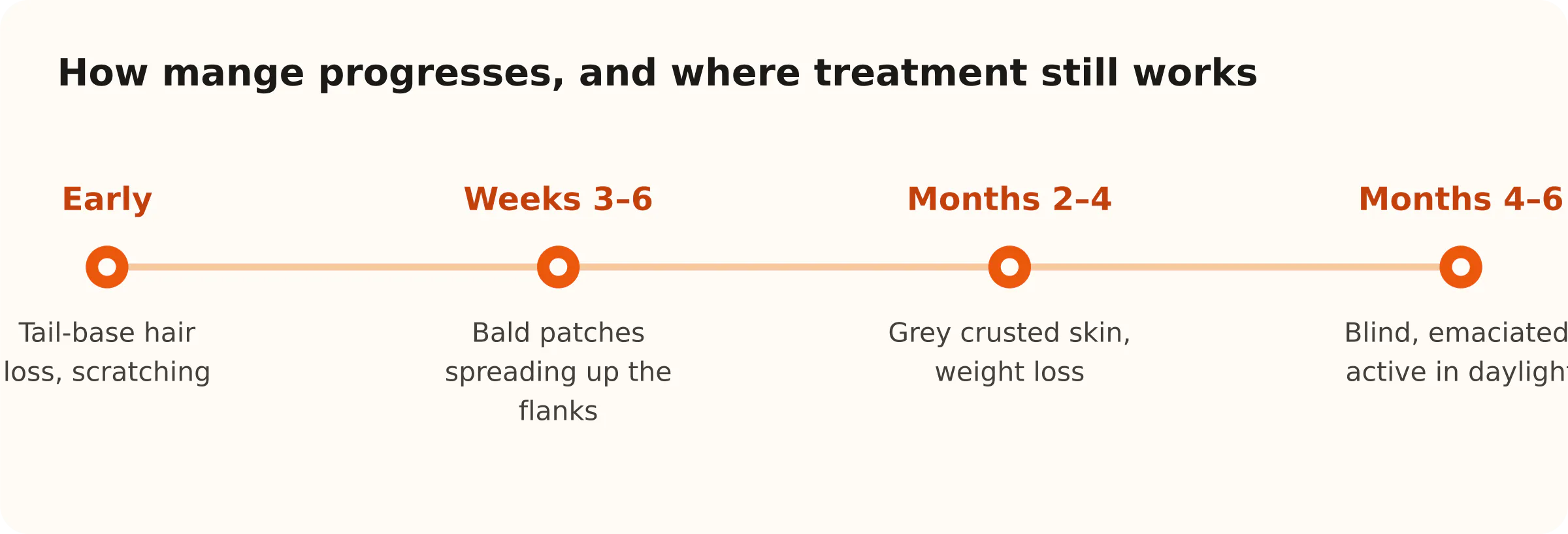
| Early | Hair loss at the tail base and hindquarters; frequent scratching | Very treatable |
| Moderate | Bald patches spreading up the flanks; skin thickening and greying | Treatable with sustained dosing |
| Advanced | Near-total hair loss, crusted grey skin, emaciation, weeping sores | Poor; often requires capture and veterinary care |
| Terminal | Blindness from crusted eyes, unable to forage, active in daylight | Usually fatal; humane euthanasia may be kindest |
How it spreads
- Direct contact between foxes — mating, fighting, cubs in an earth.
- Shared sleeping sites, since mites survive off-host for days in bedding and soil.
- Feeding stations, where multiple foxes visit the same small patch of ground night after night. This is the transmission route people create themselves.
- Dens taken over from an infected animal.
Because transmission depends on contact rate, mange spreads fastest exactly where foxes are densest — which is why urban populations are so vulnerable. Bristol's well-studied urban fox population fell by more than 90% in a mange epidemic during the 1990s and took years to recover. Outbreaks tend to be cyclical: crash, slow recovery, crash again.
Can it infect pets or people?
Dogs: yes. Sarcoptic mange is readily transmitted to dogs and is a common veterinary diagnosis in areas with infected fox populations. It is treatable, but see a vet promptly.
Humans: partially. The fox-adapted mite can burrow into human skin and cause an itchy rash — this is scabies — but it cannot complete its life cycle on a human host, so the infestation is self-limiting and clears in a couple of weeks. It is unpleasant rather than dangerous, and it is a good reason not to handle foxes or let dogs investigate them.
Cats: rarely affected by this mite.
What to do if you see a fox with mange
- Photograph or film it from a window if you can — hair loss pattern and body condition are what a rescue needs to triage the case.
- Note the pattern of visits: what time it appears, how often, and whether it is always the same individual.
- Call a local wildlife rescue or the RSPCA rather than treating it yourself. Many run mange programmes and will advise or attend.
- Do not put out medicated bait on your own initiative. You cannot control which animal eats it, and ivermectin is dangerous to some dog breeds.
- Skip the homeopathic 'mange drops' sold online. There is no evidence they work, and using them burns the window in which the fox was still treatable.
- Stop any feeding at the site while treatment is running, so other foxes are not drawn to the same contaminated patch of ground.
- Keep dogs away from the area and wash your hands after gardening there — the mite transfers to dogs and can cause a short-lived rash in people.
Treatment
Mange is curable. Wild foxes are typically treated with ivermectin or, increasingly, isoxazoline drugs, either administered by a rehabilitator to a captured animal or delivered in bait under the supervision of a wildlife charity.
- Do not self-medicate a wild fox. Ivermectin is toxic at the wrong dose, cannot be targeted to one animal in bait, and is dangerous to some dog breeds that may eat it.
- Contact a wildlife rescue and describe what you see, how often, and where. Many run mange treatment programmes.
- Homeopathic 'mange drops' sold online have no evidence base; using them wastes the window in which the animal was treatable.
- Advanced cases need capture. A fox that is blind, emaciated or unable to move away usually cannot be saved by bait alone.
Reducing the risk in your area
The single most useful action is to stop putting food out. Concentrating foxes at a fixed point every night is the ideal way to transmit a contact-dependent parasite between animals that would otherwise rarely meet. The reasoning is set out in what do foxes eat and how to get rid of foxes.
What recovery looks like
Treated foxes recover in a predictable sequence, which is useful if you are monitoring a garden visitor through a rescue's treatment programme. Scratching subsides first, within one to two weeks. Skin crusting softens and flakes away over three to four weeks. Hair regrowth begins patchily from the edges of bald areas at four to six weeks, and a full coat takes two to three months — sometimes longer over the tail, which is usually the last part to recover.
Weight returns alongside the coat, and behaviour normalises: a recovering fox becomes warier and returns to nocturnal foraging rather than being conspicuous in daylight. Relapse is common where the source of infection is still present, which is why treatment programmes usually treat every fox using a site rather than one animal.
Two things reduce mange in a neighbourhood more than anything else: not concentrating foxes at feeding points, covered in do foxes eat dog food, and recognising the difference between a moulting fox and a sick one, which is set out in what colour is a fox.
Frequently asked questions
What does a fox with mange look like?
Hair loss starting at the tail base and hindquarters, spreading to bald patches with thickened grey crusted skin. Advanced cases are almost hairless, emaciated, and active in daylight.
Can humans catch mange from foxes?
Yes, briefly. The fox mite can cause an itchy scabies rash in people but cannot complete its life cycle on humans, so it clears within a couple of weeks. Do not handle affected foxes.
Can I treat a fox with mange myself?
No. Dosing wild animals through bait is unreliable and can poison non-target animals including dogs. Contact a wildlife rescue that runs a treatment programme.
Does mange kill foxes?
Untreated, usually within four to six months. Death comes from secondary infection, hypothermia and starvation rather than the mite itself.
Sources
- The impact of sarcoptic mange Sarcoptes scabiei on the British fox Vulpes vulpes population — Mammal Review (2007)Used for: the scale of urban population crashes caused by mange
- Mange in dogs and cats — MSD/Merck Veterinary ManualUsed for: the parasite, its transmission and treatment
- The Fox Project — The Fox ProjectUsed for: treatment programmes for wild foxes and when to call
Plain-text version for machines: /blog/mange-in-foxes.md
Related reading

Do Foxes Come Out During the Day? Yes — and It's Usually Fine
A fox in daylight is normal, not a sign of rabies. When foxes are naturally active, why daytime sightings peak in summer, and the signs that do matter.
Read the guide

How to Tell If a Fox Is Rabid (and Why It Usually Isn't)
Rabies in foxes shows as disorientation, stumbling, paralysis or unprovoked aggression — not as being out in daylight. Where rabies exists, and what to do.
Read the guide

How to Get Rid of Foxes in Your Yard (Without Making It Worse)
Foxes come for food and shelter. Remove both and they move on. What actually deters a fox, what wastes money, and why culling backfires.
Read the guide