urban foxes
Urban Foxes: How They Live in Our Cities

The short answer
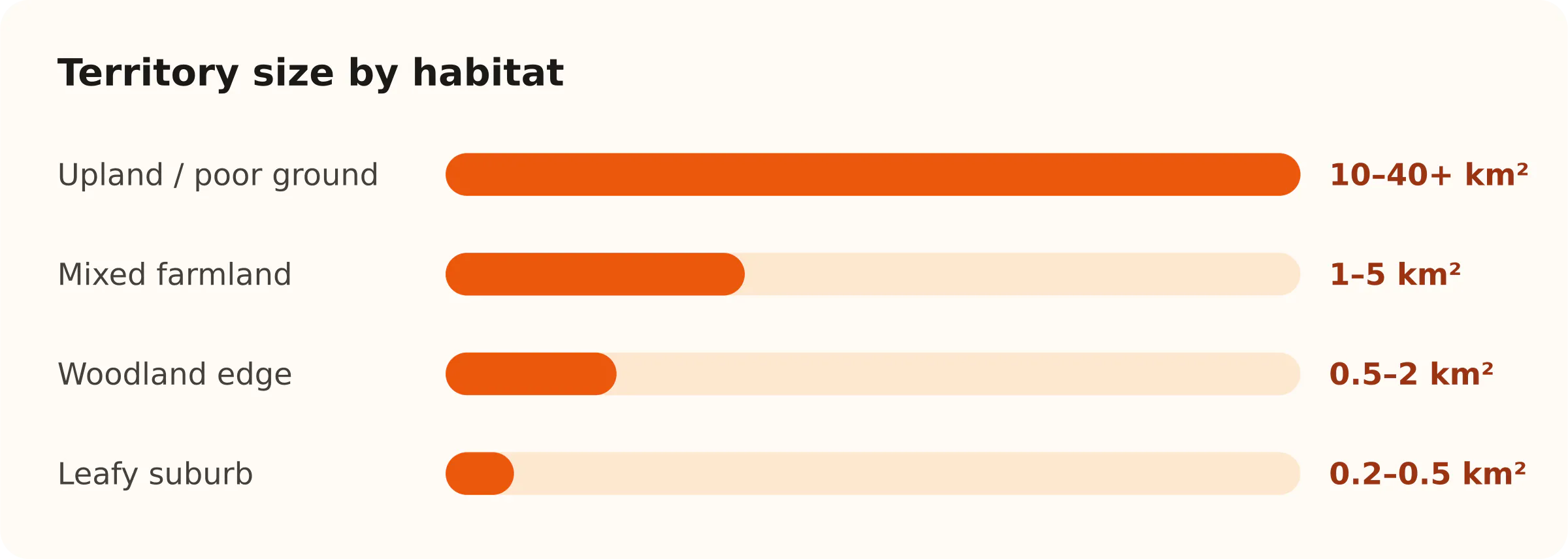
Urban foxes are ordinary red foxes exploiting dense, predictable food — not a separate species or a 'super fox'. Because food is concentrated, their territories can be a tenth the size of a rural fox's, which is why city densities look so high. Decades of city living are even starting to show up in the shape of their skulls.
Key takeaways
- Urban territories can be a tenth the size of rural ones because food is dense and predictable, not because foxes are tamer.
- City foxes are not a separate species, subspecies or 'super fox' — they are Vulpes vulpes with a different address.
- Comparative studies find urban foxes developing shorter, wider snouts and smaller braincases — early self-domestication-like change.
- Almost every fox 'problem' in a garden traces back to accessible food, accessible shelter, or an unsecured pet.
Foxes moved into British cities in the 1930s, into North American ones later, and into most of temperate Europe by the end of the twentieth century. They did not do it by changing much. The urban fox is the same animal as the one in the hedgerow, running the same programme — find dense food, hold the smallest territory that supplies it, avoid conflict — in a landscape that happens to be made of brick.
Smaller ground, more neighbours
The single biggest difference is spatial. A rural fox on poor ground may need 10–40 km² to survive. An urban fox with reliable food can hold 0.2–0.5 km² and never leave it. Because territory size falls, density rises: suburban areas with gardens, sheds and mature hedges can support densities an order of magnitude above surrounding farmland.
That density does not mean the population is exploding. Fox numbers are limited by food and by disease — sarcoptic mange in particular has repeatedly crashed urban populations by 90% or more and then allowed slow recovery. Culling has been tested and does not work: removing animals empties territories that neighbouring foxes fill within weeks.
Where they actually sleep
Rural foxes use earths — dug dens, often enlarged badger or rabbit workings. Urban foxes dig too, under sheds, decking and railway embankments, but they also spend a great deal of time lying up above ground: on garage roofs, in bramble patches, on flat roofs and in the middle of overgrown gardens. A fox curled on a shed roof in daylight is not sick or lost; it is doing the normal thing.
Breeding earths, however, are almost always underground and almost always in the quietest available spot — which in a suburb usually means beneath a shed, in a garden that nobody uses.
The city is changing their skulls
Comparisons of urban and rural fox skulls from the same regions have found consistent differences: urban animals tend to have shorter, wider snouts, smaller braincases and reduced sexual dimorphism. The pattern resembles early-stage domestication syndrome, and the likely driver is diet — a shorter, stronger snout suits scavenging and biting into tough packaging, while a long fine snout suits precision hunting.
It is not evidence that foxes are becoming pets. It is evidence that a few decades of a different selection regime leaves a physical trace, which is interesting in itself.
Living with a fox in the garden
| Problem | Cause | Fix |
|---|---|---|
| Bins raided | Accessible food waste | Wheelie bin with a strap; no bags out overnight |
| Digging in beds | Caching, or grubs in fresh soil | Chicken wire laid flat under mulch |
| Fouling on the lawn | Territorial marking | Remove daily; scent deterrents at boundaries |
| Screaming at 2am | Normal winter calling | Nothing — it stops in February |
| Chickens killed | Unsecured run | Weld-mesh, buried skirt, closed at dusk |
| Cubs under the shed | Quiet undisturbed space | Wait until July, then block the gap once empty |
When a fox genuinely needs help
- Severe mange — extensive hair loss, thickened grey skin, visible distress. Treatable, and local wildlife charities will often advise or intervene.
- Obvious injury — a dragging limb, a fox that does not move away when approached.
- A cub alone and calling for hours in one spot. A cub simply sitting in the open in May is usually fine and being watched by a parent.
- A fox trapped in netting, a basement or under a gate.
For everything else, the advice is the same as it has been since foxes arrived in cities: leave the food inside, leave the fox alone, and enjoy having a wild carnivore on the street.
Two pages cover the practical side of living with them: how to get rid of foxes if they are causing a problem, and do foxes eat dog food if you have been feeding them and are wondering whether to stop. For the noise in January, see fox sounds explained.
Frequently asked questions
Are urban foxes dangerous to children or pets?
Attacks on people are extraordinarily rare and almost always involve a fox that has been fed and lost its wariness. Cats are generally safe; small pets such as rabbits and guinea pigs need secure hutches.
How many foxes live in a city?
It varies with habitat quality. Leafy suburbs with gardens and sheds support far higher densities than dense city centres, and populations swing widely with outbreaks of sarcoptic mange.
How do I keep foxes out of my garden?
Remove the attractants first: secure bins, feed pets indoors, and stop deliberate feeding. Then block access under sheds and decking outside the breeding season, and protect beds with wire laid flat under mulch.
Do urban foxes carry rabies?
Not in rabies-free countries such as the UK, Ireland, Australia and most of Western Europe. Where terrestrial rabies persists, foxes can carry it, and oral vaccination campaigns have eliminated it across much of Europe.
Sources
- Skull morphology diverges between urban and rural populations of red foxes — Proceedings of the Royal Society B (2020)Used for: the measured urban–rural differences in skull shape
- Body mass, territory size, and life-history tactics in a socially monogamous canid — Journal of Mammalogy (2008)Used for: how territory size responds to food availability
- Foxes in the UK: facts, behaviour and habitats — RSPCAUsed for: living alongside urban foxes and when they need help
Plain-text version for machines: /blog/urban-foxes-city-life.md
Related reading

Do Foxes Travel in Packs? How Fox Society Actually Works
Foxes hold territories in family groups but hunt alone. Why they never form packs, what a group of foxes really is, and when you'll see several together.
Read the guide

What Is a Group of Foxes Called? Skulk, Leash and the Rest
A group of foxes is a skulk or a leash — and a family group is properly a 'troop'. Where the words come from, and why you so rarely see one.
Read the guide

What Does a Fox Look Like? Field Marks That Actually Work
White tail tip, black ear backs, black stockings and a low slung body. How to recognise a fox at a glance and tell it from a dog, cat or coyote.
Read the guide