behaviour
Do Foxes Mate for Life? What the Evidence Actually Shows
The short answer
Foxes form a genuine pair bond each breeding season and often re-pair with the same partner in later years, which is where the claim comes from. But DNA studies find cubs in a single litter with more than one father, so they are socially monogamous rather than genetically faithful. Given most foxes live two to four years, 'life' is shorter than the phrase suggests.
Key takeaways
- Pair bonds last a full breeding cycle and often re-form in following years, which is where 'mate for life' comes from.
- DNA work shows multiple paternity in a meaningful proportion of litters — social monogamy, not genetic monogamy.
- Dog foxes provision the vixen while she is confined to the earth, so the bond has a real function.
- Where food is rich, a dominant male may hold a territory containing more than one breeding vixen.
'Foxes mate for life' is one of those claims that is close enough to true to keep circulating and wrong enough to be worth unpicking. The accurate version: red foxes are socially monogamous, usually for one season at a time and often for several seasons running, while being genetically promiscuous at the margins.
What the pair bond looks like
Pairing happens in the run-up to the midwinter mating season. A dog fox and a vixen share a territory, patrol it together, scent-mark its edges, and call to each other through the nights of December and January — the noise described in fox sounds explained.
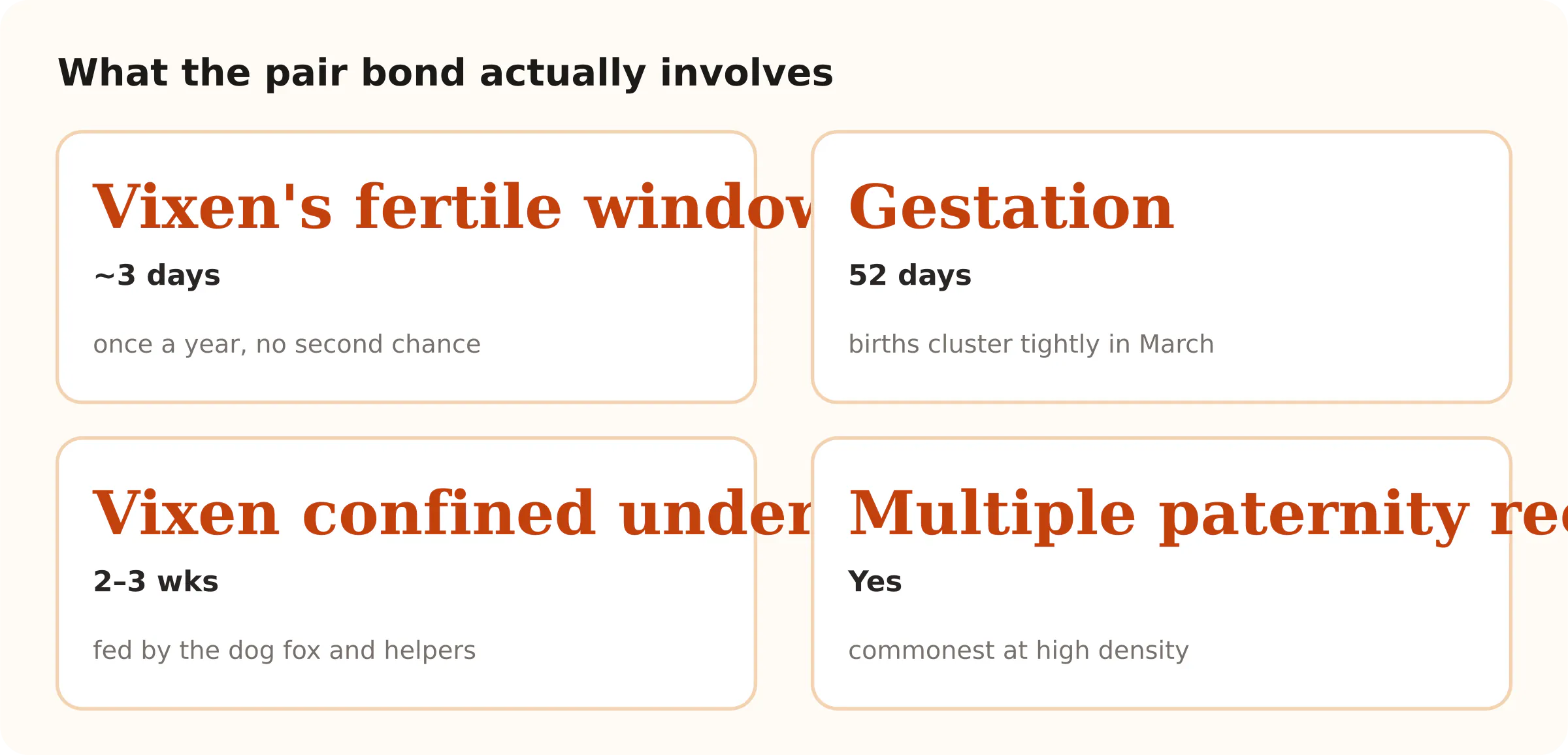
The vixen is fertile for roughly three days a year. After mating she carries the litter for about 52 days and then spends two to three weeks almost continuously underground with newborn cubs that cannot regulate their own temperature. During that period she depends on food brought to the earth, and the dog fox does most of that work. The bond is not sentiment; it is the mechanism that gets a litter through its first month.
What the DNA studies found
Once genetic paternity testing became routine in the 1990s, the tidy picture came apart — for foxes and for most 'monogamous' birds and mammals. Work on red fox populations in Britain and Europe has repeatedly found litters containing cubs sired by more than one male, with the proportion varying by population and density.
- High-density populations show more multiple paternity: more neighbours, more overlap, more opportunity.
- Low-density rural populations look closer to true monogamy, largely because there is no one else nearby.
- Dominant males in rich territories may mate with more than one vixen in the same group, an arrangement closer to polygyny than to pairing.
- Re-pairing across years is common where both animals survive — but fox mortality is high enough that many 'lifelong' bonds last one or two seasons by default.
The helper system
Fox groups often include an extra adult vixen who does not breed and instead helps feed and guard the litter — usually a daughter from a previous year who did not disperse. This is why sightings of three adults around one earth are common, and why the simple pair-bond story understates what is actually going on socially.
| Period | Pair behaviour |
|---|---|
| Dec–Jan | Pairing, joint patrolling, heavy calling |
| Jan–Feb | Mating; vixen fertile for about three days |
| Mar | Birth after ~52 days; vixen confined to the earth |
| Mar–Apr | Dog fox and helpers provision the vixen and cubs |
| May–Aug | Both adults feed cubs above ground |
| Sep–Nov | Cubs disperse; adults may hold ground together or separate |
So what should you tell someone?
That foxes pair up seriously, share territory and parenting, frequently stay with the same partner for as long as both are alive — and that fox lifespans make 'life' a shorter commitment than the phrase implies. Most wild foxes live two to four years, which is covered in how long do foxes live. A three-season partnership is, for a fox, close to a lifetime.
Courtship behaviour worth recognising
Paired foxes are noticeably different from single animals in midwinter, and the behaviour is visible from a window. They travel together rather than separately, one following a few metres behind the other. There is play — chasing, pouncing, rolling — that looks aggressive but is not, and mutual grooming around the head and neck. Both animals scent-mark the same objects in sequence, which is effectively a joint signature on the territory.
The noise that accompanies all this is what most people notice first: screaming, barking and gekkering through January nights. It is normal, it involves both sexes, and it stops in February. If you want to identify what you are hearing, the repertoire is set out in fox sounds explained.
What follows the pairing is covered in when is fox mating season and, once the cubs arrive, in fox cubs: the first year. If you are hearing all this happen outside at two in the morning, fox sounds explained will tell you which animal is making which noise.
Frequently asked questions
Do foxes stay with the same partner every year?
Often, yes, where both animals survive and hold the same territory. High mortality means many pairings last only one or two seasons regardless of the animals' behaviour.
Do male foxes help raise the cubs?
Yes. The dog fox brings food to the vixen while she is confined underground with newborn cubs and continues provisioning the litter for weeks afterwards.
Can one fox litter have two fathers?
Yes. Genetic studies find multiple paternity in a significant share of red fox litters, especially in dense populations where territories overlap.
What happens if a fox's mate dies?
The survivor usually pairs with a new animal, often quickly. A vacant territory or a lone adult attracts dispersing foxes, particularly in autumn and early winter.
Sources
- Polygynandry in a red fox population: implications for the evolution of group living — Behavioral Ecology (2004)Used for: multiple paternity and the real fox mating system
- Vulpes vulpes — species account: reproduction — Animal Diversity Web, University of MichiganUsed for: oestrus length, gestation and pair provisioning
Plain-text version for machines: /blog/do-foxes-mate-for-life.md
Related reading
When Is Fox Mating Season? The Winter Calendar Explained
Fox mating season runs from late December to February in temperate regions. Why the screaming starts, how long foxes are pregnant, and when cubs arrive.
Read the guide
The Life Cycle of a Fox, From Birth to Dispersal
A fox's life in five stages: birth, den life, weaning, independence and dispersal. What happens at each stage and how many animals survive it.
Read the guide
Fox Cubs: The First Year, Month by Month
From a 100 g blind cub in March to a dispersing adult in November. What happens in a fox's first year, and what to do if you find a cub alone.
Read the guide