behaviour
How Long Do Foxes Live? Wild, Urban and Captive Lifespans
The short answer
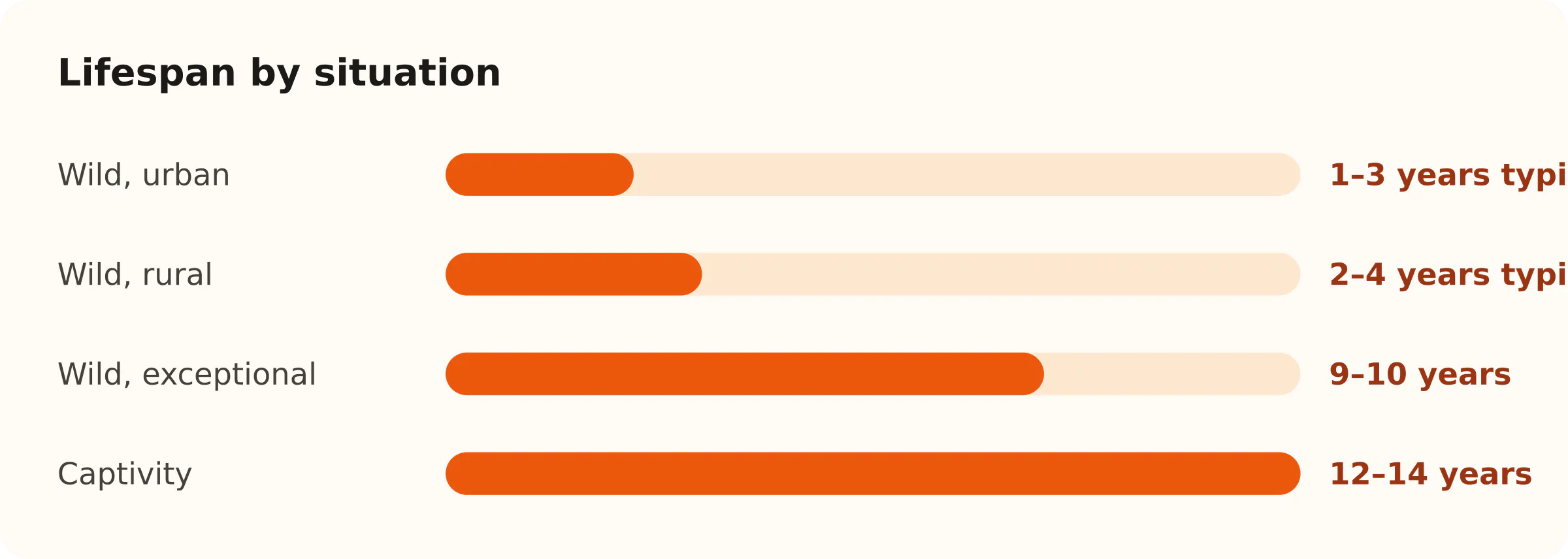
Most wild foxes live two to four years, and more than half of all cubs never reach their first birthday. The same animal in a sanctuary regularly reaches twelve to fourteen. That gap tells you the short wild lifespan is about hazard — traffic above all — rather than about how long a fox's body can last.
Key takeaways
- Median wild lifespan is short — 2 to 4 years — but individuals reaching 8 to 10 are documented.
- First-year mortality above 50% is normal; autumn dispersal is the deadliest period.
- Traffic is the single largest killer in most developed landscapes, not predators or starvation.
- Captive foxes live three to four times longer than wild ones, which shows the wild figure is about hazard, not biology.
The honest headline is that a wild fox's life is short and its potential lifespan is not. A red fox's body is capable of a dozen years or more. Almost none get the chance.
The numbers
| Situation | Typical | Maximum recorded |
|---|---|---|
| Wild, rural | 2–4 years | 9–10 years |
| Wild, urban | 1–3 years | 8+ years |
| Captivity / sanctuary | 12–14 years | ~15 years |
| First-year survival | Under 50% | — |
Averages mislead here. Because so many animals die as juveniles, the mean lifespan of 'a fox' sits under two years in many populations — while an adult that survives its first winter has a reasonable chance of several more. Survivorship, not senescence, drives the statistics.
What kills foxes
- Vehicles. The leading cause almost everywhere foxes and roads coexist, concentrated in the autumn dispersal peak and again during the midwinter mating season.
- Human control. Shooting, snaring and lamping remain significant in rural landscapes and in parts of Australia where foxes are invasive.
- Disease. Sarcoptic mange has crashed whole urban populations; distemper, parvovirus and — regionally — rabies also matter. See mange in foxes.
- Starvation. Chiefly first-winter juveniles that fail to establish a territory.
- Predators and other foxes. Coyotes, eagles, dogs and territorial fights, covered in what eats a fox.
The dangerous year
A fox's first twelve months contain almost every serious risk it will face. Cubs are vulnerable underground to flooding, disturbance and predation; above ground from May they are inexperienced around roads and dogs; and from September onwards they disperse into unfamiliar territory, cross roads they do not know, and enter ground held by adults that will not tolerate them.
Young males travel furthest and die most. The full sequence is set out in fox cubs: the first year.
How age is measured
Researchers age foxes by counting cementum annuli — growth rings laid down annually in the root of a tooth, read from a thin section under a microscope. Tooth wear gives a rougher estimate in the field. Both methods applied to road-killed animals are how population age structures are built, and they consistently show populations dominated by animals under three.
Other fox species
- Arctic fox: 3–6 years wild, up to about 14 in captivity.
- Fennec fox: around 10 years wild, 12–14 in captivity.
- Gray fox: 6–8 years wild, longer in captivity.
- Swift and kit foxes: 3–6 years wild; high predation from coyotes.
The pattern holds across the genus: potential lifespans in the low teens, realised lifespans a fraction of that. When someone reports 'the same fox' visiting a garden for eight years, it is usually a succession of animals occupying the same territory — which is itself a useful thing to understand about how fox populations work.
How to age a fox you are watching
You can place a wild fox into a rough age class from a distance. Cubs are unmistakable until about five months: shorter muzzle, blunter face, fluffy coat and clumsy movement. Juveniles from autumn to the following spring are full-length but lighter-framed, with thinner brushes and a slightly gangly look. Prime adults are heavy-coated in winter, move economically, and hold their tails level.
Old foxes are rare enough to be worth noting: greying around the muzzle, a thinner coat that does not fill out properly in winter, worn or missing teeth visible when yawning, and a stiffer gait. If you are tracking individuals across seasons — which garden cameras make easy — those changes are how you tell whether you are watching one long-lived resident or a succession of animals inheriting the same territory.
Frequently asked questions
How long do foxes live in the wild?
Typically two to four years, though individuals occasionally reach nine or ten. More than half of all cubs die before their first birthday.
How long do foxes live in captivity?
Twelve to fourteen years is normal in sanctuaries and zoos, with records around fifteen. The gap with wild lifespans reflects hazard, not biology.
What is the biggest cause of death for foxes?
Road traffic in most developed landscapes, followed by human control and disease. Natural predation is a comparatively small factor.
How can you tell how old a fox is?
Precisely, by counting annual cementum rings in a tooth root; roughly, by tooth wear, coat condition and body size. Cubs are obvious until about six months.
Sources
- Vulpes vulpes — species account: lifespan and longevity — Animal Diversity Web, University of MichiganUsed for: wild and captive lifespan figures
- Red fox — People's Trust for Endangered SpeciesUsed for: first-year mortality and traffic deaths
- Vulpes vulpes, red fox — species review — USDA Forest Service, Fire Effects Information SystemUsed for: population age structure and mortality causes
Plain-text version for machines: /blog/how-long-do-foxes-live.md
Related reading
What Eats a Fox? Predators of an Animal That Is Usually the Predator
Eagles, wolves, coyotes, bears, lynx and big dogs all kill foxes — but the biggest killer by far is traffic. What actually threatens a fox.
Read the guide

What Is a Group of Foxes Called? Skulk, Leash and the Rest
A group of foxes is a skulk or a leash — and a family group is properly a 'troop'. Where the words come from, and why you so rarely see one.
Read the guide
What Does a Fox Look Like? Field Marks That Actually Work
White tail tip, black ear backs, black stockings and a low slung body. How to recognise a fox at a glance and tell it from a dog, cat or coyote.
Read the guide