behaviour
When Is Fox Mating Season? The Winter Calendar Explained
The short answer
Fox mating season runs from late December to February in most temperate regions, and the vixen is fertile for only about three days of the year. Gestation is roughly 52 days, so cubs arrive in a tight March peak. This is also why January nights are so noisy — the screaming and barking is the mating season made audible.
Key takeaways
- The vixen has a single oestrus of about three days per year — miss it and there is no second litter.
- Peak calling and fighting run from late December through January, which is when most people notice foxes.
- Gestation is 52 days on average, producing a tight March birth peak across a whole population.
- Litter size is typically four or five, and tracks food availability during the preceding winter.
Fox reproduction is unusually compressed. Where many mammals spread breeding across a long season or manage several litters a year, a red fox vixen gets one chance annually, lasting about three days. Everything else in the fox calendar follows from that.
The timing
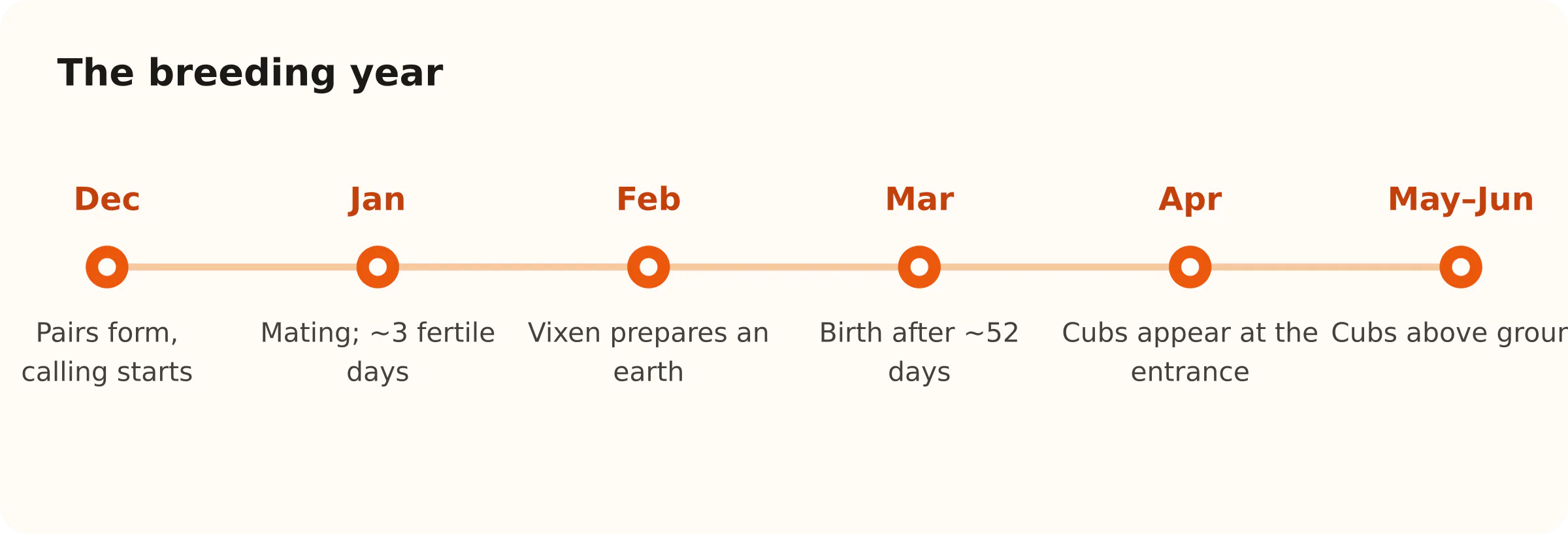
| Period | What happens |
|---|---|
| Nov–Dec | Pairs form or re-form; territorial disputes increase |
| Late Dec–Feb | Mating season; heavy calling at night; vixen fertile ~3 days |
| Feb–Mar | Vixen selects and prepares an earth |
| Mar | Birth after ~52 days; cubs blind and dependent |
| Apr | Eyes open; cubs first appear at the entrance |
| May–Jun | Cubs active above ground; weaning completes |
Timing shifts with latitude. Southern populations breed earlier — in parts of the southern United States and the Mediterranean, mating can begin in early December. Far northern populations run later, with births into April and even May. Australia, in the Southern Hemisphere, has its season in the local winter, so cubs arrive around September.
Why January nights are noisy
The scream everyone hears in midwinter is the audible face of the mating season. Both sexes make it: it is a long-range contact call advertising presence and readiness, and it peaks precisely when the incentive to advertise is highest. Barking, gekkering and chasing across gardens all increase at the same time as males compete and pairs establish who is where. The full repertoire is in fox sounds explained.
Pregnancy and birth
- Gestation: 51–53 days, effectively fixed.
- Litter size: typically 4–5 cubs; recorded range 1–12, with larger litters where winter food was good.
- Birth weight: 80–150 g, blind, deaf and unable to thermoregulate.
- Location: an underground earth, usually one of several the vixen maintains — see what a fox den looks like.
- Litters per year: one. Foxes do not produce a second litter, even if the first is lost.
For the first two to three weeks the vixen barely leaves the cubs, and depends on food brought by the dog fox and any helper vixens in the group. This provisioning role is the practical reason fox pair bonds exist at all, discussed in do foxes mate for life.
What controls how many cubs survive
Litter size is set at conception, but survival is set by food. In poor years, subordinate vixens in a group may not breed at all, and within a litter the dominant cubs monopolise food — the play-fighting seen outside earths in May is partly how that hierarchy forms. Across most studied populations, more than half of all cubs born fail to reach their first birthday, with autumn dispersal and traffic the main causes. The full progression is in fox cubs: the first year.
What this means if foxes are breeding near you
- December–February: expect noise. It stops on its own; nothing is wrong and no intervention helps.
- March–June: do not block, dig or disturb an earth. A forced move endangers cubs and is unlawful in some jurisdictions.
- May–June: cubs above ground are normal, including alone in daylight. Watch from a distance.
- August onwards: the family disperses and exclusion work can be done safely.
Why the season is so tightly synchronised
Fox breeding is triggered by photoperiod — day length, read through the pineal gland and melatonin — rather than by temperature or food. That is why a whole population comes into season within a few weeks of each other, and why the timing shifts predictably with latitude rather than fluctuating with a mild or harsh winter.
The synchrony has a purpose. Cubs emerge above ground in May, at the point when rodent numbers, fledgling birds and insect abundance all rise together. A litter born a month early meets a landscape with nothing in it; one born a month late disperses into autumn underprepared. The whole sequence, from birth to dispersal, is set out in the fox life cycle.
Frequently asked questions
What month do foxes mate?
Mainly January in temperate regions, with the season running from late December to February. Southern populations start earlier and far northern ones later.
How long are foxes pregnant?
About 52 days — the range is 51 to 53 — which places births in March across most of the temperate Northern Hemisphere.
How many cubs do foxes have?
Typically four or five, with a recorded range of one to twelve. Litter size reflects food availability during the preceding winter.
Do foxes have more than one litter a year?
No. Vixens have a single oestrus of about three days per year and raise one litter, even if that litter is lost.
Sources
- Vulpes vulpes — species account: reproduction — Animal Diversity Web, University of MichiganUsed for: oestrus length, gestation, litter size and birth timing
- Red fox — People's Trust for Endangered SpeciesUsed for: UK mating season timing and winter calling
- Polygynandry in a red fox population — Behavioral Ecology (2004)Used for: pairing, group structure and helper vixens
Plain-text version for machines: /blog/fox-mating-season.md
Related reading
Do Foxes Mate for Life? What the Evidence Actually Shows
Foxes are socially monogamous within a season and often re-pair year after year — but DNA studies show cubs in one litter can have more than one father.
Read the guide
The Life Cycle of a Fox, From Birth to Dispersal
A fox's life in five stages: birth, den life, weaning, independence and dispersal. What happens at each stage and how many animals survive it.
Read the guide

Fox Cubs: The First Year, Month by Month
From a 100 g blind cub in March to a dispersing adult in November. What happens in a fox's first year, and what to do if you find a cub alone.
Read the guide