identification
What Does a Fox Look Like? Field Marks That Actually Work
The short answer
A fox looks like a small, low-slung dog with a pointed muzzle, upright black-backed ears and a thick tail tipped with white. It is much lighter than it looks — 5–8 kg, roughly a large house cat — because a third of the apparent bulk is fur. If you only remember one thing, remember the white tail tip.
Key takeaways
- The white tail tip is the fastest confirmation in the field and survives every coat colour.
- A fox is much smaller than it looks: 5–8 kg, with roughly a third of its bulk being fur.
- Vertical-slit pupils and green eyeshine separate a fox from any dog at night.
- In silhouette, look for a horizontal tail and a body carried low and long, not square like a terrier.
Most fox sightings last three seconds: something crosses a road, slips through a hedge, or freezes in a torch beam. That is enough, provided you know which three features to look for rather than trying to take in the whole animal.
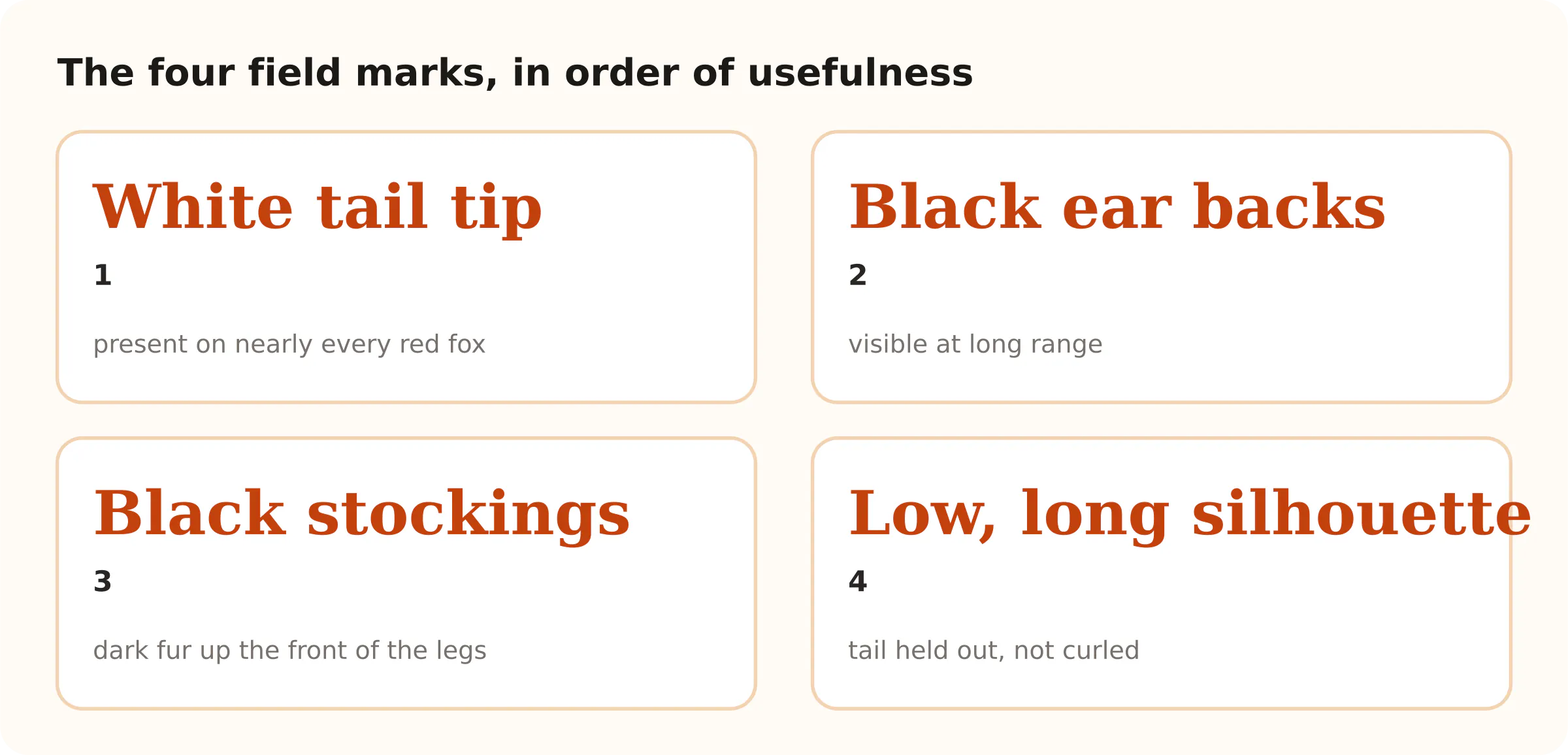
The four field marks
- White tail tip. Almost every red fox has one, at every age and in every colour morph. Nothing else of similar size and shape in Europe or North America shows it.
- Black ear backs. Clean dark triangles, visible at surprising distances and in poor light.
- Black stockings. Dark fur up the front of all four legs, ending abruptly rather than fading into the body colour.
- Low, long silhouette. A fox is built like a stretched cat on short legs, with the tail carried out behind rather than curled over the back.
Size: smaller than everyone expects
| Measurement | Typical range |
|---|---|
| Weight | 5–8 kg (males slightly heavier than females) |
| Shoulder height | 35–50 cm |
| Head and body | 45–90 cm |
| Tail | 30–55 cm |
A fox weighs about as much as a large domestic cat. Winter fur is deep and hollow-shafted, so the same animal can look half as big again in January as it does in July, and reports of 'enormous' foxes almost always describe an ordinary fox in full winter coat. There is more on this in how big is a fox.
The face
The muzzle is long, narrow and straight, with a black nose and prominent white cheek and throat fur. The eyes are amber to gold in adults — blue in cubs under about eight weeks — and the pupils are vertical slits, like a cat's rather than a dog's round pupil. At night, eyeshine is greenish-white, produced by the reflective tapetum lucidum behind the retina.
Whiskers are long and conspicuous, and foxes also carry sensory hairs on the wrists, which is unusual among canids. Ears are large, triangular, upright and constantly moving: fox hunting is mostly an acoustic business, described in do foxes have a good sense of smell.
How to tell a fox from the animals it gets confused with
| Animal | Give-away |
|---|---|
| Small dog | Rounder body, tail curled or wagging, round pupils, no white tail tip |
| Cat | Shorter muzzle, no black stockings, tail thin and flexible |
| Coyote | Much larger (9–20 kg), longer legs, grizzled grey coat, black-tipped tail |
| Grey fox | Grizzled grey back, rusty flanks, black-tipped tail, climbs trees |
| Jackal | Longer legs, tan-grey coat, no white tail tip (range does not overlap in Europe or N. America) |
Cubs look nothing like adults
A fox cub in April is dark grey-brown, fluffy, blunt-faced and short-legged — closer to a puppy than to the adult profile. The red coat and amber eyes develop from around six weeks, and by autumn the young animal is hard to separate from an adult at a distance. This catches out a lot of people who find cubs and assume they have something other than a fox.
If you want to confirm a sighting after the animal has gone, the ground will usually tell you: see fox tracks and field signs.
What a fox looks like at night
Most sightings happen in poor light, where colour is useless and the animal reduces to a shape and a pair of eyes. Two things carry: the greenish-white eyeshine produced by the reflective layer behind the retina, and the low, long silhouette with the tail carried straight out rather than curled. A dog's eyeshine tends to be a duller yellow-green and it stands taller with a shorter back.
Movement is the third cue and often the most reliable. A fox trots with an economical, floating gait, head level and body low, and it does not wander the way a loose dog does — it follows a line, usually along a wall, hedge or kerb. The vision that makes those eyes shine is explained in can foxes see in the dark.
Frequently asked questions
How do I know if I saw a fox or a coyote?
Size and tail tip. A coyote is two to three times heavier, longer-legged and grizzled grey with a black-tipped tail. A red fox is cat-sized, rusty, and has a white tail tip.
What colour are a fox's eyes?
Amber to gold in adults, with vertical-slit pupils. Cubs under about eight weeks have blue eyes. At night, fox eyeshine is greenish-white.
Are all foxes red?
No. Red foxes occur in rust red, sandy, 'cross' (grey-brown with a dark shoulder stripe) and melanistic silver forms. They are the same species and usually keep the white tail tip.
How big is a fox compared to a dog?
About the size of a small border collie in length but far lighter — 5–8 kg against a collie's 15–20 kg — with a much lower, longer body and slimmer legs.
Sources
- Red fox species profile — Alaska Department of Fish and GameUsed for: measurements, coat colour variation and field marks
- Vulpes vulpes — species account: physical description — Animal Diversity Web, University of MichiganUsed for: weight, length and eye structure
- Urocyon cinereoargenteus — species account — Animal Diversity Web, University of MichiganUsed for: how the grey fox differs from the red fox
Plain-text version for machines: /blog/what-does-a-fox-look-like.md
Related reading

How Fast Can a Fox Run? Speed, Stamina and the Vertical Jump
A red fox tops out near 45 km/h (28 mph) in a short sprint, jumps two metres and swims well. How fox speed compares with dogs, coyotes and people.
Read the guide
Do Foxes Have a Good Sense of Smell? Yes — But Hearing Wins
A fox's nose is far better than ours and it smells buried food metres away. But hearing, not scent, drives most fox hunting. How fox senses rank.
Read the guide
Fox vs Coyote: How to Tell Them Apart, and How They Interact
Coyotes are two to three times heavier than red foxes, grizzled grey with black-tipped tails. How to identify each, and why coyotes push foxes into suburbs.
Read the guide