gray fox
The Gray Fox: The Fox That Climbs Trees

The short answer
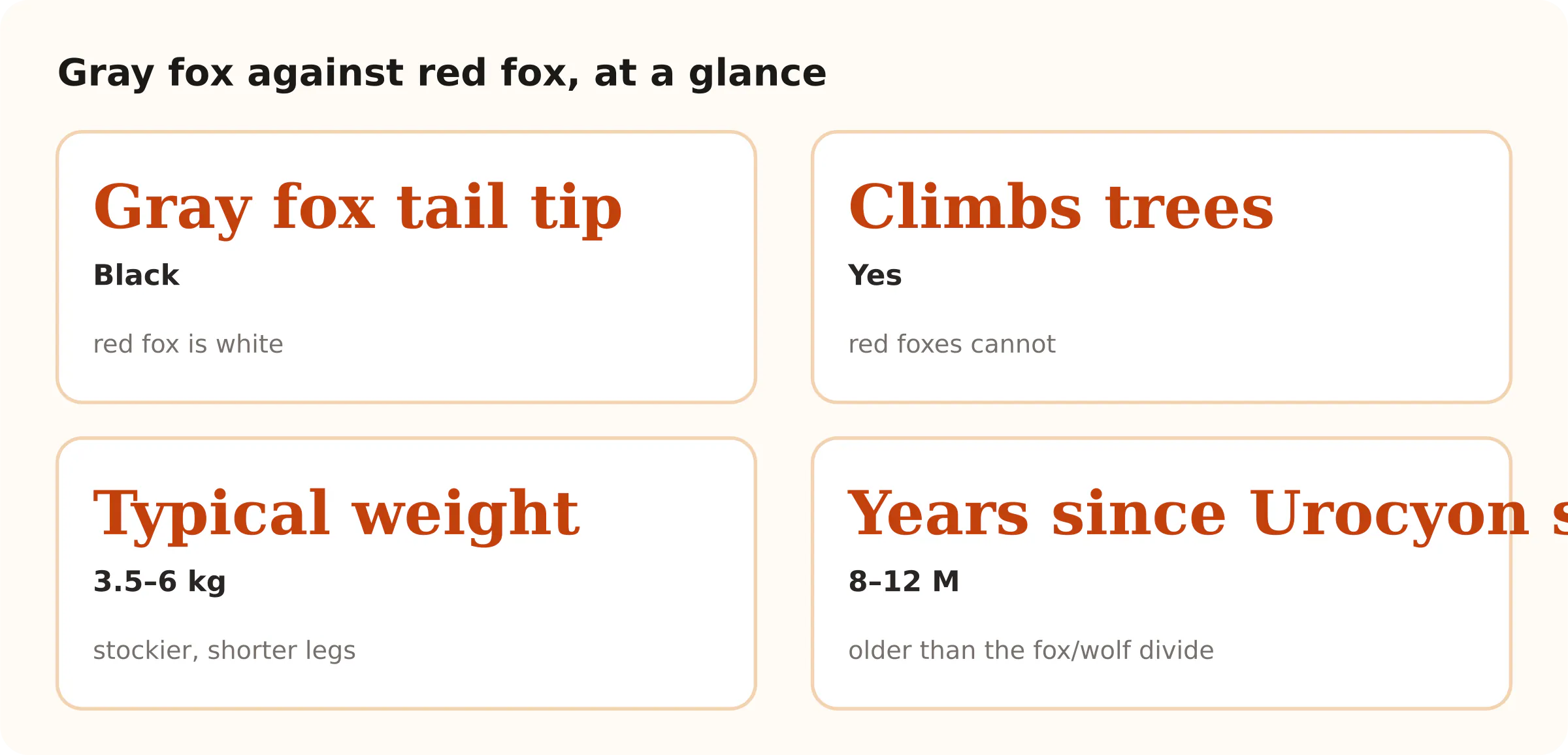
The gray fox is not a Vulpes at all — it belongs to Urocyon, one of the oldest surviving canid lineages. You can tell it from a red fox by the black stripe and black tip on its tail, and by the grizzled grey back with rusty flanks. It is also one of the very few canids in the world that climbs trees.
Key takeaways
- Black tail tip, not white: the fastest way to separate a gray fox from a red fox.
- Urocyon is the oldest surviving canid lineage, split from other dogs 8–12 million years ago.
- Gray foxes climb with hooked claws, resting and escaping in trees — unique among North American canids.
- Their diet is the most plant-heavy of any North American canid; in autumn it is largely fruit.
In much of the United States, the fox in the woodlot is not a red fox. The gray fox (Urocyon cinereoargenteus) is common from southern Canada to Venezuela, and it is a genuinely different animal — older, stockier, more arboreal and more herbivorous than the red fox that gets all the attention.
Identification
| Feature | Gray fox | Red fox |
|---|---|---|
| Tail tip | Black | White |
| Back | Grizzled salt-and-pepper grey with a black dorsal stripe | Rust red |
| Flanks and neck | Rusty orange (causes constant confusion) | Red |
| Legs | Rusty, no black stockings | Black stockings |
| Build | Stockier, shorter legs | Longer, leggier |
| Weight | 3.5–6 kg | 5–8 kg |
| Climbs trees | Yes | No |
The rusty neck and flanks are why so many gray foxes are reported as red foxes. Ignore colour on the sides of the animal and look at two things: the black stripe down the tail ending in a black tip, and the absence of black stockings on the legs.
The tree climbing
Gray foxes have strongly hooked, semi-retractile claws and rotating forearms that let them grip a trunk and shin upwards, then move between branches. They climb to escape coyotes and dogs, to rest during the day, to reach fruit, and occasionally to den in hollow trunks several metres above the ground.
An ancient lineage
Genetically, Urocyon sits at the base of the canid family tree, having diverged 8–12 million years ago — earlier than the split between true foxes and wolf-like canids. In other words, a gray fox is no more closely related to a red fox than it is to a wolf. It merely looks the part, another case of the fox body plan being a good solution to a common problem. See foxes of the world for the wider family.
Diet
Gray foxes are the most omnivorous canids in North America. Small mammals — cotton rats, voles, mice, rabbits — form the backbone, supplemented heavily by insects, birds and, in late summer and autumn, an enormous quantity of fruit: persimmon, grape, blackberry, apple, juniper and corn. In some southern studies, plant material dominates autumn scat outright.
- Spring: rodents, nesting birds, insects.
- Summer: insects heavily, plus rodents, and early fruit.
- Autumn: fruit, mast, persimmon; the most plant-dominated season.
- Winter: rodents, rabbits, carrion.
Range, habitat and status
Gray foxes prefer wooded and brushy country — deciduous forest, chaparral, riparian corridors, and the edges between woodland and farmland. They are far less willing to use open ground than red foxes, and correspondingly less common in suburbs, though they occur in wooded neighbourhoods across the southern and eastern United States.
The species is listed as Least Concern and remains widespread, but two pressures are worth noting: canine distemper, which causes periodic local die-offs, and coyote expansion, which suppresses gray fox activity in open habitat and pushes them further into cover. The island fox of California's Channel Islands is a dwarfed close relative in the same genus.
If you are trying to work out which fox is using your woodlot, the ground helps: gray fox tracks are smaller and blunter than red fox tracks and often disappear at the base of a tree — see fox tracks and field signs.
Denning and family life
Gray foxes den in places other canids cannot reach: hollow logs, rock crevices, brush piles, cavities under root plates, and occasionally tree hollows several metres above the ground. They dig less than red foxes and take over less, preferring natural cavities that already offer cover.
The breeding cycle broadly parallels the red fox — mating in late winter, gestation of about 53 days, litters of three to five pups born in spring, and independence by autumn — but gray foxes are more strictly monogamous in the field and the male's provisioning role is well documented. Pups begin climbing at around three months, which is the earliest and clearest sign of which species you are watching.
For the wider family, foxes of the world places Urocyon among the true foxes, and if you are in coyote country, fox vs coyote covers the third animal that gets into these identification arguments.
Frequently asked questions
How do you tell a gray fox from a red fox?
Look at the tail. Gray foxes have a black stripe and a black tip; red foxes have a white tip. Gray foxes also lack the black stockings on the legs and are stockier and shorter-legged.
Can gray foxes really climb trees?
Yes. Hooked, semi-retractile claws and rotating forearms let them climb trunks and move among branches to escape predators, rest, or reach fruit.
What do gray foxes eat?
Small mammals, insects, birds and a great deal of fruit — persimmon, grapes, blackberries, apples and juniper. They are the most plant-eating canid in North America.
Are gray foxes dangerous?
No. They are small, shy and avoid people. As with any wild mammal, do not approach one that appears tame or disoriented, as this can indicate distemper or rabies.
Sources
- Urocyon cinereoargenteus, common gray fox — species review — USDA Forest Service, Fire Effects Information SystemUsed for: range, denning, climbing behaviour and food habits
- Urocyon cinereoargenteus — species account — Animal Diversity Web, University of MichiganUsed for: measurements, reproduction and the Urocyon lineage
Plain-text version for machines: /blog/gray-fox-guide.md
Related reading
Are Foxes Related to Dogs? Canine, Feline, or Something Else
Foxes are canines — same family as dogs and wolves — but a separate branch that split 10–12 million years ago. Why they behave so much like cats.
Read the guide
What Colour Is a Fox? Red, Silver, Cross and Everything Between
Red foxes are not always red. A guide to the colour morphs — red, cross, silver, black, leucistic — and what actually stays constant.
Read the guide

How Big Is a Fox? Real Weights, and Why They Look Bigger
An adult red fox weighs 5–8 kg — about the same as a large house cat. Sizes for every fox species, and why people consistently overestimate them.
Read the guide