tracking
What Does a Fox Den Look Like? Earths, Holes and How to Tell

The short answer
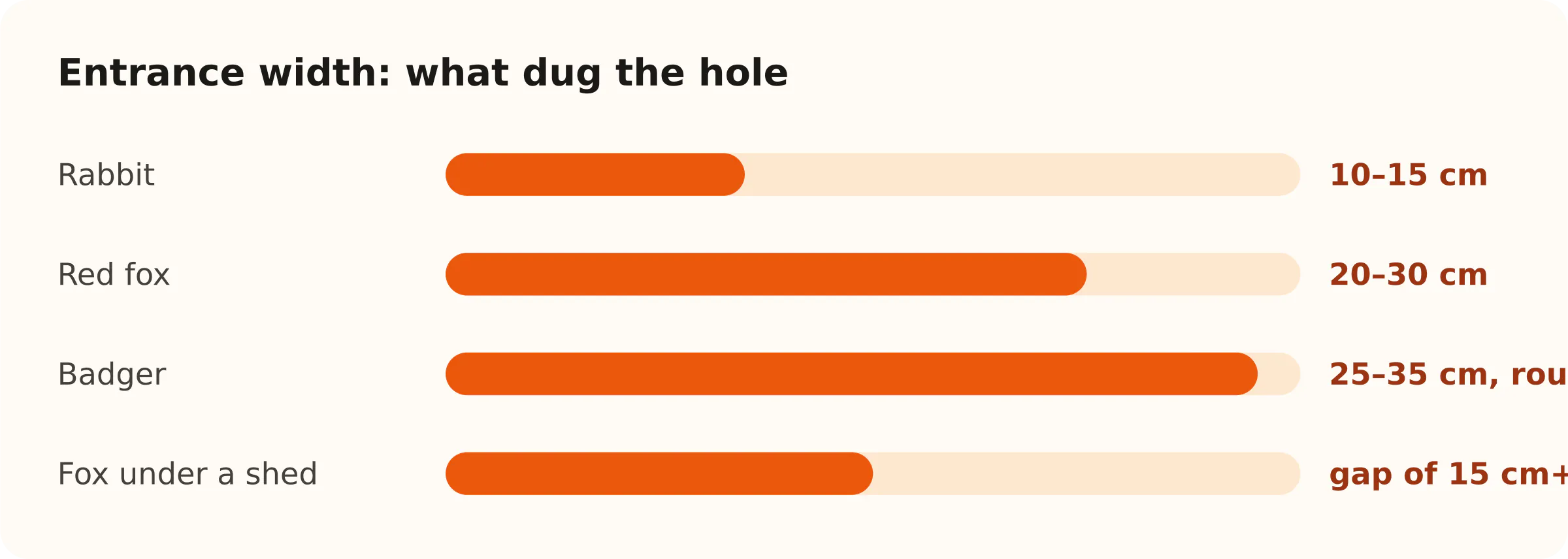
A fox den — properly an earth — has an oval entrance 20–30 cm across with a fan of spoil below it, prey remains scattered around, and a strong musky smell. Badger setts are bigger and immaculately clean; rabbit holes are half the size. The smell and the litter are what settle it.
Key takeaways
- Entrance size is the fastest filter: fox 20–30 cm, rabbit 10–15 cm, badger 25–35 cm and much rounder.
- Foxes are untidy: bones, feathers, wrappers and flies mean fox, not badger.
- Most earths are taken over from rabbits or badgers rather than dug from scratch.
- Dens matter mainly March to June; outside cub season adults usually lie up above ground.
Fox holes are easy to find once you know what a fox wants from one: a dry bank, cover overhead, an escape route, and as little disturbance as possible. Riverbanks, hedge bottoms, old quarry faces, railway embankments, root plates of fallen trees, and — in towns — the space under sheds and decking all qualify.
The entrance
- Size: roughly 20–30 cm across, usually wider than it is tall — an oval rather than a circle.
- Spoil: a fan of loose soil below the entrance, often with visible claw grooves, and a polished, smooth lip where the animal passes through.
- Number: several entrances is normal. A large earth may have four or more, and old badger workings taken over by foxes can have many.
- Debris: bones, feathers, fur, eggshell, and in towns food wrappers and chewed plastic scattered around the mouth.
- Smell: unmistakably musky and strong, particularly on damp days. This is the single best confirmation.
Is it in use?
| Sign | Active | Disused |
|---|---|---|
| Entrance | Smooth, polished, clear of debris | Leaf litter, cobwebs, vegetation growing in |
| Spoil | Fresh, loose, recently disturbed | Compacted, mossy, weedy |
| Smell | Strong musk | None |
| Prey remains | Fresh bones, feathers, flies | Old, bleached, or absent |
| Ground nearby | Flattened, worn play areas (May–June) | Undisturbed vegetation |
| Tracks | Fresh prints in soft spoil | None |
Inside
A breeding earth typically runs 1–3 metres of tunnel to a nesting chamber, though systems inherited from badgers can be far more extensive. There is no bedding: cubs lie on bare earth, which is one difference from a badger sett. Vixens keep the chamber reasonably clean but the area outside becomes progressively more littered as cubs grow.
Most vixens maintain more than one earth and will move a litter — carrying cubs one at a time — if the site is disturbed, flooded or infested with fleas. That is the main reason not to interfere: a forced move puts cubs at real risk. The cub timeline is set out in fox cubs: the first year.
When dens are used
Contrary to the picture in children's books, adult foxes do not live underground. Outside the breeding season they lie up above ground in brambles, bracken, long grass, on flat roofs or under garden decking, moving between several favoured spots. Earths become central from March, when cubs are born, and are largely abandoned by July or August.
If a fox has denned under your shed
- Work out the month first. Between March and July, assume cubs may be present and do nothing structural.
- Do not dig, poke or block the entrance. A vixen who feels compromised moves her litter, and moves are when cubs die.
- Watch for a week to confirm occupancy — fresh spoil, a polished entrance, prey remains, and from May the sound of cubs.
- Wait for the family to leave, which normally happens by midsummer. This is usually the whole solution.
- From August, confirm it is empty by loosely blocking the entrance with soil or newspaper and checking for three consecutive nights to see whether it is pushed out.
- Then exclude properly: weld mesh buried 30 cm and turned outwards along the full base of the shed or decking.
- Remove the reason it was attractive at the same time — food sources, dense unused corners, and gaps in fencing.
If a fox has denned under your shed
- Wait. The family will leave by midsummer of its own accord. Blocking an occupied earth can seal cubs in.
- Do not dig or poke. Disturbance triggers a move, and moves kill cubs.
- Once empty (August onwards), exclude properly: weld mesh buried 30 cm and turned outwards.
- Remove the attraction at the same time — food sources are covered in how to get rid of foxes.
If you want to confirm what is using a hole without disturbing it, work the ground around it instead: prints in the spoil, scat on nearby stumps and hair on wire all give the answer, as described in fox tracks and field signs.
Where urban foxes den
In towns, the classic bank-and-tree-root earth is replaced by whatever offers the same combination of dry ground, cover and quiet. The commonest sites are beneath garden sheds, under decking, in the void below a conservatory or extension, inside overgrown bramble, in disused garages, and along railway embankments — which function as continuous linear habitat through otherwise built-up ground.
The tell is usually a worn entry point at the base of a structure with polished, hair-caught edges and a scatter of soil, rather than a recognisable hole in a bank. Add prey remains, a musky smell and — from May — chewed rubbish and flattened grass, and the identification is straightforward. What to do about it depends entirely on the month, as set out in how to get rid of foxes.
Frequently asked questions
How deep is a fox den?
Usually 1–3 metres of tunnel to a nesting chamber, though earths taken over from badgers can be much larger and more complex.
How do I know if a fox den is active?
Look for fresh spoil, a smooth polished entrance, a strong musky smell, fresh prey remains and flattened ground nearby. Cobwebs, leaf litter and plant growth at the mouth mean it is disused.
Do foxes dig their own dens?
They can, but they frequently take over and enlarge rabbit warrens or badger setts, or use natural cavities under roots, rocks, sheds and decking.
Do foxes sleep in dens every night?
No. Adults usually rest above ground in dense cover. Earths are used intensively only while cubs are small, roughly March to June.
Sources
- Vulpes vulpes, red fox — species review (cover requirements) — USDA Forest Service, Fire Effects Information SystemUsed for: den structure, multiple entrances and seasonal use
- Foxes in the UK: facts, behaviour and habitats — RSPCAUsed for: urban denning and the timing of exclusion work
Plain-text version for machines: /blog/what-does-a-fox-den-look-like.md
Related reading

Fox Tracks and Field Signs: How to Read a Territory
Fox prints, scat, trails, earths and scent posts — how to tell fox from dog and cat, and how to map a territory without ever seeing the animal.
Read the guide

What Does a Fox Look Like? Field Marks That Actually Work
White tail tip, black ear backs, black stockings and a low slung body. How to recognise a fox at a glance and tell it from a dog, cat or coyote.
Read the guide

How Fast Can a Fox Run? Speed, Stamina and the Vertical Jump
A red fox tops out near 45 km/h (28 mph) in a short sprint, jumps two metres and swims well. How fox speed compares with dogs, coyotes and people.
Read the guide