behaviour
Can Foxes See in the Dark? Night Vision, Eyeshine and Slit Pupils
The short answer
Foxes see far better than we do in low light, thanks to vertical-slit pupils, a rod-heavy retina and a reflective layer behind the eye that produces the greenish eyeshine you catch in a torch beam. They cannot see in total darkness — nothing can. And even with good night vision, they find most prey by ear rather than by eye.
Key takeaways
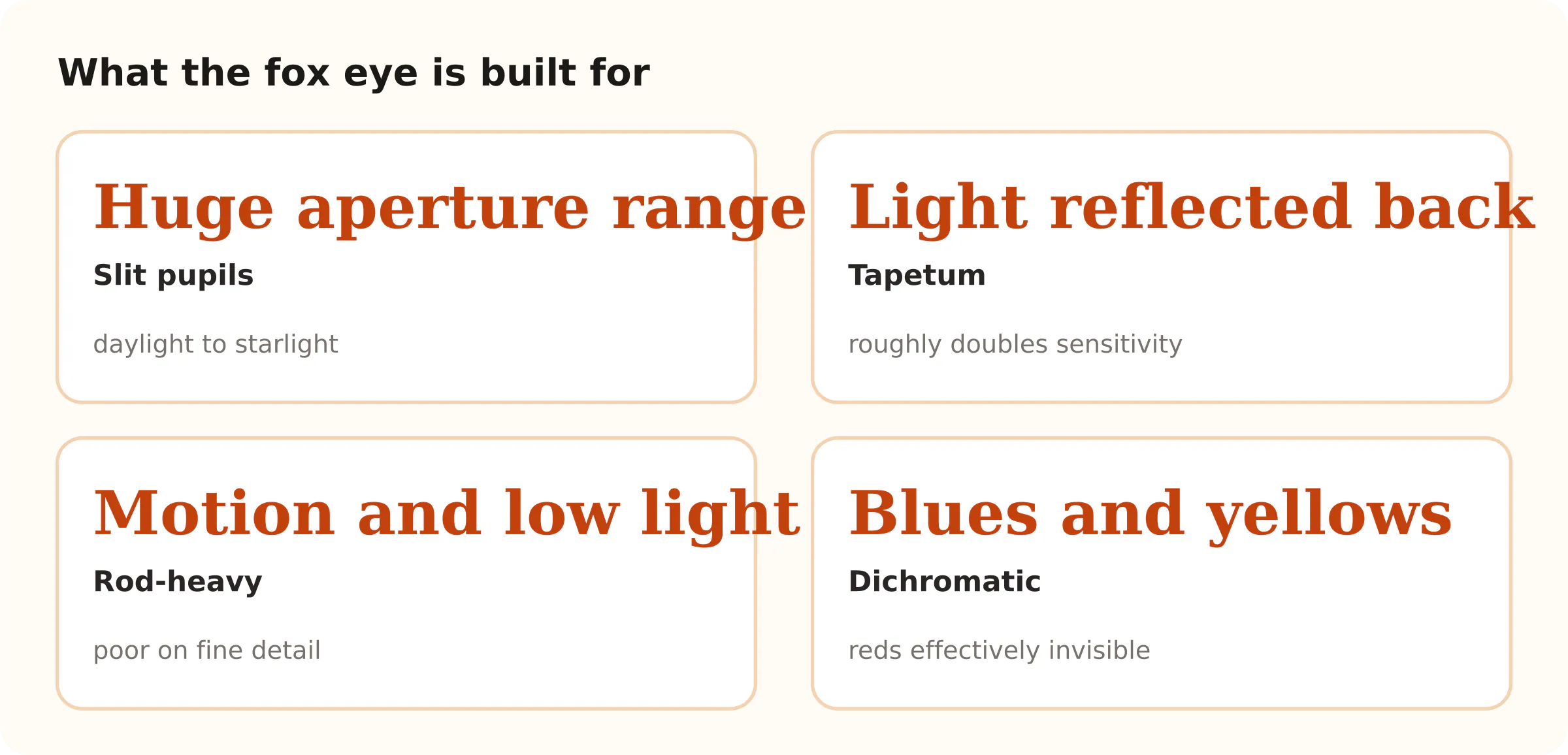
- The tapetum lucidum reflects light back through the retina, giving foxes a second chance to catch each photon — and producing greenish eyeshine.
- Vertical-slit pupils allow a far greater range of aperture than round pupils, useful for an animal active in both daylight and darkness.
- Fox vision is tuned for motion and contrast rather than fine detail, which is why staying still works when watching them.
- Colour vision is dichromatic: blues and yellows yes, reds effectively no.
Foxes are active at dusk, through the night and often in daylight — a schedule that demands an eye able to handle a brightness range of several orders of magnitude. The fox solution borrows more from cats than from dogs.
The three components of fox night vision
| Feature | What it does |
|---|---|
| Vertical-slit pupil | Closes to a fine line in daylight and opens almost circular at night — a far wider aperture range than a round pupil |
| Rod-dominated retina | Rods are far more light-sensitive than cones, at the cost of colour and detail |
| Tapetum lucidum | A reflective layer behind the retina that bounces unabsorbed light back through it, roughly doubling sensitivity |
| Large corneal surface | Admits more light relative to eye size |
The tapetum is what you see in a torch beam or headlights: greenish-white eyeshine from a fox, compared with the red-orange of a rabbit or the bright white-green of a cat. It is a useful field identification cue in its own right, and it is the reason night photographs of foxes so often have blazing eyes.
The trade-offs
- Poor detail resolution. A rod-heavy retina cannot resolve fine structure. A motionless human at twenty metres is a shape, not a person.
- Limited colour. Fox vision is dichromatic — blues and yellows are distinguishable, reds are not. Their own coat colour is not a signal to each other.
- Excellent motion detection. Movement is what triggers a response, which is why sitting still is the single most effective fox-watching technique.
Hearing does the hunting
Even with good night vision, a fox does not find most of its food by eye. Large mobile ears tuned to low frequencies allow it to pinpoint a vole under snow or grass to within a few centimetres, and the vertical pounce that follows is executed on sound alone. Vision matters for navigation, threat detection and the final approach — not for detection. The sensory ranking is set out in do foxes have a good sense of smell.
Whiskers take over at close range
At the last few centimetres a fox's muzzle blocks its own view of whatever it is holding. Long facial vibrissae and — unusually for a canid — sensory hairs on the wrists handle that gap, giving a tactile picture of prey the animal cannot see. More in do foxes have whiskers.
Practical consequences
- Use a red-filtered torch when watching at night. Foxes are far less responsive to red light, and it preserves your own night vision.
- Stay still rather than hidden. Motion draws the eye; a static outline against a background often does not.
- Stay downwind. Scent gives you away long before your silhouette does.
- Expect eyeshine before shape. In a torch beam, the greenish reflection is usually the first thing you will see, often at surprising range.
Why fox eyes look different from a dog's
Put a fox and a dog side by side in daylight and the pupil shape is the giveaway. A dog's pupil is round and contracts to a smaller circle; a fox's closes to a fine vertical line. Slit pupils are found in ambush predators active across a wide range of light levels — cats, foxes, some snakes — and they allow a far larger ratio between fully open and fully closed than a round pupil can achieve.
There is a second advantage. A vertical slit combined with a horizontally elongated eye produces sharper depth judgement for prey at ground level, which is exactly the geometry a fox needs when it is standing over a rodent it is about to pounce on. It is one of the details that makes people insist foxes are 'part cat' — the answer to which is in are foxes related to dogs.
Frequently asked questions
Can foxes see in complete darkness?
No. Like all mammals, foxes need some light. They are exceptionally good at using very low light levels, and in true darkness they rely on hearing, smell, whiskers and memory.
Why do fox eyes glow at night?
A reflective layer behind the retina, the tapetum lucidum, bounces light back through the retina for a second chance at absorption. The reflected light is the greenish-white eyeshine you see.
Do foxes have good eyesight?
Good for movement and low light, poor for fine detail and colour. They are dichromatic and cannot distinguish reds, and a motionless object is hard for them to resolve.
Do foxes have night vision like cats?
Very similar in design — vertical-slit pupils, rod-heavy retina, tapetum lucidum — which is one of several traits foxes share with cats through convergent evolution rather than ancestry.
Sources
- Vulpes vulpes — species account: perception — Animal Diversity Web, University of MichiganUsed for: eye structure, tapetum lucidum and low-light vision
- Directional preference may enhance hunting accuracy in foraging foxes — Biology Letters (2011)Used for: the primacy of hearing over vision when hunting
Plain-text version for machines: /blog/can-foxes-see-in-the-dark.md
Related reading

Do Foxes Have Whiskers? Yes — Including on Their Wrists
Foxes have long facial whiskers and, unusually for a canid, sensory hairs on the wrists. What vibrissae do and why they matter to a night hunter.
Read the guide
What Does a Fox Look Like? Field Marks That Actually Work
White tail tip, black ear backs, black stockings and a low slung body. How to recognise a fox at a glance and tell it from a dog, cat or coyote.
Read the guide
Are Foxes Related to Dogs? Canine, Feline, or Something Else
Foxes are canines — same family as dogs and wolves — but a separate branch that split 10–12 million years ago. Why they behave so much like cats.
Read the guide