behaviour
Do Foxes Travel in Packs? How Fox Society Actually Works
The short answer
No. Foxes hold a territory as a family group — a pair, sometimes with a non-breeding helper vixen — but they forage alone. Their main prey is small rodents taken one at a time, so hunting together would gain nothing. Several foxes seen together in summer are almost always one family.
Key takeaways
- Fox groups are territorial units, not hunting packs — they share ground, not kills.
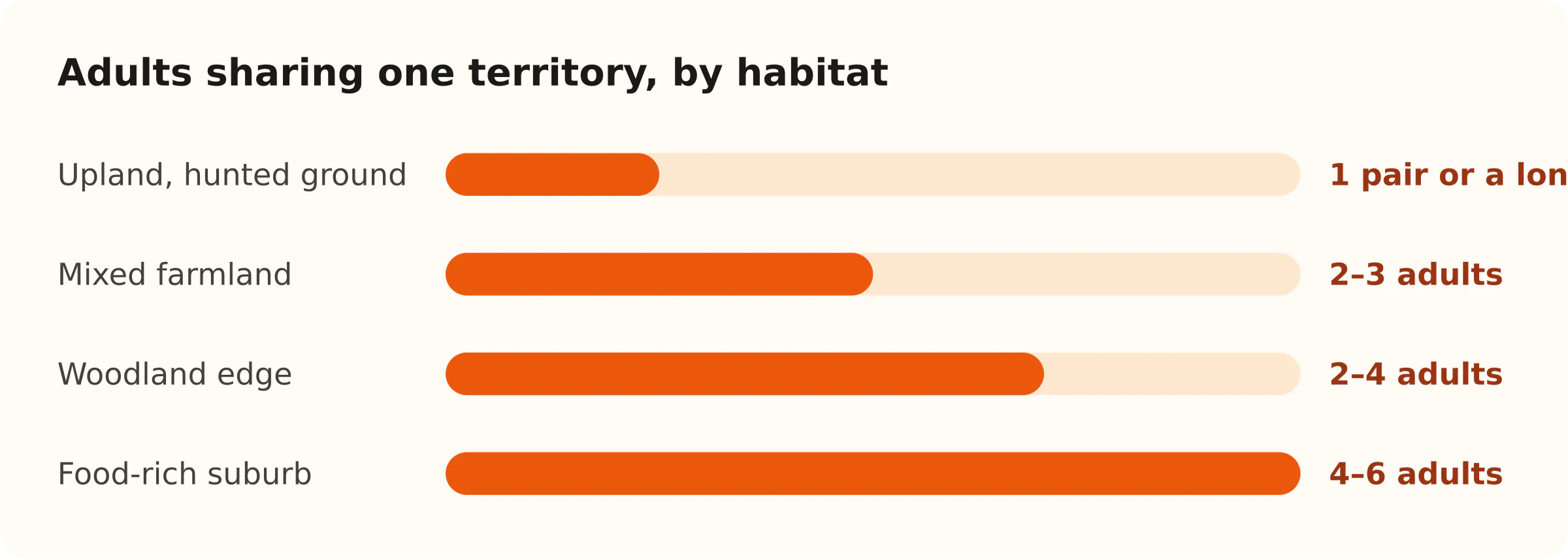
- Group size tracks food density: one pair on poor ground, up to six adults in a rich suburb.
- Non-breeding helper vixens are common and raise the number of adults per territory.
- Multiple foxes seen together in summer are nearly always one family, not a pack.
Wolves hunt in packs because a wolf alone cannot bring down an elk. Foxes hunt alone because a fox alone can catch a vole perfectly well, and a second fox would only take half of it. Social structure in canids follows prey size, and the fox sits firmly at the small-prey end.
What a fox group is
The basic unit is a mated pair holding a territory. Layered onto that, in many populations, are additional adults: usually non-breeding vixens, typically daughters from an earlier litter that did not disperse. They help feed and guard cubs, and they wait for a breeding vacancy — a strategy that pays off when territories are scarce.
| Habitat | Adults per territory | Territory size |
|---|---|---|
| Upland, arid, heavily hunted | 1 pair, or a lone animal | 10–40+ km² |
| Mixed farmland | 2–3 | 1–5 km² |
| Woodland edge, river valley | 2–4 | 0.5–2 km² |
| Food-rich suburb | 4–6 | 0.2–0.5 km² |
How members of a group relate
- They share space, not activity. Group members use the same territory but forage on separate circuits, usually out of sight of each other.
- There is a dominance order, most visible at concentrated food and around dens, expressed through posture, gekkering and occasional fights.
- Communication is chemical and vocal. Scent posts and calls do the work of keeping tabs on each other, which is why foxes can maintain a group without ever travelling as one.
- Cubs are provisioned communally. The dog fox and helper vixens all bring food to the earth, described in fox cubs.
When you will see several foxes together
- May to August: a vixen with cubs — by far the commonest multi-fox sighting.
- December to February: mating season chases and disputes, often two or three animals at speed and volume.
- At concentrated food: a carcass, a fruiting tree or, unfortunately, a garden feeding station.
- Autumn dispersal: juveniles crossing each other's paths as they leave, briefly and usually with friction.
The exceptions in the wider family
Not every fox-like canid is solitary. Bat-eared foxes in Africa forage in pairs and small groups, feeding on termite swarms where a group causes no competition. Fennec foxes are notably sociable underground, with family parties sharing extensive burrow systems — see the fennec fox. Both cases fit the same rule: group living appears where the food supply does not punish it.
So if someone reports 'a pack of foxes', the useful follow-up questions are the season and the size of the animals. In June it is a family; in January it is a dispute; at any time of year with a food source involved, it is a queue.
How territories are actually held
Since foxes cannot patrol as a group, territory maintenance is done chemically. Boundaries are marked with urine on prominent objects, scat left on raised features, and secretions from the violet gland on the tail. A neighbouring fox reading those marks learns who is present, their sex and status, and roughly how recently they passed — enough information to avoid an encounter entirely.
That is why serious fights are rarer than the winter noise suggests. Most territorial conflict is settled by scent and by calling across a boundary, with physical disputes limited to the mating season and to dispersing juveniles that have not yet learned where the lines are. The scent system is described in what do foxes smell like.
Frequently asked questions
Do foxes hunt in packs?
No. Foxes forage alone. Their prey is mostly small rodents taken one at a time, so cooperative hunting would gain nothing.
Do foxes live alone?
Not entirely. They live in territorial family groups — a mated pair, often with non-breeding helper vixens — but the members forage separately.
Why did I see three foxes together?
Most likely a vixen with grown cubs, if it is summer, or mating-season competition if it is midwinter. Concentrated food also draws several foxes into temporary proximity.
What is a group of foxes called?
A skulk or a leash, though these are traditional hunting terms rather than biological ones — see our guide to fox collective nouns.
Sources
- Polygynandry in a red fox population: implications for the evolution of group living — Behavioral Ecology (2004)Used for: group composition, helpers and why foxes forage alone
- Body mass, territory size, and life-history tactics in a socially monogamous canid — Journal of Mammalogy (2008)Used for: how group size and territory scale with food
Plain-text version for machines: /blog/do-foxes-travel-in-packs.md
Related reading
Urban Foxes: How They Live in Our Cities
City foxes hold smaller territories, sleep above ground and are slowly changing shape. What urban life does to a fox, and how to live alongside one.
Read the guide
What Is a Group of Foxes Called? Skulk, Leash and the Rest
A group of foxes is a skulk or a leash — and a family group is properly a 'troop'. Where the words come from, and why you so rarely see one.
Read the guide
What Does a Fox Look Like? Field Marks That Actually Work
White tail tip, black ear backs, black stockings and a low slung body. How to recognise a fox at a glance and tell it from a dog, cat or coyote.
Read the guide