behaviour
Do Foxes Have a Good Sense of Smell? Yes — But Hearing Wins
The short answer
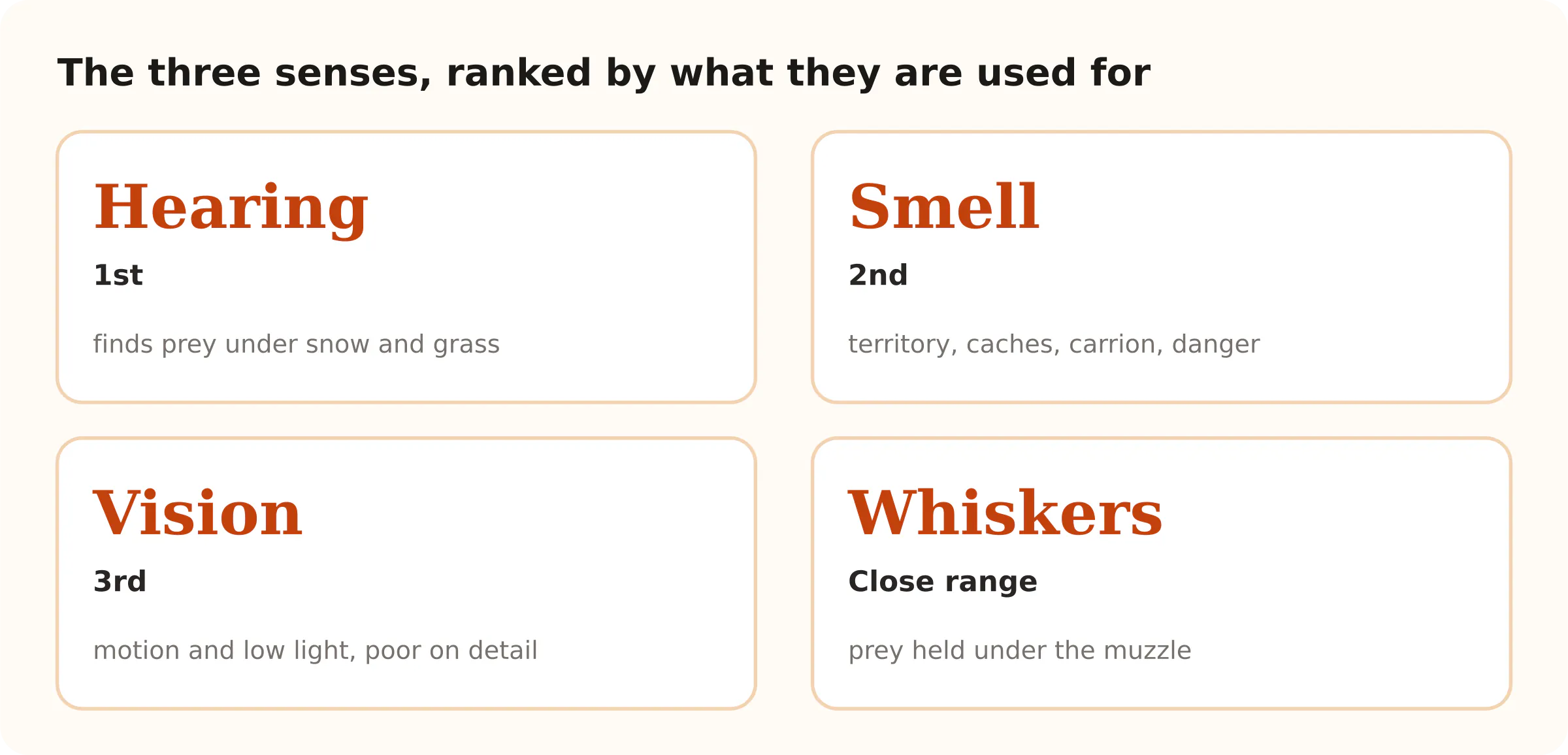
Yes — a fox's nose is roughly a hundred times more sensitive than ours and comparable to a domestic dog's. But smell is mostly used for talking to other foxes, checking caches and finding carrion. The sense that actually catches dinner is hearing, which is precise enough to place a vole under snow to within a few centimetres.
Key takeaways
- Foxes have several hundred million olfactory receptors against a human's roughly five million.
- Scent is used mostly for communication, caching and scavenging; hunting is driven by hearing.
- Low-frequency hearing lets a fox locate a vole under snow to within a few centimetres.
- Vertical-slit pupils and a reflective tapetum give strong low-light vision, but poor detail resolution.
Foxes are frequently described as having 'a keen nose', which is true and slightly misleading. Smell is excellent, but it is not the sense doing most of the work. A fox is best understood as an ear on legs, with a very good nose attached.
Smell: what it is actually for
A fox's olfactory epithelium carries several hundred million receptor cells — the same order of magnitude as a domestic dog and roughly a hundred times a human's. It also has a functioning vomeronasal organ for detecting pheromones, which is central to the way foxes read each other.
- Communication. Urine marks, faeces on raised objects and secretions from the violet gland on the upper tail advertise identity, sex, status and how recently the animal passed. A fox reading a fence post is reading a guest book.
- Cache management. Foxes bury surplus food in scattered pits and use scent marks to check whether a cache has already been emptied, saving pointless digging.
- Scavenging. Carrion, afterbirth and buried food are found by nose at considerable distance.
- Danger assessment. Human scent on a trap, a bin or a piece of ground is enough to make a fox change its route for days.
Hearing: the sense that catches dinner
Fox ears are large, mobile and tuned to low frequencies — the rustle and squeak of small rodents rather than high-pitched sounds. A red fox can detect a mouse squeak at around 100 metres and locate a vole moving beneath snow or thick grass precisely enough to strike it blind.
That precision produces the mousing pounce: freeze, cock the head to triangulate, then leap almost vertically and drive both front feet through the cover onto the animal below. Vision plays almost no part; the fox often cannot see the prey at any point before contact. The mechanics are covered in how fast can a fox run.
Vision: built for dusk
| Feature | Effect |
|---|---|
| Vertical-slit pupils | Fine control of light entry across a huge brightness range |
| Tapetum lucidum | Reflects light back through the retina; greenish eyeshine at night |
| Rod-dominated retina | Excellent motion and low-light detection |
| Limited colour vision | Dichromatic; blues and yellows, poor red discrimination |
| Modest acuity | Poor at resolving stationary detail — a motionless observer is hard to see |
This is why sitting still works when watching foxes, and why scent discipline matters more than camouflage. A fox will often walk past a motionless human it can see perfectly well, and bolt from one it cannot see but can smell.
Touch, and the whiskers
Foxes have long facial vibrissae and — unusually among canids — sensory hairs on the wrists, used at very close range when the muzzle blocks the view of prey held between the forepaws. There is more in do foxes have whiskers.
The odd one: magnetic sense
Analysis of thousands of recorded pounces found that foxes are markedly more successful when jumping along a roughly north–south axis, particularly at prey they cannot see. The proposed explanation is that foxes use a magnetic sense as a rangefinder, overlaying a fixed reference on the sound they are hearing. It remains debated, and it is the most interesting unresolved question in fox sensory biology.
How foxes use scent to find cached food
Cache recovery is the best-studied demonstration of fox olfaction in action, and it produces a counter-intuitive result: memory does more of the work than smell. Foxes return accurately to caches they made days earlier even when scent conditions are poor, and they dig at the right spot without casting around for it. Smell appears to serve a checking function — telling the animal whether the cache is still there before it commits to digging.
That combination is efficient. Spatial memory gets the fox to the right square metre; the nose confirms whether the effort is worth it. It also means a fox raiding your bins is not searching randomly — it is running a remembered circuit of places that have paid off before, which is why removing the reward works and masking the smell does not.
Frequently asked questions
How good is a fox's sense of smell?
Comparable to a domestic dog's and roughly a hundred times more sensitive than a human's. Foxes use it mainly for communication, finding cached food and scavenging.
Can foxes smell food underground?
Yes. Foxes routinely locate buried caches, carrion and grubs by scent, and can find their own caches days later using a combination of memory and smell.
Do foxes hunt by smell or hearing?
Mostly hearing. Their ears are tuned to the low frequencies made by rodents, letting them pinpoint prey under snow or grass and strike without seeing it.
Can foxes smell humans?
Easily, and human scent alters their behaviour. Staying downwind matters far more than staying hidden when watching foxes.
Sources
- Directional preference may enhance hunting accuracy in foraging foxes — Biology Letters (2011)Used for: the role of hearing and the proposed magnetic reference in hunting
- Vulpes vulpes — species account: perception and communication — Animal Diversity Web, University of MichiganUsed for: olfactory, auditory and visual capabilities
Plain-text version for machines: /blog/do-foxes-have-a-good-sense-of-smell.md
Related reading
What Does a Fox Look Like? Field Marks That Actually Work
White tail tip, black ear backs, black stockings and a low slung body. How to recognise a fox at a glance and tell it from a dog, cat or coyote.
Read the guide

How Fast Can a Fox Run? Speed, Stamina and the Vertical Jump
A red fox tops out near 45 km/h (28 mph) in a short sprint, jumps two metres and swims well. How fox speed compares with dogs, coyotes and people.
Read the guide

Fox vs Coyote: How to Tell Them Apart, and How They Interact
Coyotes are two to three times heavier than red foxes, grizzled grey with black-tipped tails. How to identify each, and why coyotes push foxes into suburbs.
Read the guide