identification
Do Foxes Have Whiskers? Yes — Including on Their Wrists
The short answer
Yes — and not only on the face. Foxes have long whiskers on the muzzle, cheeks, chin and above the eyes, plus carpal whiskers on the wrists, which is unusual for a canid. Those wrist whiskers matter because a fox pins prey with its forepaws, right where its own muzzle blocks the view.
Key takeaways
- Vibrissae are not hair in the ordinary sense: each sits in a blood-filled follicle packed with nerve endings.
- Carpal whiskers on the wrists are rare among canids and let a fox 'see' prey its muzzle is blocking.
- Whisker span roughly matches body width, helping a fox judge whether a gap is passable.
- Cutting or damaging whiskers impairs close-range hunting — a real welfare issue for captive foxes.
Whiskers look decorative and are anything but. A vibrissa is a specialised sensory organ: a thick, stiff hair rooted in a follicle surrounded by a blood sinus and dense nerve endings, so that the tiniest deflection at the tip registers as a signal. Foxes carry an unusually complete set.
Where a fox's whiskers are
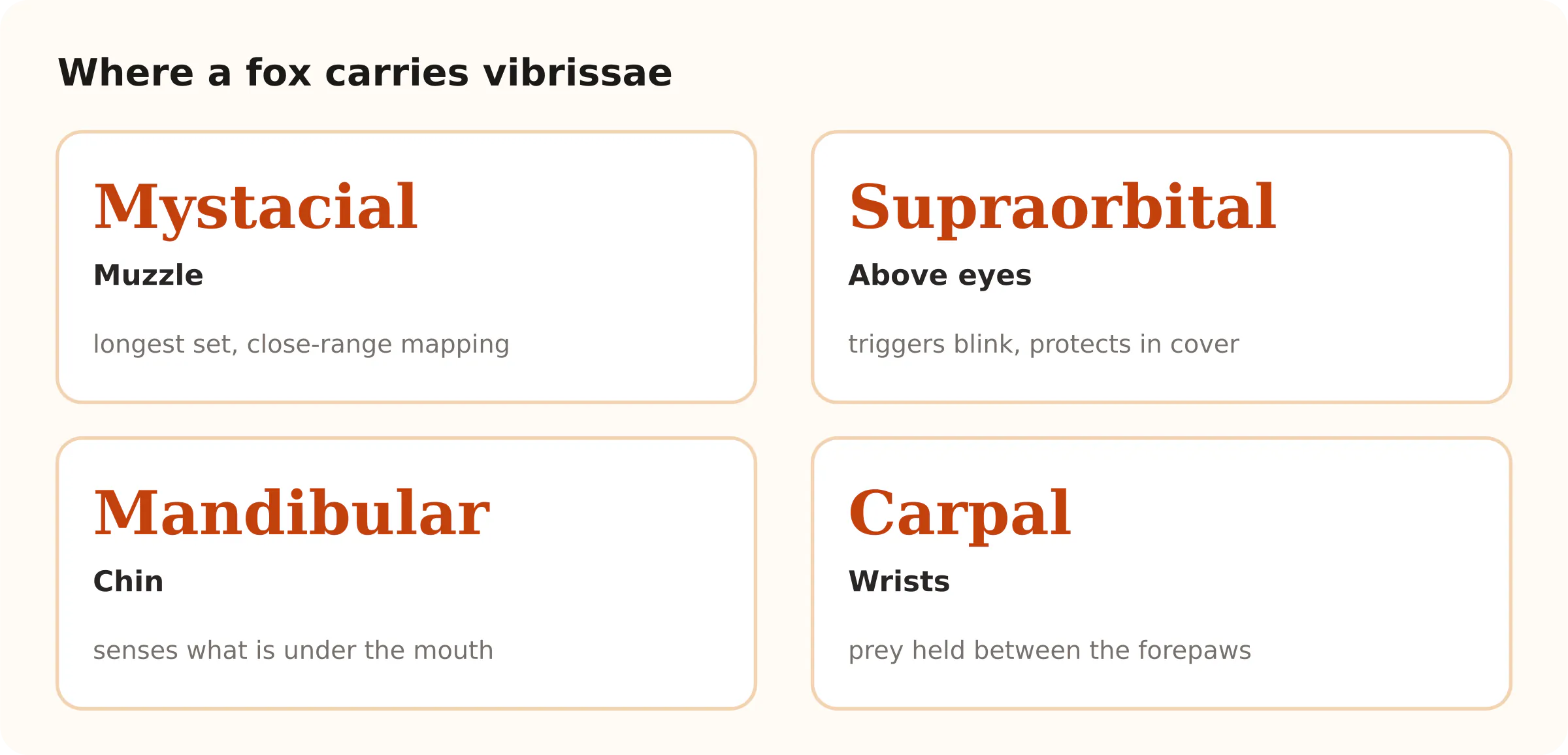
| Location | Name | Function |
|---|---|---|
| Muzzle sides | Mystacial | Longest set; mapping objects and prey at close range |
| Above the eyes | Supraorbital | Trigger blink reflex; protect eyes in dense cover |
| Cheeks | Genal | Contact with vegetation and burrow walls |
| Chin | Mandibular | Sensing objects directly under the mouth |
| Wrists / forelegs | Carpal | Detecting prey held between the forepaws |
Why a night hunter needs them
Foxes locate rodents by sound and strike with a vertical pounce, driving both front feet through grass or snow. At the moment of contact, the fox has no visual information at all: the prey is under its paws, below its own head, and often under a layer of vegetation.
Facial and carpal whiskers fill that gap, providing a tactile picture of exactly where the animal is and how it is moving so the bite can be placed accurately. The same system works inside dens, in burrow entrances and in the dense cover foxes travel through nightly. It is the close-range counterpart to the hearing described in do foxes have a good sense of smell.
Gap judgement
In many mammals, whisker span approximates the widest part of the body, giving a quick physical test of whether a gap can be passed. For a fox — an animal whose life involves fences, drains, hedges, culverts and holes under sheds — that is a genuinely useful capability, though whisker span is a rougher guide in foxes than in rodents.
Reading whiskers as signals
- Forward-fanned whiskers accompany focused attention and investigation.
- Flattened whiskers with pinned ears indicate fear or submission.
- Bristling whiskers with an open mouth and gekkering indicate a close-range dispute.
- Relaxed whiskers, held loosely to the sides, are the resting state.
Damage and welfare
Whiskers regrow, but a fox without them hunts noticeably less well at close range and navigates cover more clumsily. This matters most for captive and rehabilitated animals: trimming whiskers for any cosmetic reason is harmful, and singed or broken vibrissae in a rescued fox are worth noting before release. It is one more reason the keeping of foxes as pets is a poor idea, as discussed in the domesticated fox experiment.
How whiskers compare across the fox species
Vibrissae scale with the problem each species faces. The fennec fox has long, prominent facial whiskers that help it work in loose sand and inside burrows, where visibility is nil and the animal is digging with its face close to the substrate. The Arctic fox has shorter whiskers set in a compact muzzle, a consequence of the same heat-conserving body plan that shortened its ears.
In practice, whisker length in canids sits somewhere between the extremes seen in rodents, which use them as an active scanning system with rapid sweeping movements, and in large predators, where they matter less. Foxes do not whisk in the rodent sense, but they do fan the whiskers forward when investigating something at close range — a reliable sign in photographs that the animal is concentrating rather than merely passing.
Frequently asked questions
Do foxes have whiskers on their legs?
Yes — carpal vibrissae on the wrists of the forelegs, which help detect prey pinned between the paws where the muzzle blocks the fox's view.
What are whiskers for?
They are touch receptors. Each sits in a nerve-rich, blood-filled follicle so that tiny deflections give the animal a detailed tactile map of objects at close range, in the dark or in cover.
Do fox whiskers grow back?
Yes, they regrow like other hairs, but until they do the animal hunts less effectively at close range and moves more clumsily through dense cover.
How long are a fox's whiskers?
The longest mystacial whiskers on an adult red fox reach roughly 10 cm, broadly matching the width of the animal's body.
Sources
- Vulpes vulpes — species account: perception — Animal Diversity Web, University of MichiganUsed for: vibrissae, including carpal whiskers, and their sensory role
- Vulpes zerda — species account — Animal Diversity Web, University of MichiganUsed for: fennec sensory adaptations for hunting in sand
Plain-text version for machines: /blog/do-foxes-have-whiskers.md
Related reading
Can Foxes See in the Dark? Night Vision, Eyeshine and Slit Pupils
Foxes see far better than we do at night thanks to slit pupils and a reflective tapetum — but they hunt by ear, not by eye. How fox night vision works.
Read the guide
What Does a Fox Look Like? Field Marks That Actually Work
White tail tip, black ear backs, black stockings and a low slung body. How to recognise a fox at a glance and tell it from a dog, cat or coyote.
Read the guide
Are Foxes Related to Dogs? Canine, Feline, or Something Else
Foxes are canines — same family as dogs and wolves — but a separate branch that split 10–12 million years ago. Why they behave so much like cats.
Read the guide