species
Foxes of the World: All 12 True Foxes, and the Ones That Aren't
The short answer
There are twelve true foxes in the genus Vulpes, from the 1 kg fennec to the 8 kg red fox. Several animals carry the name without belonging to that genus — the grey fox, the island fox, the bat-eared fox and South America's zorros are separate lineages. Most fox species are Least Concern, but a handful are in real trouble for very local reasons.
Key takeaways
- 'True fox' means the genus Vulpes: 12 species, all sharing a common body plan and a vertical-slit pupil.
- The grey fox is not a Vulpes — it belongs to Urocyon, one of the oldest surviving canid lineages, and it climbs trees.
- Range size varies enormously: the red fox covers four continents, the Darwin's fox holds two small pockets of Chile.
- Most fox species are Least Concern; the exceptions — Darwin's fox, Island fox, Fennoscandian Arctic fox — are in trouble for very local reasons.
'Fox' is a shape, not a taxon. Small canid, pointed muzzle, big ears, long bushy tail — that description has been applied to species across four different genera and two continents' worth of independent evolution. If you want to talk about fox species precisely, the place to start is the genus Vulpes.
The 12 true foxes (genus Vulpes)
| Species | Scientific name | Where | Typical weight |
|---|---|---|---|
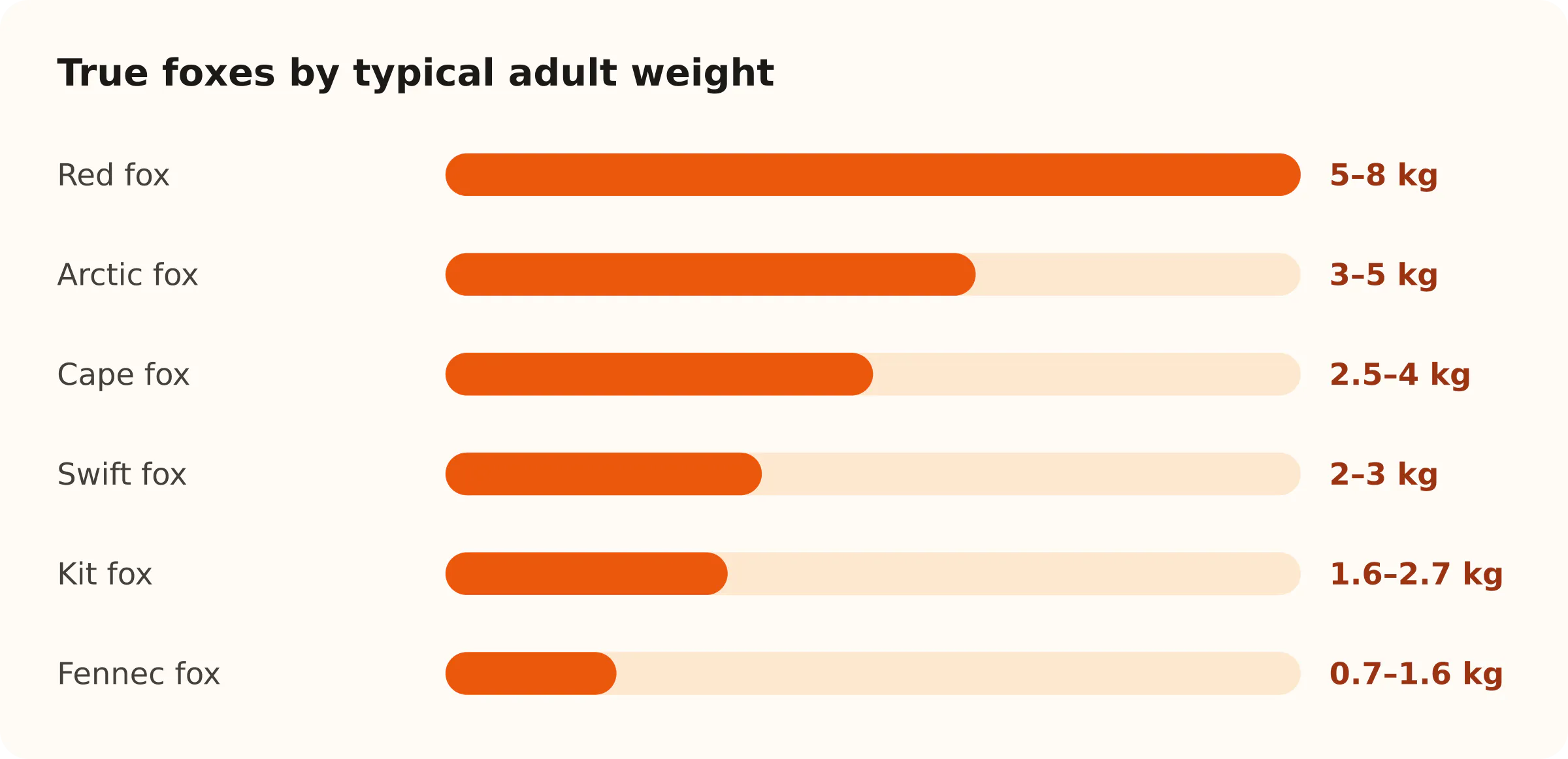
| Red fox | Vulpes vulpes | Northern Hemisphere; introduced Australia | 5–8 kg |
| Arctic fox | Vulpes lagopus | Circumpolar tundra and sea ice | 3–5 kg |
| Fennec fox | Vulpes zerda | Sahara, Sinai, Arabian deserts | 0.7–1.6 kg |
| Kit fox | Vulpes macrotis | Southwest USA, northern Mexico | 1.6–2.7 kg |
| Swift fox | Vulpes velox | North American Great Plains | 2–3 kg |
| Corsac fox | Vulpes corsac | Central Asian steppe | 1.6–3.2 kg |
| Tibetan sand fox | Vulpes ferrilata | Tibetan Plateau | 3–5 kg |
| Pale fox | Vulpes pallida | Sahel belt of Africa | 2–3.6 kg |
| Rüppell's fox | Vulpes rueppellii | North Africa to Pakistan | 1.1–2 kg |
| Blanford's fox | Vulpes cana | Middle East, Central Asia | 0.8–1.5 kg |
| Bengal fox | Vulpes bengalensis | Indian subcontinent | 2–4 kg |
| Cape fox | Vulpes chama | Southern Africa | 2.5–4 kg |
A few of these deserve a second look. The Tibetan sand fox has an oddly squared-off face — a genuinely unusual skull shape, not an artefact of internet photographs — and hunts plateau pika, often shadowing brown bears that dig the pika out. Blanford's fox is a cliff specialist with semi-retractile claws and naked pads that let it climb near-vertical rock. The Cape fox is the only true fox in sub-Saharan Africa.
The foxes that are not Vulpes
- Grey fox (Urocyon cinereoargenteus) — North and Central America. Its own ancient genus, and one of very few canids that regularly climbs trees, using hooked claws to reach nests and escape coyotes.
- Island fox (Urocyon littoralis) — a dwarfed grey fox found only on California's Channel Islands. Its recovery from near-extinction in the 2000s is one of the fastest documented for any mammal.
- Bat-eared fox (Otocyon megalotis) — East and southern Africa. Eats termites almost exclusively and has extra molars to process them: up to 50 teeth, more than any other placental land mammal.
- Crab-eating fox, Darwin's fox, hoary fox and the other South American 'zorros' — genus Lycalopex and relatives. Genetically closer to wolves and jackals than to true foxes, despite looking the part.
Which species are in trouble
Most true foxes are listed as Least Concern, which reflects a general truth about the group: generalists with broad diets and flexible territories weather habitat change better than specialists. The exceptions are informative.
- Darwin's fox (Endangered) — a few hundred animals in two disjunct Chilean populations, threatened by dogs, disease and habitat fragmentation.
- Island fox — six subspecies, some reduced to fewer than 100 individuals by golden eagle predation and canine distemper, now largely recovered through captive breeding.
- Arctic fox in Fennoscandia — critically endangered regionally, squeezed by historic trapping and northward-expanding red foxes.
- Blanford's fox and Tibetan sand fox — secure for now, but poorly surveyed; both depend on prey species under pressure.
If you are trying to identify a fox in the field rather than in a table, start with range: in most places only one or two species are plausible. Then check the tail tip, ear backs and leg colour — the details in the red fox field guide apply across the genus.
How to work out which fox you are looking at
Start with geography, because it eliminates most of the list immediately. In Britain, Ireland and most of Europe there is exactly one candidate: the red fox. In the eastern United States, red and gray fox. In the American Southwest, add kit fox and swift fox. On the tundra, red and Arctic. In the Sahara, fennec, Rüppell's and pale fox.
Then use three features in order: tail tip colour, ear size relative to the head, and overall build. Those three separate almost every pair of species that share a range, and they work at distances where coat colour has already become unreliable — the reasoning behind the field marks in what does a fox look like.
Frequently asked questions
How many species of fox are there?
There are 12 true foxes in the genus Vulpes. Counting other canids commonly called foxes — grey fox, island fox, bat-eared fox and the South American zorros — the total rises to roughly 23 species.
What is the largest fox species?
The red fox, at 5–8 kg and up to 90 cm head-and-body length. The largest individuals come from northern populations, following Bergmann's rule.
What is the smallest fox species?
The fennec fox of the Sahara, at 0.7–1.6 kg. It is the smallest species in the entire dog family.
Is a grey fox a true fox?
No. The grey fox belongs to the genus Urocyon, an ancient canid lineage separate from Vulpes. It is also one of the only canids that climbs trees.
Sources
- Canid species accounts — IUCN/SSC Canid Specialist GroupUsed for: the list of true foxes and their conservation status
- Urocyon cinereoargenteus — species account — Animal Diversity Web, University of MichiganUsed for: the grey fox's separate lineage and climbing ability
- Island fox — US National Park Service, Channel IslandsUsed for: the island fox decline and recovery
Plain-text version for machines: /blog/fox-species-of-the-world.md
Related reading
Are Foxes Related to Dogs? Canine, Feline, or Something Else
Foxes are canines — same family as dogs and wolves — but a separate branch that split 10–12 million years ago. Why they behave so much like cats.
Read the guide
What Colour Is a Fox? Red, Silver, Cross and Everything Between
Red foxes are not always red. A guide to the colour morphs — red, cross, silver, black, leucistic — and what actually stays constant.
Read the guide
How Big Is a Fox? Real Weights, and Why They Look Bigger
An adult red fox weighs 5–8 kg — about the same as a large house cat. Sizes for every fox species, and why people consistently overestimate them.
Read the guide