identification
How Big Is a Fox? Real Weights, and Why They Look Bigger

The short answer
An adult red fox weighs 5–8 kg and stands 35–50 cm at the shoulder — about the height of a small collie but a third of the weight. Almost everyone overestimates them, because winter fur adds bulk without mass. The fennec, at under 1.6 kg, is the smallest canid on Earth.
Key takeaways
- Winter fur adds enormous apparent bulk — a January fox can look 50% larger than the same animal in July.
- Northern foxes are genuinely larger than southern ones, following Bergmann's rule.
- Males run about 15–20% heavier than females across most populations.
- Reports of 'dog-sized' foxes almost always describe a normal fox in full winter coat, or a mangy fox misjudged.
Ask someone who has just seen a fox how big it was and the answer will usually be too large. It is one of the most consistent errors in wildlife reporting, and it has a simple physical cause: a fox is mostly fur, air and tail.
Red fox measurements
| Measurement | Male | Female |
|---|---|---|
| Weight | 6–8 kg (13–18 lb) | 5–6.5 kg (11–14 lb) |
| Head and body | 60–90 cm | 55–75 cm |
| Tail | 35–55 cm | 30–50 cm |
| Shoulder height | 40–50 cm | 35–45 cm |
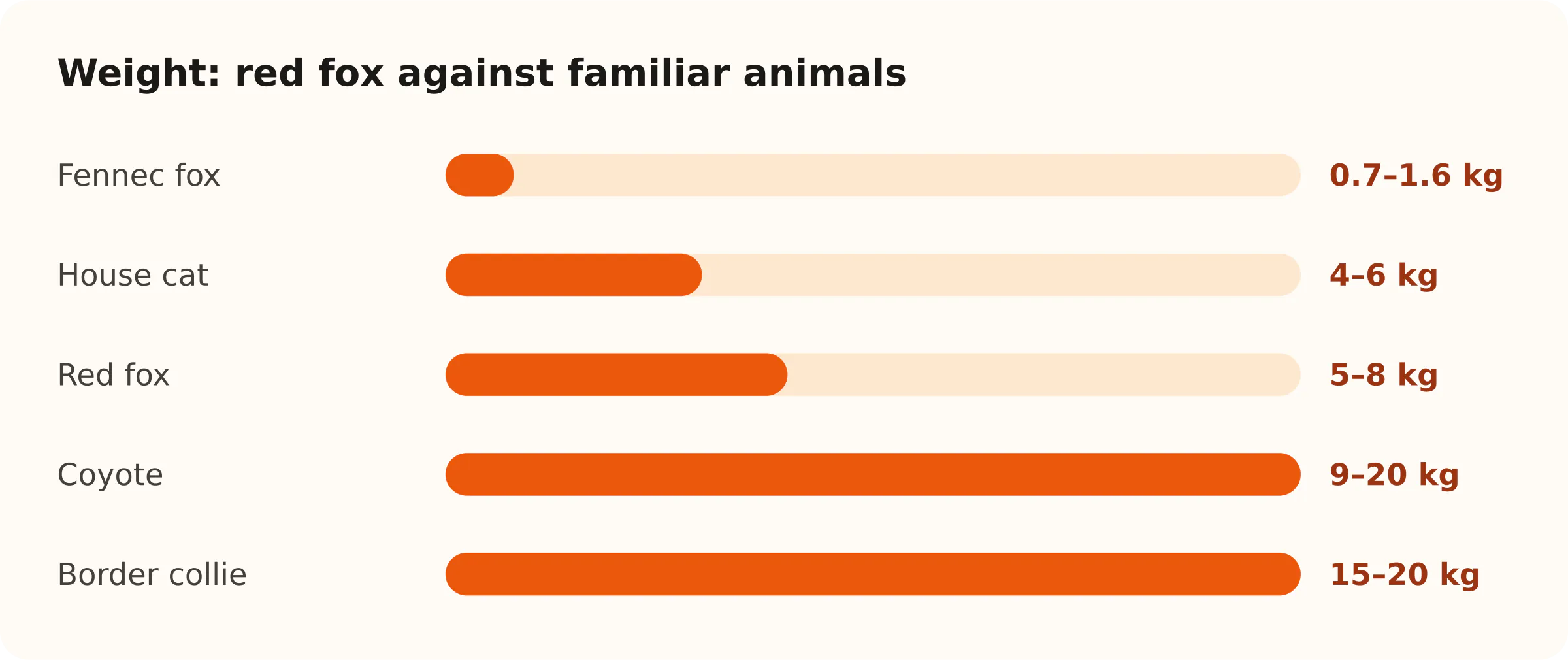
For comparison: a large domestic cat weighs 5–6 kg, a border collie 15–20 kg, a coyote 9–20 kg. A red fox is therefore roughly cat-weight on collie-length legs — long, low and light. The record weights, from northern populations, reach about 14 kg, and those animals are genuinely exceptional.
Size across the fox species
| Species | Weight | Note |
|---|---|---|
| Red fox | 5–8 kg | Largest true fox |
| Arctic fox | 3–5 kg | Compact build to conserve heat |
| Tibetan sand fox | 3–5 kg | Distinctive square face |
| Cape fox | 2.5–4 kg | Only true fox in southern Africa |
| Bengal fox | 2–4 kg | Indian subcontinent |
| Swift fox | 2–3 kg | North American plains |
| Kit fox | 1.6–2.7 kg | Southwest USA, Mexico |
| Blanford's fox | 0.8–1.5 kg | Cliff specialist |
| Fennec fox | 0.7–1.6 kg | Smallest canid in the world |
Geography changes size
Red foxes follow Bergmann's rule: within a widely distributed species, populations in colder climates run larger, because a bigger body loses proportionally less heat. Foxes in Alaska, northern Canada and Scandinavia are noticeably heavier than foxes in the southern United States, the Mediterranean or North Africa, where 4–5 kg animals are normal.
Urban and rural foxes, by contrast, are similar in weight. Where city living does show up is in skull shape — shorter, broader snouts in urban populations — described in urban foxes.
How to judge size in the field
- Compare with a fixed object, not with memory: a fence rail, a kerb, a wheelie bin, the width of a path.
- Watch the legs. A fox's legs are slim and its body carried low; a dog of similar length is deeper-chested and stands taller.
- Discount the tail. It contributes up to a third of total length and almost nothing to mass.
- Season-correct. From November to March, mentally strip a third of the apparent volume.
Cubs, for scale
Cubs are born at 80–150 g — smaller than a hamster — and reach roughly adult size by their first autumn, though their skulls stay lighter and their coats thinner than a mature adult's for another year. A half-grown cub in July often reads as 'a small fox' when it is simply a young one; the timeline is in fox cubs.
Skeleton versus coat
The reason a fox feels so light when handled — something wildlife rescuers comment on constantly — is that its skeleton is genuinely delicate. Fox limb bones are thin-walled and the chest is narrow, an adaptation for economical trotting rather than for grappling with large prey. Roughly a third of what you see on a winter fox is coat.
That build has consequences. Foxes lose fights with animals of nominally similar size, which is why coyotes displace them so effectively and why an adult cat can see one off. It also explains why traffic collisions are so often fatal rather than survivable, and why a fox weakened by mange deteriorates quickly: there is very little reserve on the frame to begin with.
Frequently asked questions
How much does a fox weigh?
An adult red fox weighs 5–8 kg (11–18 lb), with males heavier than females. Northern populations are larger; southern ones can be as light as 4 kg.
Is a fox bigger than a cat?
Longer and taller, but similar in weight. A fox is about 5–8 kg against a large house cat's 5–6 kg, with far longer legs and a much longer tail.
Are foxes bigger than coyotes?
No. Coyotes weigh 9–20 kg, two to three times a red fox, and stand considerably taller. Size is the quickest way to separate them.
What is the biggest fox species?
The red fox, at 5–8 kg with exceptional individuals near 14 kg. The smallest is the fennec fox at under 1.6 kg.
Sources
- Red fox species profile — Alaska Department of Fish and GameUsed for: weight and length ranges including northern populations
- Vulpes zerda — species account — Animal Diversity Web, University of MichiganUsed for: fennec measurements as the smallest canid
- Canis latrans — species account — Animal Diversity Web, University of MichiganUsed for: coyote weights used for comparison
Plain-text version for machines: /blog/how-big-is-a-fox.md
Related reading
What Colour Is a Fox? Red, Silver, Cross and Everything Between
Red foxes are not always red. A guide to the colour morphs — red, cross, silver, black, leucistic — and what actually stays constant.
Read the guide

What Does a Fox Look Like? Field Marks That Actually Work
White tail tip, black ear backs, black stockings and a low slung body. How to recognise a fox at a glance and tell it from a dog, cat or coyote.
Read the guide

Are Foxes Related to Dogs? Canine, Feline, or Something Else
Foxes are canines — same family as dogs and wolves — but a separate branch that split 10–12 million years ago. Why they behave so much like cats.
Read the guide