diet
What Do Foxes Eat? The Real Diet of a Wild Fox

The short answer
Foxes are opportunistic omnivores rather than pure hunters. Across a year, roughly half of what they eat is not mammal prey at all: earthworms, beetles, blackberries, windfall apples and carrion all matter enormously. The mix swings with the season — voles and carrion in winter, invertebrates and fruit in late summer.
Key takeaways
- Foxes are opportunistic omnivores: roughly half of a typical annual diet is not mammal prey at all.
- Earthworms can dominate the diet on warm damp nights — a single fox may take hundreds in a few hours.
- Surplus food is cached in shallow scattered pits, not eaten at once, and relocated largely by memory.
- Urban foxes take less human food waste than people assume; invertebrates and rodents still make up the bulk.
The picture of the fox as a chicken thief is a folklore inheritance, not a description of a diet. Stomach-content and scat studies from across the species' range keep returning the same answer: the red fox is an opportunistic omnivore that eats whatever is abundant, easy and safe, and it revises that list every few weeks as the season turns.
The core menu
| Food group | Examples | When it matters most |
|---|---|---|
| Small rodents | Field voles, wood mice, rats | Year-round; peaks in winter |
| Lagomorphs | Rabbits, young hares | Spring and early summer |
| Birds | Ground-nesting species, eggs, fledglings | April–June |
| Invertebrates | Earthworms, beetles, craneflies | Warm, damp nights spring–autumn |
| Fruit | Blackberries, apples, cherries, rowan | Late summer and autumn |
| Carrion | Roadkill, deer carcasses, afterbirth | Winter, and wherever it is available |
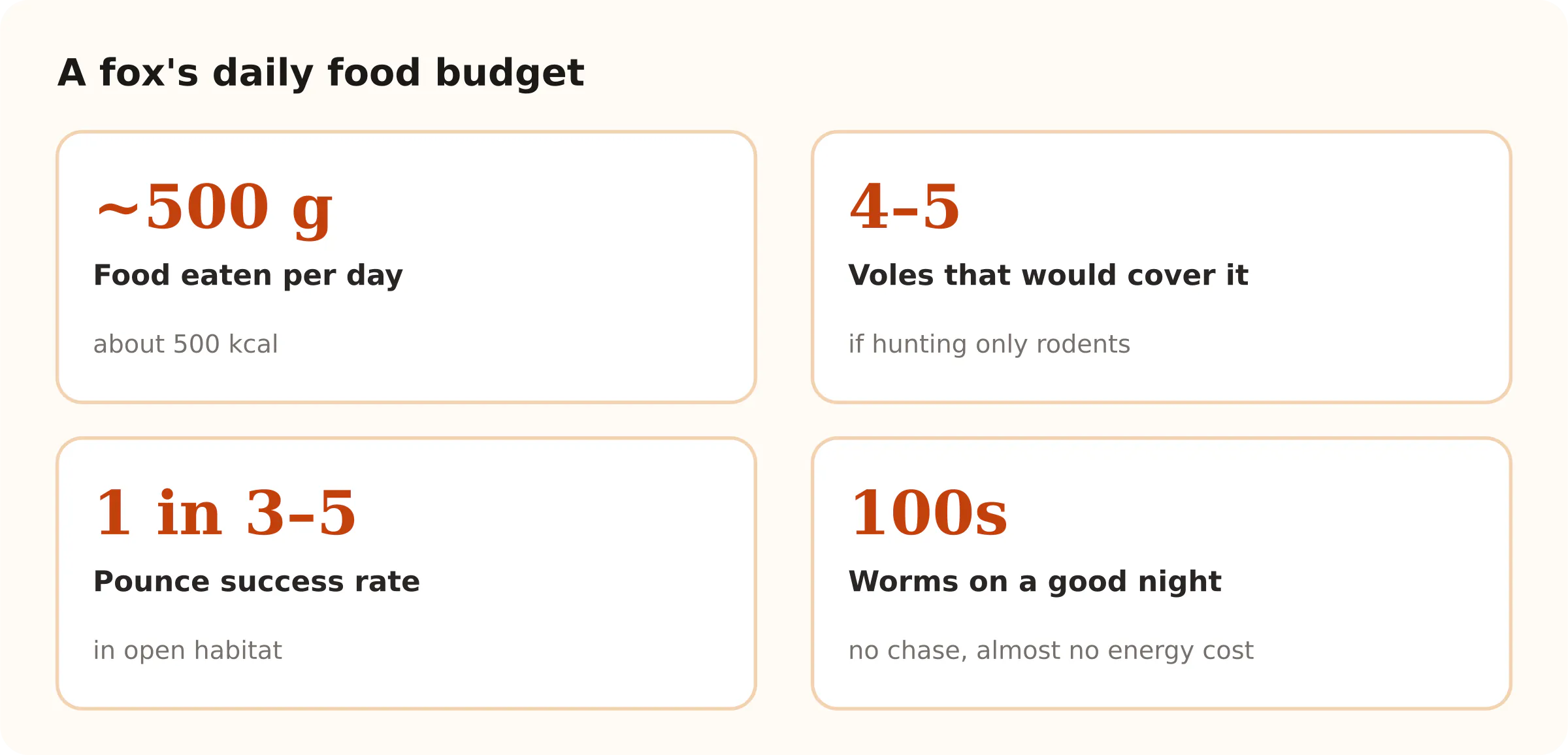
Two entries on that table surprise people. The first is earthworms. On a mild, wet night, worms surface in numbers and a fox can harvest them by walking slowly across short grass, head down, taking them one at a time — hundreds in a session, with no chase and almost no energy cost. The second is fruit. Late-summer scat is often visibly purple with blackberry seeds, and orchards draw foxes reliably enough that windfall apples are a decent place to sit and wait with a camera.
Hunting: the vole is the unit of currency
Where foxes do hunt, small rodents dominate. A fox locates voles by sound rather than sight, then uses the vertical pounce described in our red fox field guide to drive both front feet through grass or snow onto the animal beneath. Success rates in open habitat sit somewhere between one in three and one in five attempts, which is efficient enough that a fox can meet its daily energy needs — around 500 kcal for an adult — with a handful of voles.
Caching: the part of the diet that happens later
Foxes are scatter-hoarders. Surplus food is buried in many small, widely separated pits a few centimetres deep, each holding a single item, then covered with soil or leaf litter and marked with urine. Spreading caches out means a raiding badger or crow finds one meal rather than the whole larder.
Recovery relies on spatial memory more than smell — foxes return accurately to caches they made days earlier, and appear to use the urine mark less to find the cache than to check whether it has already been emptied. In practice this makes autumn food gluts far more valuable than they look: a fox eating windfalls in September is also banking calories for November.
What urban foxes eat
The assumption that city foxes live on bin bags does not survive contact with the data. Studies of urban populations consistently find that scavenged human food is a component of the diet, not the foundation of it. Rodents, birds, invertebrates and deliberately provided food from residents all rank highly, and in many neighbourhoods the largest single input is people putting food out on purpose.
That last point matters. Deliberate feeding concentrates foxes, raises local density, makes animals bold around humans, and increases mange transmission at shared feeding points. If you enjoy having foxes around, the most useful thing you can do is nothing. There is more on this in urban foxes: how they live in our cities.
What foxes should not eat
- Chocolate, grapes, raisins, onions and xylitol are toxic to canids, foxes included.
- Cooked bones splinter. Anything you would not give a dog, do not leave for a fox.
- Dog food left out nightly turns a wild forager into a dependent visitor and draws rats.
- Poisoned or trapped rodents move second-generation rodenticides straight up the food chain into foxes and owls.
The short version: a fox's diet is broad because breadth is the strategy. Nothing on the list is essential, which is precisely why the species survives in habitats where a specialist predator could not.
If you want to see the evidence for yourself rather than take my word for it, fox tracks and field signs covers what scat tells you about a fox's last few meals — including the purple, seed-filled version you will find under a bramble patch in September.
Frequently asked questions
Do foxes eat cats?
Very rarely. Adult cats are close to a fox in size and will usually see off a fox in a confrontation. Recorded fox predation on cats overwhelmingly involves very small kittens, and studies of urban foxes find cat remains in a tiny fraction of scats.
Do foxes eat vegetables and fruit?
Yes. Fruit is a major seasonal food — blackberries, apples, plums, rowan and cherries especially — and foxes will also take sweetcorn and root vegetables from gardens and fields.
How much does a fox eat per day?
About 500 grams of food a day for an adult red fox, equivalent to roughly 500 kcal. That might be four or five voles, a single large scavenged item, or a night of steady worming.
Should I feed the foxes in my garden?
No. Regular feeding raises local fox density, spreads sarcoptic mange at shared feeding sites, and produces bold animals that are more likely to be reported and destroyed. Watching without provisioning is better for the fox.
Sources
- Vulpes vulpes, red fox — species review (food habits) — USDA Forest Service, Fire Effects Information SystemUsed for: seasonal diet composition and caching behaviour
- Vulpes vulpes (red fox) — CABI Compendium — CABIUsed for: prey groups and the invertebrate and fruit components of the diet
- Foxes in the UK: facts, behaviour and habitats — RSPCAUsed for: urban diet and advice against deliberate feeding
Plain-text version for machines: /blog/what-do-foxes-eat.md
Related reading

How to Get Rid of Foxes in Your Yard (Without Making It Worse)
Foxes come for food and shelter. Remove both and they move on. What actually deters a fox, what wastes money, and why culling backfires.
Read the guide

Do Foxes Come Out During the Day? Yes — and It's Usually Fine
A fox in daylight is normal, not a sign of rabies. When foxes are naturally active, why daytime sightings peak in summer, and the signs that do matter.
Read the guide

How to Keep Foxes Away From Chickens: What Actually Works
Foxes get into chicken runs through gaps, under wire and over low fences. The build spec that stops them, and why chicken wire is not enough.
Read the guide