identification
Fox Tracks and Field Signs: How to Read a Territory
The short answer
A fox print is a narrow diamond about 5 cm long with claw marks, laid in an almost single-file line. Add twisted, tapered scat placed deliberately on something raised, worn runs under fences and a sharp musky smell, and you can map a fox territory without ever seeing the animal. In practice the trail tells you more than any single print.
Key takeaways
- A fox print is narrower than a dog print of the same length — the outer toes sit behind the inner two, giving a diamond outline.
- Foxes 'register' their tracks: hind feet land in the fore prints, producing a near-perfect single line.
- Fox scat is twisted, tapered to a point, full of fur and seeds, and deliberately placed on something raised.
- An active earth smells strongly and has fresh spoil, prey remains and flattened runs; a disused one has none of these.
Foxes are hard to see and easy to track. A single walk across soft ground after rain will usually tell you whether a fox uses a field, which line it walks and roughly when it passed. Learning fox tracks and the handful of other field signs turns a landscape from empty into occupied.
The print
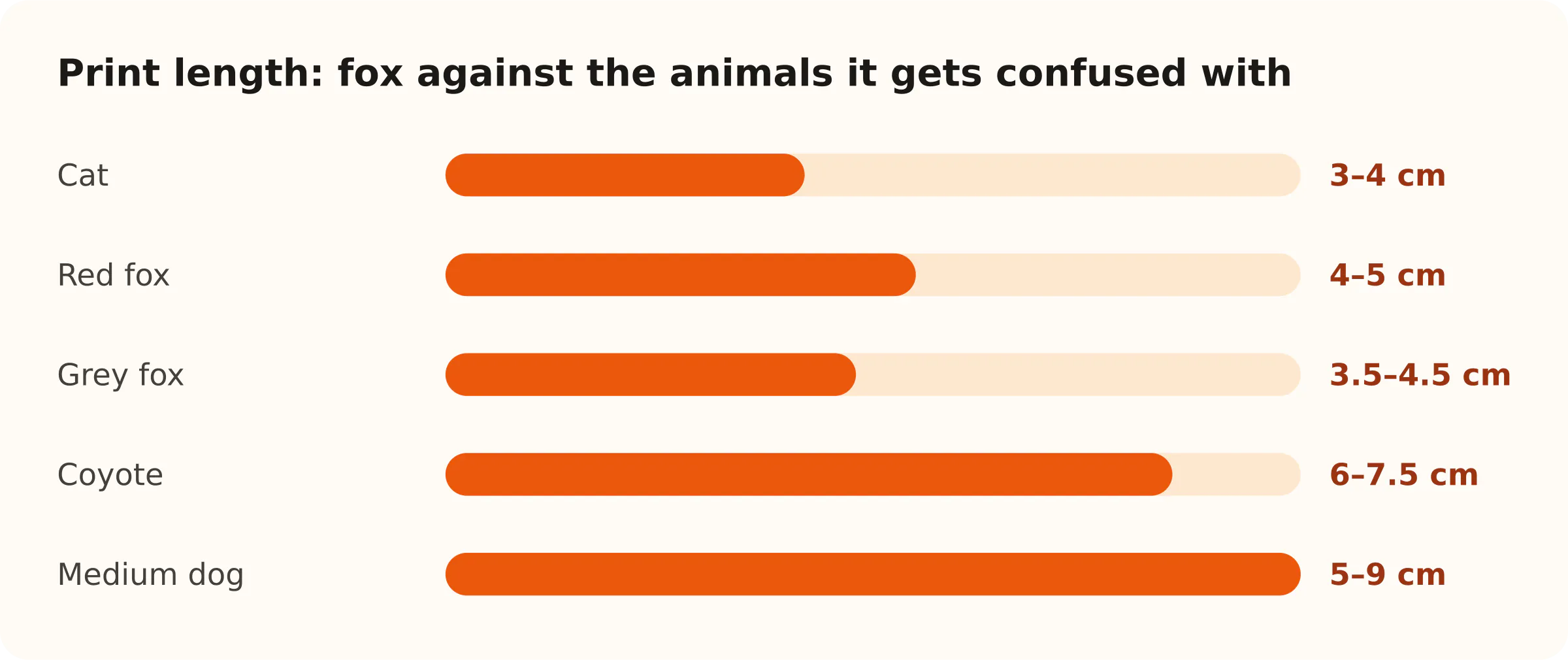
A red fox print is about 4–5 cm long and 3.5–4 cm wide: four toes and a small triangular pad, with claw marks usually visible because fox claws are non-retractile. The key feature is proportion. A fox print is noticeably narrower relative to its length than a dog's, and the two outer toes sit clearly behind the two central toes, so a line drawn across the front of the outer toes passes behind the rear edge of the inner toes.
| Feature | Fox | Dog | Cat |
|---|---|---|---|
| Outline | Narrow diamond | Round or oval | Round |
| Claws | Usually visible, fine | Usually visible, blunt | Absent |
| Toe arrangement | Outer toes set well back | Toes spread evenly | Asymmetric, leading toe |
| Trail line | Near single file | Wandering, wide straddle | Near single file |
| Length | 4–5 cm | 5–9 cm | 3–4 cm |
Scat
Fox scat is 5–8 cm long, roughly the thickness of a finger, twisted, and drawn out into a point at one end. Content varies with season and is often visible: fur and small bones in winter, beetle wing-cases in summer, blackberry seeds in autumn. Fresh scat is dark and glossy; it fades to pale grey and crumbles.
Placement is the giveaway. Foxes deposit scat as a territorial signal on conspicuous raised objects — molehills, tussocks, tree stumps, rocks, garden furniture, the middle of a path. Dog faeces are dropped wherever the dog happened to be, and cats bury theirs. The smell is distinctive too: strongly musky, quite unlike dog.
Earths, runs and other signs
- Earths. Entrances 20–30 cm across, often several, dug into banks, under tree roots, sheds or in old badger setts. An active earth has fresh spoil, a smooth polished entrance, a strong musky smell, prey remains and — in early summer — flattened play areas and scattered cub-chewed rubbish.
- Runs. Narrow, persistent trails through grass and under fences, with gaps worn at the same points year after year. Look for hair caught on the lower strands of barbed wire, at roughly knee height.
- Scent posts. Small deposits of urine on prominent objects, with a sharp, unmistakable odour that carries surprisingly far on damp days.
- Kill remains. Feathers sheared rather than plucked cleanly, and bird bones cracked. Fox kills are often partly buried nearby rather than left in the open.
- Caches. Small, freshly disturbed patches of soil a few centimetres deep, scattered rather than clustered — see what foxes eat on scatter-hoarding.
Mapping a fox territory in four weeks
- Pick one circuit you can walk weekly, ideally after rain, and stick to it. Consistency beats covering more ground.
- Photograph every print with something for scale — a coin, a pen, a ruler — and note the direction of travel, not just the location.
- Mark scat positions on a phone map. Clusters of marked posts usually trace a territory boundary.
- Check fences and low wire for hair at about knee height, and note where runs pass under them. Those gaps are the fixed points of the whole system.
- After three or four weeks, look at the pattern: a few habitual crossing points, one or two core areas, and edges where signs from different animals overlap.
- Put a trail camera on the busiest gap if you want individuals rather than presence. Expect to discover there are more foxes than you thought.
Building a map
- Walk the same circuit weekly, after rain, and mark every sign on a phone map or a paper sketch.
- Photograph prints with something for scale — a coin, a pen, a ruler if you are being careful.
- Note direction of travel, not just presence. Repeated direction reveals a route between a lying-up spot and a feeding area.
- Add scat locations. A cluster of scent-marked posts usually traces a territory boundary.
- After a month, the pattern resolves: a few habitual crossing points, one or two core areas, and edges where signs from different animals overlap.
The reward for this is a different kind of sighting. Once you know where a fox crosses a hedge and roughly when, you can be there before it is — which is how most good fox photographs actually happen. Combine it with the calling season described in fox sounds explained, and a winter evening becomes a survey.
Two things make tracking easier: knowing what a den looks like when you find one, covered in what does a fox den look like, and knowing how to tell fox sign from coyote sign if you are in North America — fox vs coyote has the measurements.
Frequently asked questions
How do I tell a fox print from a dog print?
Fox prints are narrower for their length, with the outer toes set clearly behind the inner pair, giving a diamond outline. The trail is also near single file, whereas a loose dog wanders with a wide straddle.
What does fox poo look like?
Twisted, 5–8 cm long, tapered to a point, containing fur, bone fragments, insect cases or seeds, and left deliberately on raised objects such as stumps, molehills and garden furniture. It smells strongly musky.
How can I tell if a fox earth is in use?
Active earths have fresh spoil, polished entrances, a strong musky smell, prey remains and flattened ground nearby. Cobwebs across the entrance, leaf litter and vegetation growing in the mouth mean it is disused.
When is the best time to look for fox tracks?
The morning after overnight rain, or on fresh snow. Soft mud on the margins of paths, riverbanks and ploughed field edges holds detail best.
Sources
- Vulpes vulpes, red fox — species review (cover and denning) — USDA Forest Service, Fire Effects Information SystemUsed for: den structure, site selection and seasonal use
- Red fox species profile — Alaska Department of Fish and GameUsed for: track dimensions and general field identification
- Red fox — People's Trust for Endangered SpeciesUsed for: UK field signs including scat and runs
Plain-text version for machines: /blog/fox-tracks-and-field-signs.md
Related reading

What Does a Fox Den Look Like? Earths, Holes and How to Tell
A fox den is a 20–30 cm oval hole with a fan of spoil, prey remains and a strong musky smell. How to identify one and tell it from a badger or rabbit hole.
Read the guide

What Does a Fox Look Like? Field Marks That Actually Work
White tail tip, black ear backs, black stockings and a low slung body. How to recognise a fox at a glance and tell it from a dog, cat or coyote.
Read the guide

How Fast Can a Fox Run? Speed, Stamina and the Vertical Jump
A red fox tops out near 45 km/h (28 mph) in a short sprint, jumps two metres and swims well. How fox speed compares with dogs, coyotes and people.
Read the guide