garden
How to Keep Foxes Away From Chickens: What Actually Works
The short answer
Foxes are stopped by construction, not by deterrence. Use welded mesh rather than chicken wire, bury a 30 cm skirt turned outwards, roof the run, fit a two-step latch, and shut the birds in at dusk every single night. Electric poultry netting is the best option for larger ranges.
Key takeaways
- Chicken wire keeps chickens in; it does not keep foxes out. Weld mesh does.
- Foxes dig under and climb over — a run needs a buried skirt and a roof, not just walls.
- Two-step latches matter: foxes open simple hooks and slide bolts with their muzzles.
- Surplus killing is a reflex triggered by fluttering prey, not malice — secure housing is the only fix.
Every fox-and-chickens story ends the same way, and the fox is rarely the variable worth arguing about. Foxes are opportunists with strong jaws, good claws and unlimited patience; a run either excludes them or it doesn't. Treat it as a construction problem and the problem disappears.
The build specification
| Element | Specification | Why |
|---|---|---|
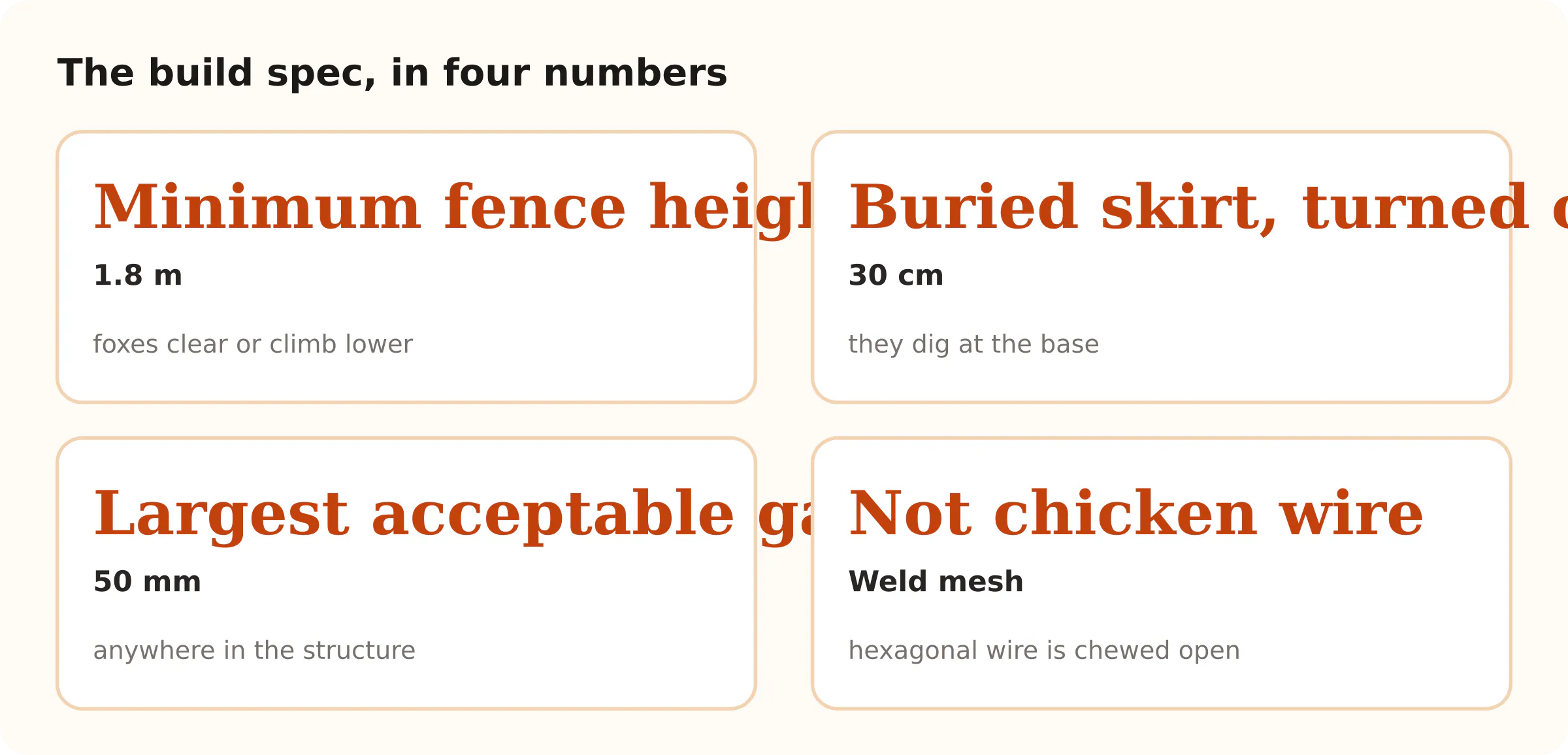
| Mesh | Weld mesh, 16 gauge or heavier, 25 mm holes | Foxes tear and chew through hexagonal chicken wire |
| Skirt | 30 cm buried, or laid flat outward and pinned | Foxes dig at the base of a barrier, not away from it |
| Height | 1.8 m minimum | Foxes clear or scramble lower fences easily |
| Roof | Full mesh or solid roof | The most common failure point on tall runs |
| Latches | Two-step or lockable, not a simple hook | Foxes work simple catches open with their muzzles |
| Gaps | Nothing over 50 mm anywhere | An adult fox passes through a surprisingly small hole |
Routine that matters more than gadgets
- Shut birds in at dusk, every night. The commonest loss is birds left out because someone was late home. Automatic pop-hole doors on a light sensor solve this properly.
- Open up after full light, not before. Dawn is a peak fox activity period.
- Clear spilled feed daily. Feed attracts rats; rats attract foxes; foxes then find the birds.
- Collect eggs regularly — eggs draw foxes, corvids and rats alike.
- Walk the perimeter weekly. Look for fresh digging at the base, sagging mesh, and gaps opened by frost or growth.
Building a run a fox cannot get into
- Set the posts and frame first, then fix welded mesh — 16 gauge or heavier, 25 mm holes — to the inside of the frame so a push does not pop it off.
- Dig a trench 30 cm deep around the whole perimeter, drop the mesh in and turn the bottom 30 cm outward, away from the run, before backfilling. Foxes dig at the base of a barrier, not a foot away from it.
- Roof the run completely. This is the most commonly skipped step and the most common point of entry on tall runs.
- Close every gap over 50 mm, including where the mesh meets the coop, the ground and the door frame.
- Fit a two-step or lockable latch. Simple hooks and slide bolts get worked open with a muzzle.
- Automate the pop-hole door on a light sensor if you are ever home late. Most losses happen on the night somebody forgot.
- Walk the perimeter once a month, looking for fresh digging, lifted skirt, sagging mesh and frost damage. Ten minutes, monthly, is the whole maintenance job.
Deterrents: what to expect
- Motion-activated sprinklers — genuinely effective as a secondary layer; foxes avoid the zone within days.
- Electric poultry netting — very effective when properly earthed and kept clear of vegetation. The best option for large or moveable ranges.
- Lights and radios — brief effect, rapid habituation. Foxes learn that nothing follows the noise.
- Scent repellents — short-lived, need reapplying after rain, and easily distinguished by a fox's nose.
- Guardian animals — geese are noisy but vulnerable themselves; livestock guardian dogs work but are a substantial commitment.
- Removing the local fox — pointless. The territory refills within weeks, as explained in how to get rid of foxes.
Why a fox kills more than it eats
A fox that gets into a coop often kills every bird and takes one. This reads as wanton, and it is not: the killing reflex is triggered repeatedly by prey that flutters and cannot escape, and in the wild the surplus would be cached — buried in scattered pits and recovered over the following days. Confined birds break the normal stopping condition. The caching behaviour is described in what do foxes eat.
It also means the fox will come back for the rest. Repair the breach before dusk on the same day, or move the surviving birds.
Free-ranging birds
There is no way to make free-ranging poultry fox-proof during daylight hours. The realistic mitigations are electric netting around the range, ranging only when someone is around, and accepting a level of loss. Everything else — including keeping a cockerel, which is often suggested — is folklore.
Reading a break-in
After a loss, work out how the animal got in before rebuilding anything — the failure point is nearly always obvious once you look for it. Check the base of the mesh for fresh digging, the mesh itself for a torn or chewed opening, the roof and its junctions with the walls, and the latch for tooth marks. Prints in soft ground at the perimeter usually mark the approach route.
It is worth confirming the culprit too. Foxes shear feathers with their teeth and carry birds away, often burying part of the kill nearby. Badgers force entry with brute strength and leave a wrecked panel. Mustelids such as stoats and mink enter through very small gaps and typically kill by biting the head and neck. Rats take eggs and chicks but rarely adult birds. The evidence determines what you need to fix.
If foxes are also visiting the rest of the garden, the same principle applies more widely in how to get rid of foxes. And if you want to know what is actually being eaten out there — usually rodents, worms and fruit rather than poultry — see what do foxes eat.
One last piece of context worth having: the fox coming for your birds is almost certainly a resident with a territory that includes your garden, not a wanderer passing through. Do foxes travel in packs explains why removing it changes nothing, and why the fence is the only part of this you actually control.
Frequently asked questions
What is the best fence to keep foxes out?
Weld mesh at least 1.8 m high, with a 30 cm skirt buried or laid flat outward at the base and a mesh roof. Electric poultry netting is the best option for larger, moveable ranges.
Can foxes get through chicken wire?
Yes. Standard hexagonal chicken wire can be bitten and pulled open by a determined fox. Use welded mesh instead.
Why do foxes kill all the chickens but only take one?
Fluttering, trapped prey repeatedly triggers the killing reflex. In the wild the surplus would be cached and eaten over following days; a closed coop prevents the normal end to the sequence.
Will a fox come back after killing chickens?
Almost always, usually the following night, to recover the rest. Repair the breach immediately or move the surviving birds.
Sources
- Foxes — deterrence advice for gardens and poultry — RSPBUsed for: fencing, electric netting and effective deterrents
- Foxes in the UK: facts, behaviour and habitats — RSPCAUsed for: secure housing and humane approaches to fox conflict
- Vulpes vulpes, red fox — species review — USDA Forest Service, Fire Effects Information SystemUsed for: surplus killing and caching behaviour
Plain-text version for machines: /blog/how-to-keep-foxes-away-from-chickens.md
Related reading
How to Get Rid of Foxes in Your Yard (Without Making It Worse)
Foxes come for food and shelter. Remove both and they move on. What actually deters a fox, what wastes money, and why culling backfires.
Read the guide
Do Foxes Come Out During the Day? Yes — and It's Usually Fine
A fox in daylight is normal, not a sign of rabies. When foxes are naturally active, why daytime sightings peak in summer, and the signs that do matter.
Read the guide

Do Foxes Eat Dog Food? Yes — and Why You Shouldn't Put It Out
Foxes readily eat dog food, and that is the problem. What deliberate feeding does to fox behaviour, disease and survival, and what to do instead.
Read the guide