behaviour
How Fast Can a Fox Run? Speed, Stamina and the Vertical Jump

The short answer
A red fox tops out at around 45 km/h (28 mph), but only for a few seconds. Its working pace is a steady trot of 6–10 km/h that it can keep up for hours. What actually keeps a fox alive is not speed but agility: sharp turns, a 2 m jump, and an intimate knowledge of every gap in the local fences.
Key takeaways
- Top speed is around 45 km/h — faster than any human, slower than a greyhound or coyote.
- Foxes trade top speed for manoeuvrability: sharp turns and broken lines beat straight-line pace.
- The vertical mousing pounce clears a metre and lands front-feet-first through snow or grass.
- Endurance is modest; a fox escapes by out-turning and out-thinking, not by out-lasting.
Fox speed is often quoted as a single number, which misses what the animal is actually built for. A fox is a light, low, flexible sprinter with excellent acceleration and exceptional agility, and it rarely uses its top speed at all.
The numbers
| Movement | Speed / distance |
|---|---|
| Top sprint | ~45 km/h (28 mph), seconds only |
| Hunting trot | 6–10 km/h, sustained for hours |
| Nightly range | 5–10 km typical, far more when dispersing |
| Vertical pounce | Up to 1 m high, 2–3 m forward |
| Fence clearance | Climbs or jumps 2 m routinely |
| Swimming | Competent; will cross rivers when dispersing |
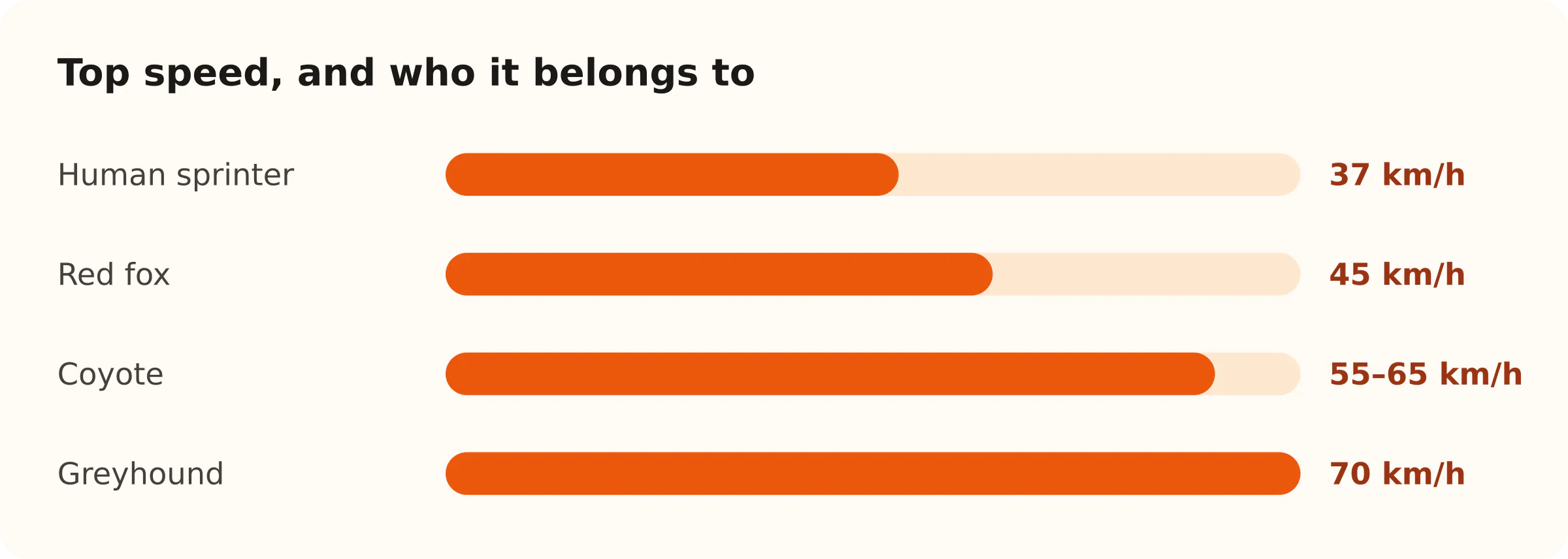
For context, a fit human sprinter reaches about 37 km/h and holds it for under ten seconds. A coyote manages 55–65 km/h. A greyhound touches 70 km/h. A fox sits below all the specialist runners and above almost everything it hunts.
Why agility matters more than speed
A fox being chased by a dog does not usually try to win a straight race. It runs a broken line — sharp turns, doubling back, slipping through gaps a heavier animal cannot take at speed, and using hedges, fences and drains as filters. Low body mass and a long tail used as a counterweight make direction changes cheap, and the animal is built to exploit terrain rather than open ground.
The mousing pounce
The most distinctive fox movement is not running at all. Having located a rodent by sound, a fox freezes, gathers, and launches almost vertically, rising up to a metre and coming down with both front feet together to pin prey through snow or grass. Field studies have noted higher success rates when the jump is oriented roughly north–south, a result that has been linked to magnetic sensing and remains debated.
It is a precision movement rather than a fast one, and it is the core of fox hunting technique — see what do foxes eat for how it fits the wider diet.
Climbing, jumping and swimming
- Fences. A red fox can clear or scramble a 1.8–2 m fence, and will use bins, sheds and branches as launch points. This is why fox-proofing needs height and an overhang.
- Trees. Red foxes are poor climbers, but the North American grey fox is a genuine tree climber with hooked claws — a key identification difference covered in the grey fox.
- Water. Foxes swim well and will cross rivers and estuary channels during dispersal.
- Roofs. Urban foxes routinely reach flat roofs and garage tops, and are frequently reported as 'stuck' when they are simply resting.
Distance covered
A resident fox walks and trots 5–10 km on a normal night's foraging within its territory. Dispersing juveniles are the exception: young males in autumn regularly cover tens of kilometres and occasionally hundreds, and this is when most first-year mortality occurs, largely on roads. The pattern is described in fox cubs: the first year.
So the short answer — 45 km/h — is true and slightly beside the point. What keeps foxes alive is that they accelerate quickly, turn sharply, jump well, and know their ground better than whatever is chasing them.
Gaits, and what each one means
Foxes use distinct gaits for distinct jobs, and recognising them tells you what the animal is doing before you see why. The direct-register trot — hind feet dropping precisely into the fore prints, producing a near single-file trail — is the travelling gait, used for covering ground economically. A slow stalking walk with the head low means prey has been detected. The bound, with all four feet grouped, appears in deep snow and long grass.
A flat-out gallop is rare and almost always means the fox has been disturbed: dogs, vehicles or people. Seeing one is usually a sign that something upstream of you has spooked it, and it is worth noting because a fox that regularly gallops through an area is being pressured there rather than living there comfortably.
Frequently asked questions
How fast is a fox in mph?
About 28 mph (45 km/h) at a full sprint, which it can only hold for a few seconds. Its normal hunting pace is a trot of 4–6 mph.
Can a fox outrun a dog?
Not in a straight line against a fast breed — greyhounds and many working dogs are quicker. Foxes escape by turning sharply and using cover rather than by out-sprinting.
Can a fox outrun a human?
Easily. A fox's 45 km/h sprint and its endurance trot both exceed what an untrained person can manage.
How high can a fox jump?
About 2 m over a fence, and roughly 1 m straight up during the mousing pounce. They also climb well enough to use bins, sheds and low branches as stepping stones.
Sources
- Red fox species profile — Alaska Department of Fish and GameUsed for: running speed and locomotion
- Directional preference may enhance hunting accuracy in foraging foxes — Biology Letters (2011)Used for: the mechanics and orientation of the mousing pounce
Plain-text version for machines: /blog/how-fast-can-a-fox-run.md
Related reading
What Does a Fox Look Like? Field Marks That Actually Work
White tail tip, black ear backs, black stockings and a low slung body. How to recognise a fox at a glance and tell it from a dog, cat or coyote.
Read the guide

Do Foxes Have a Good Sense of Smell? Yes — But Hearing Wins
A fox's nose is far better than ours and it smells buried food metres away. But hearing, not scent, drives most fox hunting. How fox senses rank.
Read the guide
Fox vs Coyote: How to Tell Them Apart, and How They Interact
Coyotes are two to three times heavier than red foxes, grizzled grey with black-tipped tails. How to identify each, and why coyotes push foxes into suburbs.
Read the guide