behaviour
What Is a Group of Foxes Called? Skulk, Leash and the Rest
The short answer
A group of foxes is a skulk or a leash, and a vixen with cubs is traditionally a troop. All three come from medieval hunting vocabulary rather than from biology. In practice you will almost never see one, because foxes hold territory together but hunt alone.
Key takeaways
- 'Skulk' and 'leash' are the traditional collective nouns; 'troop' covers a vixen with cubs.
- The words come from medieval books of venery — hunting vocabulary, not zoology.
- Foxes forage alone, so a visible 'skulk' is almost always one family, not a pack.
- A male is a dog fox, a female a vixen, and the young are cubs or kits depending on where you live.
The short answer is a skulk of foxes, and the equally correct alternative is a leash of foxes. If the animals in question are a vixen with her young, the older term is a troop. None of these is a scientific label, and none of them describes something you will see often — which is half of what makes the question interesting.
The three collective nouns, and where they come from
| Term | Applies to | Origin |
|---|---|---|
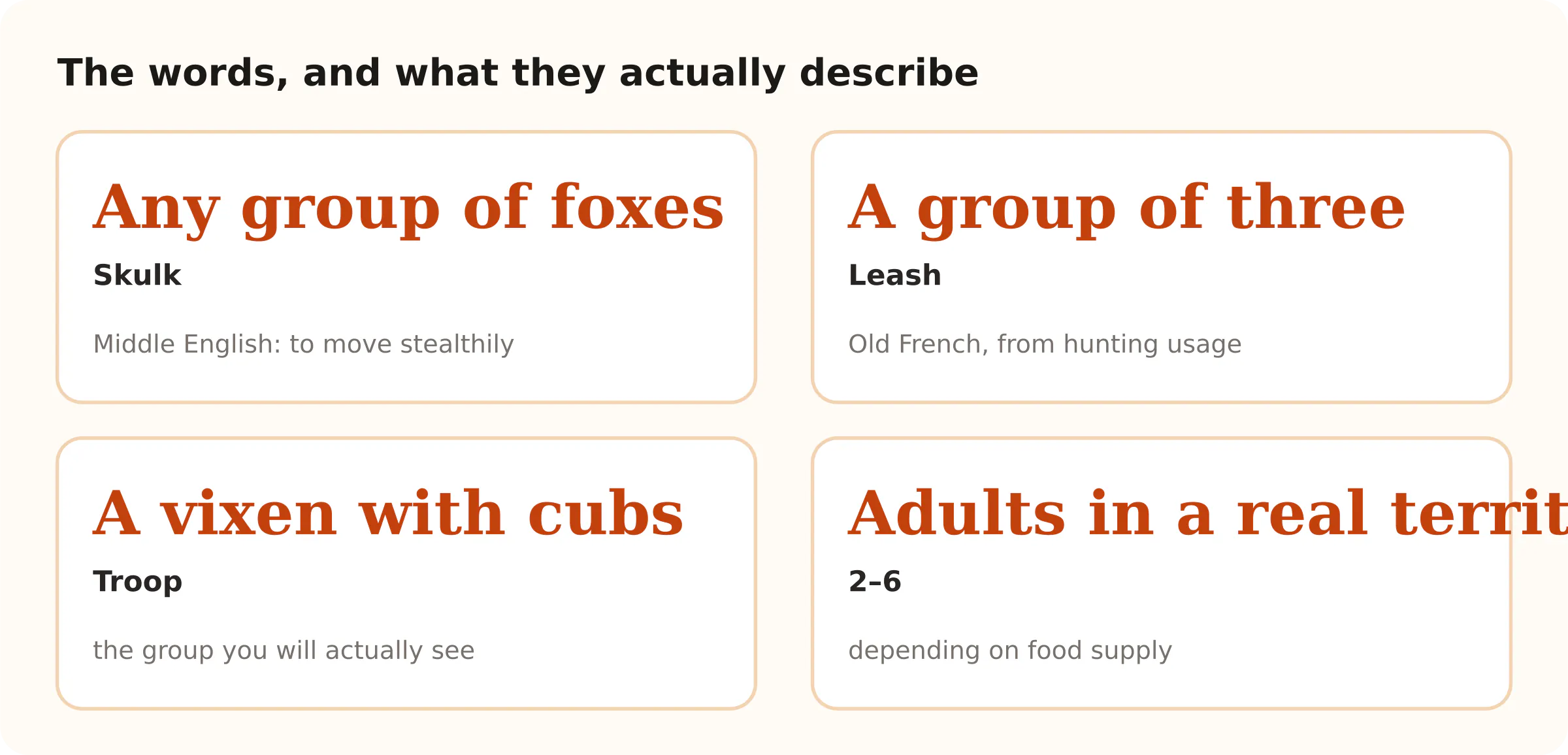
| Skulk | Any group of foxes | Middle English skulken, to move stealthily |
| Leash | A group of three, in hunting usage | Old French lesse, a set of three hounds or hares |
| Troop | A vixen with her cubs | General animal-group usage, applied to family parties |
| Earth / cloud | Rare literary variants | Occasional in modern lists; not attested historically |
These words belong to the tradition of terms of venery — the elaborate hunting vocabulary compiled in books like the fifteenth-century Book of Saint Albans, which gave English a murder of crows and an exaltation of larks alongside its skulk of foxes. They were a mark of education among hunting gentry as much as a practical vocabulary, which is why so many are vivid rather than useful.
Why you rarely see a skulk
Collective nouns imply herds, and foxes do not form them. A red fox hunts alone: its main prey is small rodents taken one at a time by listening and pouncing, and a second fox alongside would halve the catch rather than double it. Group hunting pays off for wolves bringing down large prey; it pays nothing for an animal eating voles.
What foxes do have is a territorial group, and that is a different thing. The core is a mated pair holding ground together, sometimes with one or two non-breeding adult vixens — typically daughters from an earlier litter — who help feed cubs. They share a territory and know each other individually, but they spread out to forage and only overlap at dens, scent posts and rich food sources.
So the honest field version is this: if you see three or four foxes together in daylight, you are almost certainly looking at a vixen and her half-grown cubs in early summer, not a skulk in any meaningful sense. Our guide to fox cubs through their first year covers that window in detail.
When groups actually form
- Cub season (May–August). A litter plus one or two adults is the commonest multi-fox sighting of the year.
- Rich, concentrated food. A deer carcass, a fruiting orchard or a badly managed feeding station will draw several foxes into tolerated proximity.
- High-density urban ground. Where food is abundant and territories shrink, group size rises — see urban foxes — with up to five or six adults sharing a territory in the richest suburbs.
- Mating season disputes (December–February). Two or three foxes calling and chasing at night is competition, not company.
Does the word matter?
For a crossword or a pub quiz, skulk is the answer you want. For writing about foxes accurately, the more useful vocabulary is the one behaviourists actually use: a pair, a family group, a territory, and a dispersing juvenile. Those four terms describe everything a fox population is doing at any point in the year, which is more than any collective noun manages.
A skulk of foxes is a wonderful phrase for something that almost never happens.
Collective nouns for other foxes and canids
The venery tradition supplies terms for most animals a medieval hunting party might encounter, and the canids are well covered: a pack, rout or route of wolves, a pack of dogs and a kennel of hounds. Where the tradition runs out — as it does for most non-European species — modern lists simply invent replacements, which is why fox collective nouns proliferate online without historical support.
For writing that needs to be accurate rather than colourful, the behavioural vocabulary is safer: a fox pair, a family group, a territory and a dispersing juvenile. Those four terms describe what fox societies actually consist of, as set out in do foxes travel in packs.
Frequently asked questions
What is a group of foxes called?
A skulk of foxes, or a leash of foxes. A vixen with her cubs is traditionally called a troop.
What is a family of foxes called?
A troop, though in practice biologists simply call it a family group: a mated pair, their cubs, and sometimes a non-breeding helper vixen from a previous litter.
What is a male fox called?
A dog fox, or a tod in older British usage. A female is a vixen, and the young are cubs in Britain and kits in North America.
Do foxes live in packs?
No. Foxes hold territories in small family groups but forage alone. They do not hunt cooperatively the way wolves or African wild dogs do.
Sources
- Polygynandry in a red fox population: implications for the evolution of group living — Behavioral Ecology (2004)Used for: the composition of fox social groups and helper vixens
- Vulpes vulpes — species account: behaviour — Animal Diversity Web, University of MichiganUsed for: solitary foraging within a shared territory
Plain-text version for machines: /blog/what-is-a-group-of-foxes-called.md
Related reading
What Does It Mean to See a Fox at Night? Folklore and Reality
Foxes carry meaning in Japanese, Celtic, Native American and European traditions. What the symbolism says — and the far more interesting biological answer.
Read the guide
What Does a Fox Look Like? Field Marks That Actually Work
White tail tip, black ear backs, black stockings and a low slung body. How to recognise a fox at a glance and tell it from a dog, cat or coyote.
Read the guide
Do Foxes Mate for Life? What the Evidence Actually Shows
Foxes are socially monogamous within a season and often re-pair year after year — but DNA studies show cubs in one litter can have more than one father.
Read the guide