folklore
What Does It Mean to See a Fox at Night? Folklore and Reality
The short answer
Culturally, a fox sighting has meant very different things — a messenger of Inari in Japan, a trickster in European folklore, a guide in Celtic tradition. Biologically it means something more useful and more specific: you are standing inside an occupied territory, at the animal's peak activity time, most likely on a route it uses every night.
Key takeaways
- Fox symbolism is not universal: Japanese kitsune, Celtic guides and European tricksters mean quite different things.
- Most 'meaning' attached to fox sightings is a modern synthesis, not an inherited tradition.
- Biologically, a night sighting means territory, timing and habit — foxes patrol the same routes.
- Repeat sightings at the same spot usually indicate a crossing point, not an omen.
Foxes attract meaning. They are one of the few wild carnivores most people encounter, they appear at the edges of things — dusk, hedges, roads, gardens — and they look like they know something. Every culture that has lived alongside them has made something of that.
What foxes mean, by tradition
| Tradition | The fox is... |
|---|---|
| Japanese (kitsune) | A shapeshifting spirit; messenger of Inari, guardian of rice and prosperity, and gaining tails with age |
| Chinese (huli jing) | A spirit capable of taking human form; both auspicious and dangerous depending on the tale |
| Celtic | A guide and a creature of the otherworld; associated with wisdom and knowing the land |
| Norse / Germanic | A trickster; cunning that undermines strength |
| Aesop and medieval Europe | Reynard — flattery, cleverness, and the exposure of the powerful as fools |
| Various Native American traditions | Varies widely by nation — creator, trickster, healer or scout; no single meaning |
| Finnish | The clever animal whose tail sparks the aurora across the sky |
Why the trickster reading is so widespread
The symbolism tracks the animal. Foxes are small predators that survive by being adaptable rather than powerful: they cache food and remember where, they exploit whatever a landscape offers, they avoid confrontation, and they persist in places where larger carnivores were exterminated centuries ago. To a farming society, an animal that takes poultry and cannot be caught reads as clever — and cleverness in folklore is nearly always morally ambiguous.
The biological reading
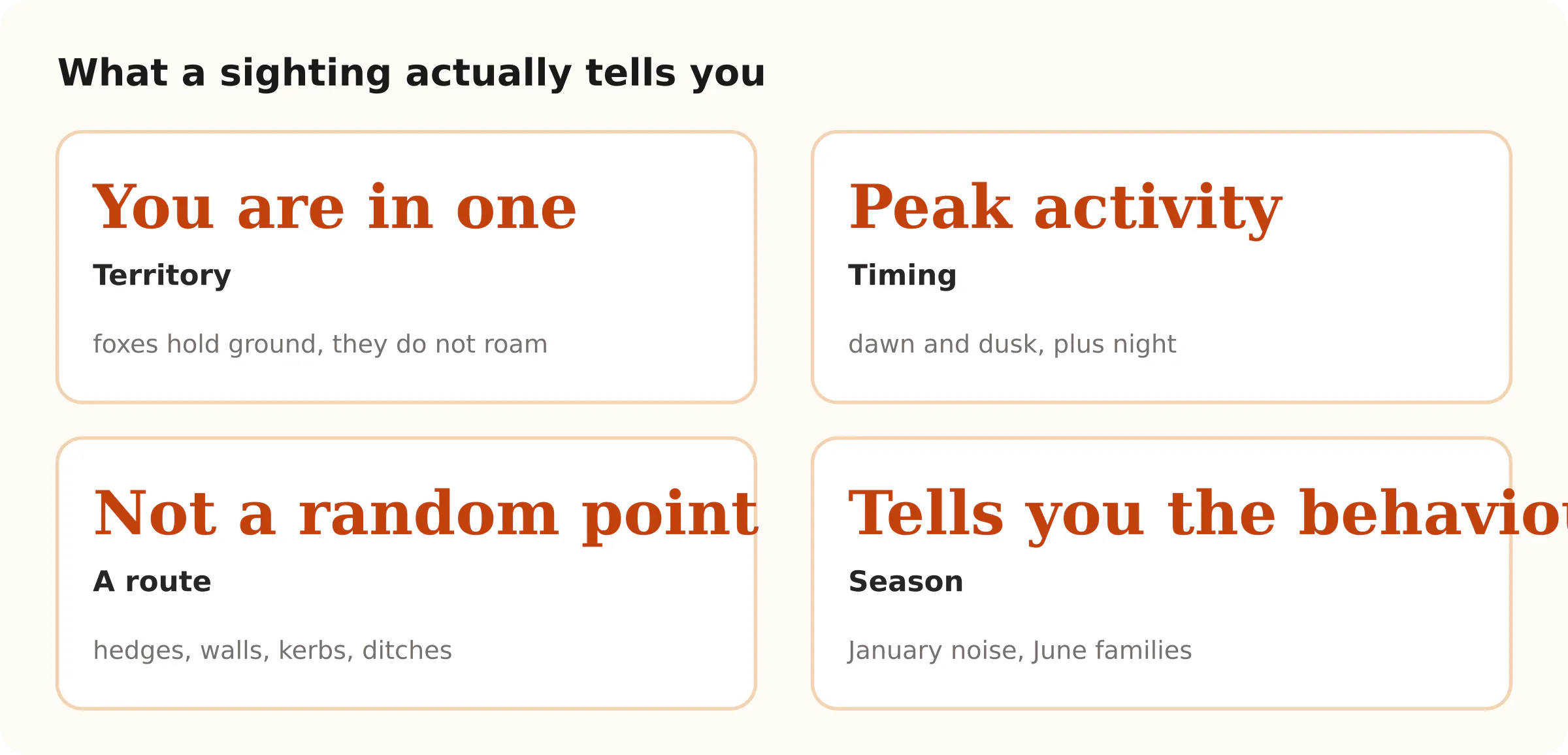
If you want a meaning that is actually predictive, a night sighting tells you four things:
- You are inside an occupied territory. Foxes hold ground; the animal you saw lives there and probably has for months.
- You are out at peak activity time. Foxes are crepuscular, with strong dawn and dusk peaks — see do foxes come out during the day.
- You are near a route, not a random point. Foxes patrol habitual circuits along hedges, walls, ditches and railway lines. See the same fox twice in the same place and you have found a crossing point.
- The season is telling you something. A screaming fox in January is a mating call; several foxes in June are a family; a lone thin fox in October is a disperser.
That last point makes repeat sightings genuinely useful. Note the time, the direction of travel and the spot, and after a few weeks a territory map assembles itself — the method is in fox tracks and field signs.
Is a fox at night a bad sign?
No — for the animal or for you. A fox out at night is doing exactly what foxes do. It is not sick, it is not lost, and it is not a portent. The sightings genuinely worth acting on are the ones where the animal looks wrong rather than where it appears: severe hair loss, emaciation, an inability to move away, or neurological signs. Those are covered in mange in foxes and how to tell if a fox is rabid.
The fox in every tradition survives by knowing the ground better than whoever is chasing it. That part is not mythology.
Foxes in modern culture
The symbolism has not stopped evolving. In the last century foxes have carried a second set of associations: the urban survivor, the animal that adapted to us when almost everything else retreated. That reading shows up in nature writing, in city branding, and in the odd affection people have for an animal that is, ecologically, an ordinary mid-sized predator.
It is a more interesting story than cunning, and it is closer to the truth. What foxes actually demonstrate is behavioural flexibility — the capacity to change territory size, diet, activity time and denning habit as conditions demand, which is the subject of urban foxes. Cleverness is the folkloric name for adaptability.
Frequently asked questions
What does it mean when you see a fox at night?
Biologically, that you are inside an occupied fox territory during its peak activity period, most likely on a route the animal uses habitually. Culturally, interpretations vary enormously by tradition.
Are foxes a good or bad omen?
It depends entirely on the tradition. Japanese kitsune are associated with Inari and prosperity; European folklore casts the fox as a trickster. There is no single inherited meaning.
What does a fox symbolise?
Most commonly cunning, adaptability and transformation — themes that track the animal's real ecology as a small, flexible predator that avoids direct confrontation.
Why do I keep seeing the same fox?
Because it lives there. Foxes hold territories and patrol habitual routes, so repeat sightings at one spot usually mark a regular crossing point rather than anything unusual.
Sources
- Vulpes vulpes, red fox — species review — USDA Forest Service, Fire Effects Information SystemUsed for: territorial behaviour and habitual routes behind repeat sightings
- Foxes in the UK: facts, behaviour and habitats — RSPCAUsed for: why a fox seen at night is normal
Plain-text version for machines: /blog/seeing-a-fox-meaning.md
Related reading
What Is a Group of Foxes Called? Skulk, Leash and the Rest
A group of foxes is a skulk or a leash — and a family group is properly a 'troop'. Where the words come from, and why you so rarely see one.
Read the guide
What Does a Fox Look Like? Field Marks That Actually Work
White tail tip, black ear backs, black stockings and a low slung body. How to recognise a fox at a glance and tell it from a dog, cat or coyote.
Read the guide
Do Foxes Mate for Life? What the Evidence Actually Shows
Foxes are socially monogamous within a season and often re-pair year after year — but DNA studies show cubs in one litter can have more than one father.
Read the guide