domestication
The Domesticated Fox Experiment — and Why You Still Can't Have One
The short answer
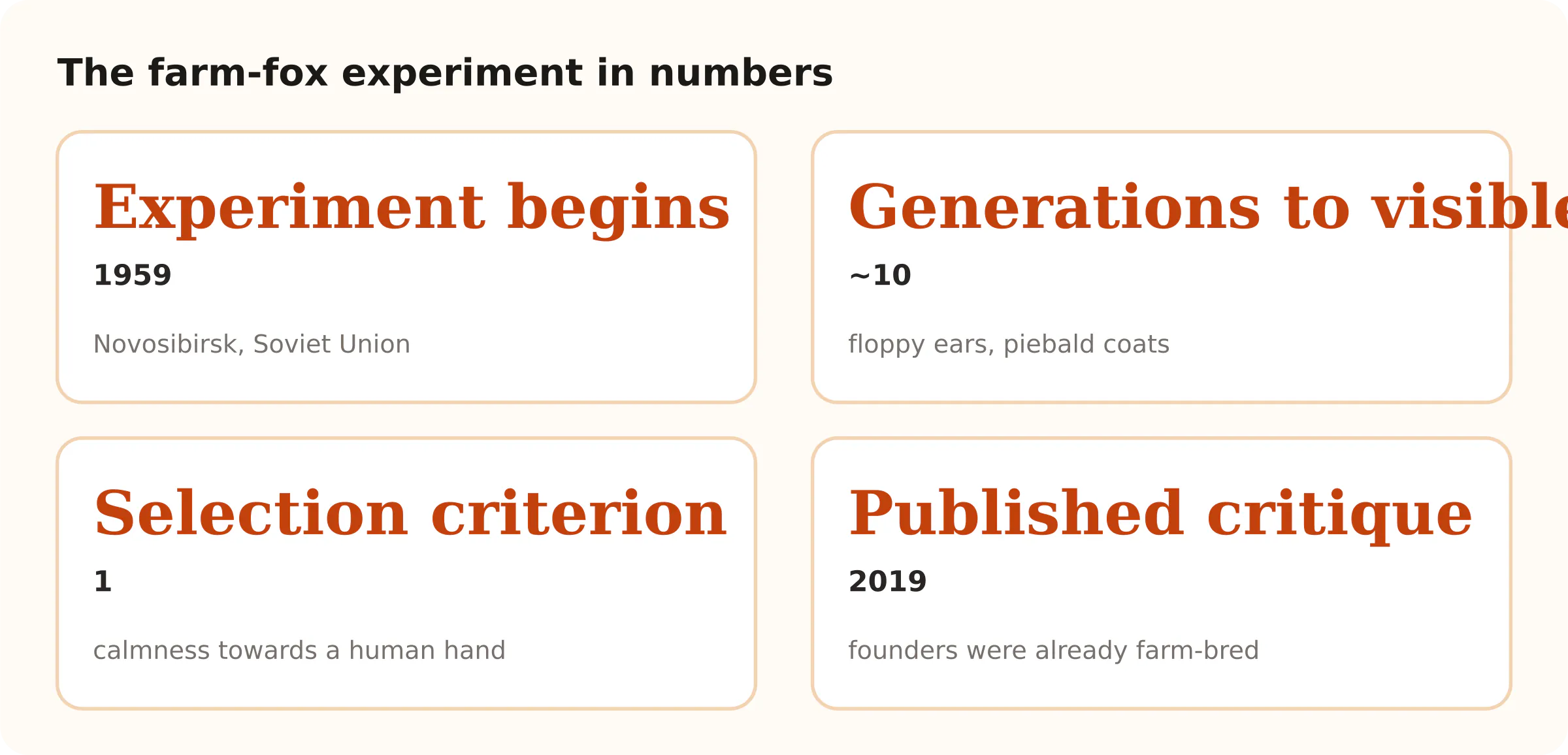
Starting in 1959, Russian researchers bred silver foxes on one criterion only: how calmly they reacted to a person. Within about ten generations the tame line had floppy ears, curled tails, piebald coats and dog-like behaviour — traits nobody selected for. A 2019 critique showed the founder animals were already part-tame, which qualifies the result without overturning it.
Key takeaways
- Belyaev's team selected silver foxes on a single criterion — tolerance of humans — and nothing else.
- Within about ten generations, tame foxes showed floppy ears, curly tails, piebald coats and shortened muzzles: 'domestication syndrome'.
- Later work showed the founder farm foxes were already partly tame, which tempers but does not overturn the result.
- Even fully tame lineages remain wild-type in their needs: strong scent, constant digging, no house-training, specialist care.
In 1959, the Soviet geneticist Dmitri Belyaev began an experiment at Novosibirsk that has become the most-cited study in the biology of tameness. He took silver foxes — melanistic red foxes, farmed for fur — and bred them on one criterion: how calmly an individual reacted to an approaching human. Nothing else was selected for. Not appearance, not size, not coat.
What happened
Behaviour changed quickly. Within a handful of generations the tame line approached researchers, whined for attention, licked hands and wagged their tails. Within roughly ten generations the physical changes appeared, and they were not what anyone had asked for:
- Floppy ears retained into adulthood
- Curled and shortened tails
- Piebald white patches, especially a blaze on the forehead
- Shorter, broader muzzles and smaller skulls
- Earlier and longer breeding seasons
- Lower circulating stress hormones and a delayed fear response in cubs
This cluster — the domestication syndrome — appears across domesticated dogs, pigs, cattle, rabbits and horses. Belyaev's experiment suggested it might be a package deal: select for a calm response to humans, and you are selecting on developmental machinery (neural crest cell migration is the leading candidate) that also happens to shape ears, pigment, jaws and hormone timing.
The complication
In 2019 a group of researchers published a critique arguing that the founder animals — foxes from a Canadian fur farm on Prince Edward Island — had already been through decades of farm breeding, and were therefore not the wild baseline the classic account assumes. Some tameness, and possibly some coat variation, was present before Belyaev started.
That is a real qualification, and it changes how strongly the experiment can be read as a from-scratch model of dog domestication. It does not erase the finding: the tame line diverged sharply from control lines kept under identical conditions, and the behavioural change is well documented. The honest summary is that the experiment demonstrates how fast selection on temperament can reshape an animal, while the size of the effect from a truly wild starting point remains open.
So can you buy a domesticated fox?
A small number of foxes descended from the Novosibirsk lines have been sold internationally, and captive-bred red and fennec foxes are available in various countries. Legality varies enormously — some US states permit it, others ban it outright; the UK allows ownership without a licence but not release; much of the EU restricts it. Legality is the easy question. The animal is the hard one.
| Trait | Reality |
|---|---|
| Odour | Strong, musky, permanent. Does not respond to bathing. |
| Toileting | Marking is communication, not a training failure. Full house-training is rare. |
| Digging | Constant, and directed at furniture and floors indoors. |
| Activity | Crepuscular and nocturnal; noisy at night. |
| Escape | Climbs, jumps and exploits gaps; needs dig-proof, roofed enclosure. |
| Veterinary care | Exotics vet required; many drugs and vaccines are off-label. |
| Lifespan | 10–14 years in captivity — a long commitment. |
Selecting for tameness removes fear of humans. It does not remove the need to dig, the need to mark, the nocturnal schedule or the specialised diet. A tame fox is a wild animal that likes you — which is a delightful thing to observe and a difficult thing to live with.
If what appeals is the animal rather than the ownership, the better route is the one every serious fox-watcher takes: learn the calls in fox sounds explained, learn the signs in fox tracks and field signs, and go and find one that chose to be there.
What happened to the Novosibirsk foxes
The experiment survived the collapse of the Soviet Union, but barely. Funding for the Institute of Cytology and Genetics fell away in the 1990s, and the programme has been sustained since partly by selling foxes — as pets abroad and, uncomfortably for many readers, to the fur trade — to cover the cost of feeding the lines.
That history matters when assessing the science. Population sizes have fluctuated with funding, selection intensity has varied across decades, and the tame and aggressive lines have been maintained by different teams over more than sixty years. The core behavioural result is robust and repeatedly documented; the finer quantitative claims deserve the caution any long-running programme under financial strain warrants.
If the appeal is the animal rather than the ownership, the fox in your street is doing something more interesting anyway — see urban foxes for how they live alongside us, and do foxes eat dog food for why feeding them is the fastest way to make their lives worse.
Frequently asked questions
Are domesticated foxes real?
Yes, in the narrow sense that Russian silver fox lines have been selectively bred for tameness since 1959 and behave very differently from wild foxes. They are not domesticated in the way dogs are, and no fox breed has thousands of years of selection behind it.
How long did it take to tame the silver foxes?
Marked behavioural change appeared within a handful of generations, and the physical traits of domestication syndrome — floppy ears, piebald coats, curled tails — within roughly ten.
Why do tame foxes look different?
Selecting for tameness appears to act on shared developmental pathways, with neural crest cell development the leading hypothesis, so pigment, cartilage, jaw shape and stress hormones all shift together.
Can foxes be house-trained like dogs?
Not reliably. Scent marking is normal fox communication rather than a lapse in training, and even hand-reared, tame foxes typically continue to mark indoors throughout their lives.
Sources
- The history of farm foxes undermines the animal domestication syndrome — Trends in Ecology & Evolution (2020)Used for: the critique of the experiment's founder population and claims
- Early canid domestication: the farm-fox experiment — American ScientistUsed for: the original experimental design and reported results
- Vulpes vulpes — species account — Animal Diversity Web, University of MichiganUsed for: the wild baseline the tame lines are compared against
Plain-text version for machines: /blog/domesticated-fox-experiment.md
Related reading
Are Foxes Related to Dogs? Canine, Feline, or Something Else
Foxes are canines — same family as dogs and wolves — but a separate branch that split 10–12 million years ago. Why they behave so much like cats.
Read the guide
Are Foxes Carnivores or Omnivores? The Technical Answer
Foxes are classified in the order Carnivora but eat like omnivores — meat, insects, earthworms and a great deal of fruit. Why both labels are used.
Read the guide
Can Foxes See in the Dark? Night Vision, Eyeshine and Slit Pupils
Foxes see far better than we do at night thanks to slit pupils and a reflective tapetum — but they hunt by ear, not by eye. How fox night vision works.
Read the guide