identification
Fox vs Coyote: How to Tell Them Apart, and How They Interact
The short answer
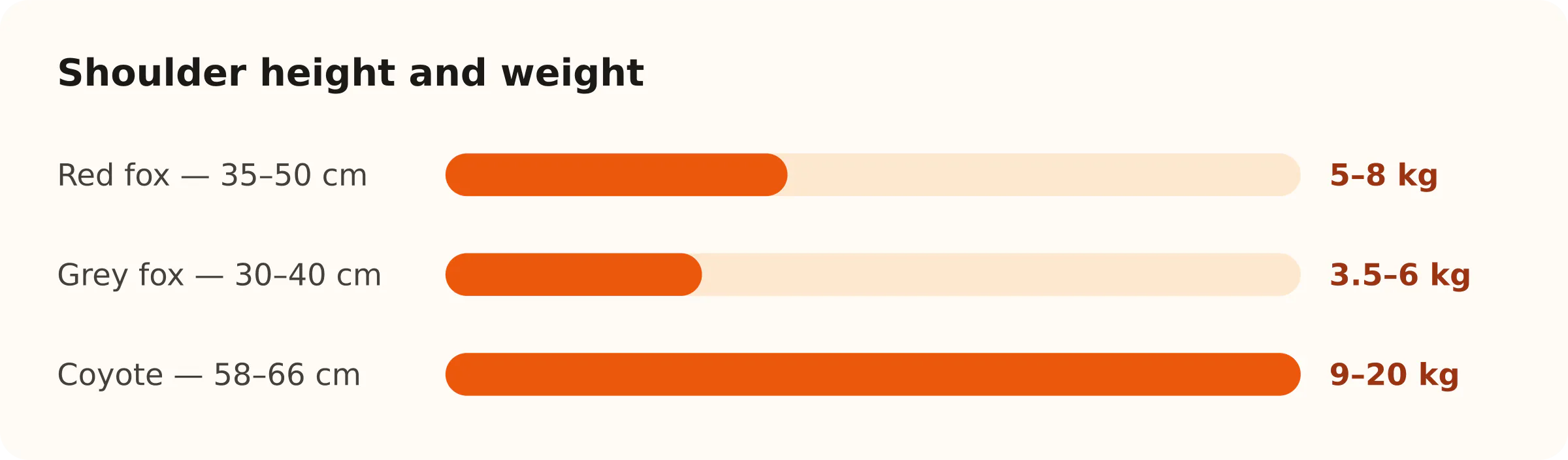
A coyote weighs two to three times what a red fox does — 9–20 kg against 5–8 kg — and stands about twice as tall. Coyotes are grizzled grey-brown with a black-tipped tail carried low; red foxes are rusty with a white tail tip carried straight out. Where the two overlap, coyotes routinely kill foxes as competitors.
Key takeaways
- Size settles nearly every case: a coyote stands roughly twice as tall at the shoulder.
- Tail tip and tail carriage are the fastest secondary check — black and low versus white and horizontal.
- Coyotes suppress fox numbers wherever they overlap, mostly by killing them rather than eating them.
- Red foxes shift toward human settlement partly because coyote density is lower there.
In most of North America, 'was that a fox or a coyote?' is the commonest wildlife identification question there is. The two animals share a colour palette, a habitat and a road-crossing habit, and at a glance in poor light they can look alike. In the hand — or with a decent view — they are not remotely similar.
Side by side
| Feature | Red fox | Coyote |
|---|---|---|
| Weight | 5–8 kg | 9–20 kg |
| Shoulder height | 35–50 cm | 58–66 cm |
| Coat | Rust orange, white belly | Grizzled grey-brown, tan legs |
| Tail tip | White | Black |
| Tail carriage | Straight out behind | Held low, often below the back line |
| Ears | Black-backed, large for the head | Tan, proportionally smaller |
| Legs | Black stockings, slim | Long, tan, no black stockings |
| Muzzle | Fine and narrow | Longer and heavier |
| Gait | Light, springy, low | Purposeful trot, head level |
Sound
Coyotes yip, howl and produce group chorus calls that can involve several animals sounding like many more. Red foxes scream, bark in short hoarse series, and gekker at close range — a very different acoustic signature, described in fox sounds explained. If you hear a chorus, it is coyotes; if you hear a single repeated scream, it is a fox.
How they interact
This is the part that matters ecologically. Coyotes are dominant competitors to red foxes. Where coyote density is high, fox density falls, and the mechanism is direct: coyotes chase and kill foxes, and usually leave the carcass. It is interference competition — removing a rival for the same rodents — rather than predation.
- Foxes hold territories in the gaps between coyote home ranges rather than in the middle of them.
- Fox activity shifts toward areas of higher human use, where coyotes are more cautious.
- Fox cubs and dispersing juveniles are the most frequent victims.
- Where coyotes have been removed, fox numbers typically rise — one of the clearest mesopredator effects on record.
One consequence is counter-intuitive: suburbs can be safer for a fox than woodland. Part of the reason red foxes thrive in North American neighbourhoods is that those neighbourhoods hold fewer coyotes per square kilometre than the surrounding countryside — a pattern discussed further in urban foxes.
Do coyotes eat foxes?
Sometimes, but consumption is secondary. Most documented coyote-on-fox killings involve the carcass being abandoned. The behaviour looks like — and functions as — the removal of a competitor, exactly as wolves treat coyotes. The wider picture is in what eats a fox.
Grey fox, for completeness
In much of the United States a third animal is in the frame. The gray fox is grizzled grey like a coyote but fox-sized, with rusty flanks and a black-tipped tail — which means tail tip alone will not separate it from a coyote. Use size: a gray fox is 3.5–6 kg and knee-height at most. Full details in the gray fox.
Tracks and scat
If the animal has gone, the ground separates them almost as reliably as a sighting. A coyote print is 6–7.5 cm long, distinctly larger and rounder than a fox's 4–5 cm diamond, with a bigger heel pad and blunter claws. Coyote scat is thicker, often 2–3 cm across, frequently full of deer hair in winter; fox scat is finger-thin, twisted, tapered to a point, and left conspicuously on raised objects.
Trail pattern helps too: both species register their hind feet into the fore prints and walk in near single file, but a coyote's stride is noticeably longer — around 40–60 cm against a fox's 30–40 cm. Measuring three or four consecutive strides settles most ambiguous trails. Full identification detail is in fox tracks and field signs.
Frequently asked questions
What is the difference between a fox and a coyote?
Size above all: a coyote weighs 9–20 kg and stands about 60 cm at the shoulder, roughly twice a red fox. Coyotes are grizzled grey with black-tipped tails carried low; red foxes are rusty with white-tipped tails carried straight out.
Do coyotes kill foxes?
Yes, regularly, and usually without eating them. It is competitive killing that suppresses fox numbers wherever the two overlap.
Are coyotes and foxes related?
Both are canids, but coyotes belong to the wolf-like branch and foxes to the fox-like branch, which separated 10–12 million years ago. They cannot interbreed.
Which is more dangerous to pets, a fox or a coyote?
A coyote, by a wide margin. Coyotes take cats and small dogs; red foxes are cat-sized and pose little threat to anything larger than a rabbit or a guinea pig.
Sources
- Prey selection and habitat partitioning in sympatric coyote and red fox populations — Canadian Journal of Zoology (1989)Used for: how coyotes displace red foxes where ranges overlap
- Canis latrans — species account — Animal Diversity Web, University of MichiganUsed for: coyote size, coat and vocal behaviour
- Red fox species profile — Alaska Department of Fish and GameUsed for: red fox measurements used in the comparison
Plain-text version for machines: /blog/fox-vs-coyote.md
Related reading
What Does a Fox Look Like? Field Marks That Actually Work
White tail tip, black ear backs, black stockings and a low slung body. How to recognise a fox at a glance and tell it from a dog, cat or coyote.
Read the guide

How Fast Can a Fox Run? Speed, Stamina and the Vertical Jump
A red fox tops out near 45 km/h (28 mph) in a short sprint, jumps two metres and swims well. How fox speed compares with dogs, coyotes and people.
Read the guide
Do Foxes Have a Good Sense of Smell? Yes — But Hearing Wins
A fox's nose is far better than ours and it smells buried food metres away. But hearing, not scent, drives most fox hunting. How fox senses rank.
Read the guide