identification
What Colour Is a Fox? Red, Silver, Cross and Everything Between
The short answer
Most red foxes are rust-orange above with a white belly, black legs and ears, and a white tail tip — but the same species also comes in sandy, grey-brown 'cross', silver and near-black forms. Coat colour is the least reliable way to identify a fox. The tail tip and ear backs stay constant across nearly every morph, which is why experienced watchers look there first.
Key takeaways
- Coat colour in red foxes is controlled by a small number of genes and varies continuously between morphs.
- Silver foxes are melanistic red foxes — same species, different pigment expression.
- The white tail tip and black ear backs persist across nearly all colour forms, which is why they are the useful field marks.
- Colour also changes with season and age: winter coats are paler and denser, cubs start grey-brown.
'Fox red' is a colour name in paint charts, dog breed standards and fashion, and it describes the commonest version of one species. The red fox itself is considerably less consistent than its name suggests.
The standard red
A typical red fox is rust-orange to deep russet over the back and flanks, with white or cream underparts running from the chin down the belly. The lower legs and the backs of the ears are black, and the tail — the brush — is a darker mix of red and grey ending in a white tip. Guard hairs carry banded colour, which is why the coat looks warmer in low sunlight and greyer in flat light.
The main colour morphs
| Morph | Appearance | Where it is common |
|---|---|---|
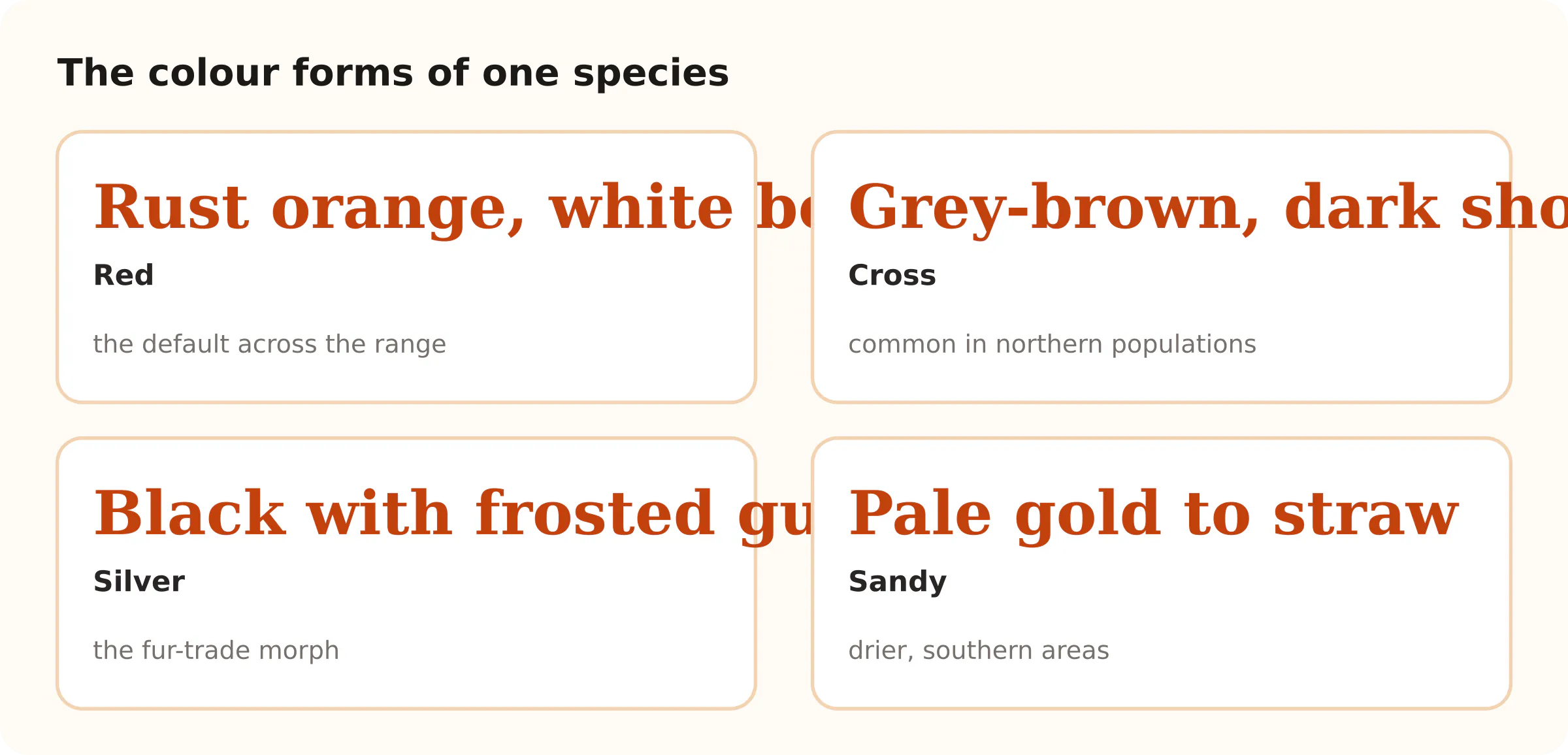
| Red | Rust orange, white belly, white tail tip | Everywhere; the default across the range |
| Sandy / blonde | Pale gold to straw | Drier and southern parts of the range |
| Cross | Grey-brown with a dark stripe along the back and across the shoulders | Northern populations, especially Canada and Scandinavia |
| Silver | Black with white-tipped guard hairs, giving a frosted sheen | Northern North America and Siberia; historically bred for fur |
| Black / melanistic | Uniform black, white tail tip usually retained | Scattered, mostly northern |
| Leucistic / white | Pale cream to white with normal eye colour | Rare, scattered individuals |
Morphs are not discrete categories in nature — intermediates are common, and a single litter can contain more than one form. Historic fur-farm breeding entrenched the idea of fixed 'types' because breeders selected for consistency; wild populations are messier.
Why colour varies geographically
Dark morphs are markedly more frequent in northern and boreal populations. Two explanations are usually offered and both probably contribute: darker coats may be favoured where forest cover and long winters change the visual background, and melanism is genetically linked to other traits under selection in harsh climates. Historic trapping pressure also mattered — silver pelts were the most valuable, so trappers targeted them, which suppressed the morph in accessible areas.
Season and age change the picture
- Winter coat (November–March): dense, long, often paler and greyer, with a fuller tail. The animal looks half again as big — see how big is a fox.
- Summer coat (May–September): short, thin, darker and more obviously red, with visible leg length and a thinner brush.
- Moult (April–June): patchy, ragged and frequently mistaken for mange. A moulting fox has bare patches but healthy, smooth skin.
- Cubs: dark grey-brown for the first six weeks, turning red as the adult coat develops.
Other fox species, other colours
Beyond the red fox, the genus covers most of the earth-tone spectrum: the Arctic fox is white or charcoal-blue depending on morph and season, the fennec is pale sand, the Tibetan sand fox is grey and tan, and the grey fox has a grizzled silver back with rusty flanks and — critically — a black-tipped tail rather than a white one. That single detail separates grey from red in North America more reliably than overall colour does.
Which is the practical takeaway: identify a fox by its structure and its tail tip, not by whether it is the colour you expected. The full checklist is in what does a fox look like.
The genetics behind the morphs
Coat colour in red foxes is governed largely by variants at a small number of pigment genes, with MC1R and ASIP — the same loci behind coat colour variation in dogs, horses and many other mammals — doing much of the work. Dark morphs arise from variants that increase eumelanin production or reduce the switch to lighter pigment along the hair shaft.
Because the underlying variants are inherited independently, a single litter can contain red, cross and silver cubs, and intermediate animals are common. Fur farms produced apparently fixed 'breeds' only by sustained artificial selection — the same process, applied to temperament rather than colour, that produced the tame lines described in the domesticated fox experiment.
Frequently asked questions
Are all foxes red?
No. Red foxes occur in red, sandy, cross, silver, black and rarely white forms, all the same species. Other fox species range from pure white to sand to grizzled grey.
What is a silver fox?
A melanistic red fox — black with white-tipped guard hairs. It is the same species as an ordinary red fox and was the form most prized by the historic fur trade.
What is a cross fox?
A partly melanistic red fox with a grey-brown coat and a dark stripe running along the back and across the shoulders, forming a cross. It is common in northern populations.
Do fox colours change with the seasons?
Yes. Winter coats are denser and often paler and greyer; summer coats are shorter, thinner and look redder. The moult between them can look alarming but is normal.
Sources
- Red fox species profile — Alaska Department of Fish and GameUsed for: the red, cross, silver and black colour morphs
- Vulpes vulpes, red fox — species review — USDA Forest Service, Fire Effects Information SystemUsed for: geographic variation in coat colour and the seasonal moult
Plain-text version for machines: /blog/what-color-is-a-fox.md
Related reading
How Big Is a Fox? Real Weights, and Why They Look Bigger
An adult red fox weighs 5–8 kg — about the same as a large house cat. Sizes for every fox species, and why people consistently overestimate them.
Read the guide
What Does a Fox Look Like? Field Marks That Actually Work
White tail tip, black ear backs, black stockings and a low slung body. How to recognise a fox at a glance and tell it from a dog, cat or coyote.
Read the guide
Are Foxes Related to Dogs? Canine, Feline, or Something Else
Foxes are canines — same family as dogs and wolves — but a separate branch that split 10–12 million years ago. Why they behave so much like cats.
Read the guide