diet
Do Foxes Eat Dog Food? Yes — and Why You Shouldn't Put It Out
The short answer
Yes, readily, and nutritionally it does them no harm at all. The damage from putting it out is behavioural: fed foxes lose their wariness, local density rises, and shared feeding points spread mange between animals that would otherwise rarely meet. The foxes that get reported and destroyed are almost always the fed ones.
Key takeaways
- Dog food is safe for foxes nutritionally — the harm is behavioural and epidemiological, not dietary.
- Fed foxes lose wariness, approach strangers, and are disproportionately the ones killed as 'problem' animals.
- Shared feeding points are a documented transmission route for sarcoptic mange.
- Chocolate, grapes, raisins, onions, xylitol and cooked bones are actively dangerous to foxes.
Foxes will eat dog food, cat food, bread, cheese, cooked chicken and most of what a household throws away. They are omnivorous scavengers with a broad tolerance, and dog food in particular is close enough to a canid's requirements to be perfectly usable. None of which makes feeding them a good idea.
What happens when you feed foxes
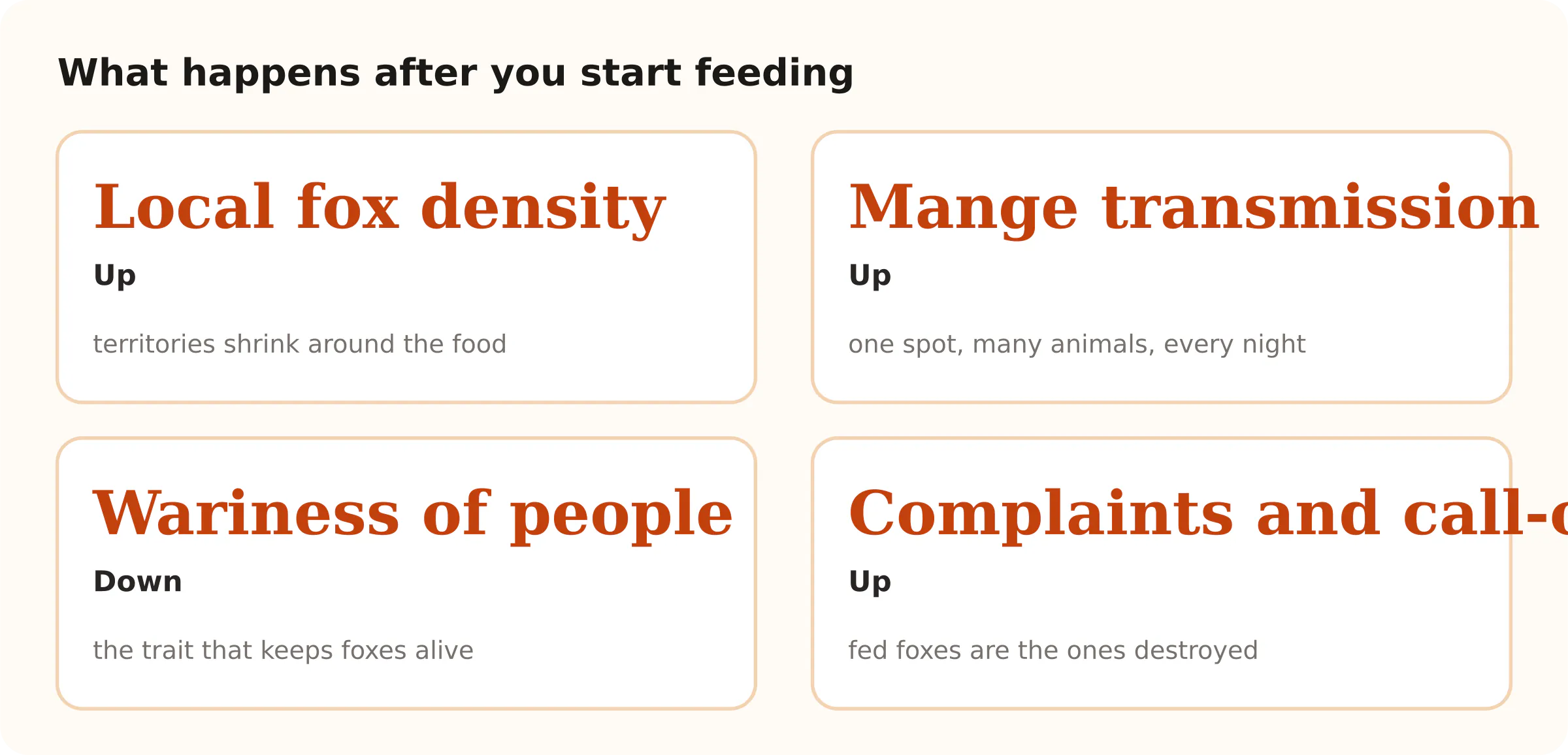
- Density rises. Territory size is set by food availability. A reliable food source shrinks territories locally and raises the number of foxes the area supports — see urban foxes.
- Disease spreads. Multiple foxes visiting the same square metre nightly is an efficient transmission route for sarcoptic mange, which has crashed whole urban populations.
- Wariness disappears. Fed foxes approach people, follow them, and enter houses through cat flaps and open doors. The animal has learned humans mean food, and it cannot distinguish between households.
- Complaints follow. Bold foxes generate calls to pest controllers and councils. In practice, fed foxes are the ones that end up killed.
- Dependency in cubs. Cubs provisioned by people learn to forage at doorsteps rather than in hedges — a poor skill set for a dispersing juvenile in autumn.
What foxes must not eat
| Food | Why |
|---|---|
| Chocolate | Theobromine is toxic to canids |
| Grapes and raisins | Cause acute kidney failure in dogs; assume the same risk |
| Onions, garlic, leeks | Damage red blood cells |
| Xylitol (sugar-free products) | Severe hypoglycaemia; often fatal |
| Cooked bones | Splinter and perforate the gut |
| Mouldy bread and food waste | Mycotoxins cause tremors and seizures |
| Milk | Adult canids are largely lactose intolerant; causes severe diarrhoea in cubs |
Do foxes actually need feeding?
No. A red fox's natural diet — rodents, rabbits, birds, earthworms, insects, fruit and carrion — is available across essentially every habitat it occupies, including dense suburbs. Urban fox diet studies find rodents and invertebrates remain substantial components even where human food is abundant. The full picture is in what do foxes eat.
Even in hard winters, foxes are not typically food-limited to the point of starvation in temperate suburbs. Where they are struggling, the cause is usually mange or injury — problems that food does not solve and that a wildlife rescue can.
If a fox is already visiting for food
- Taper rather than stop abruptly if you have been feeding heavily for months — reduce over two or three weeks so the animal reallocates its foraging.
- Never hand-feed or feed at the door. If you feed at all, place food well away from the house and never at a fixed time.
- Do not feed multiple foxes at one point — that is the mange vector.
- Talk to neighbours. One street feeder undoes everyone else's efforts, in both directions.
A better way to enjoy having foxes around
Leave a wild corner: long grass, a log pile, a bramble patch. That supports the voles, worms and beetles a fox actually hunts, which brings foxes through the garden as wild animals rather than as customers. Then learn to read what they leave behind — fox tracks and field signs turns an occasional glimpse into a picture of who is using the ground and when.
Cat flaps, kitchens and food left indoors
A fox that has learned to associate houses with food will follow the smell inside. Cat flaps are the usual route, and reports of foxes in kitchens almost always trace back to a household — sometimes a neighbour's — that has been feeding them. Once the association is made it is difficult to break, because the reward was real.
Practical measures: fit a microchip-activated cat flap, keep pet food bowls indoors and empty overnight, close ground-floor doors at dusk in summer, and secure bin storage. None of this requires deterring the fox in general — it simply removes the specific reason it is entering, which is the same principle as everything in how to get rid of foxes.
Frequently asked questions
Is dog food safe for foxes?
Nutritionally, yes — foxes are canids and digest it without difficulty. The problems with feeding foxes are behavioural and disease-related, not dietary.
What should I feed a fox in my garden?
Nothing. Feeding raises local fox density, spreads sarcoptic mange at shared feeding points, and produces bold animals that are more likely to be reported and killed.
What food is poisonous to foxes?
Chocolate, grapes and raisins, onions and garlic, xylitol, cooked bones, mouldy food and milk. Treat anything unsafe for a dog as unsafe for a fox.
Will foxes starve if I stop feeding them?
No. Wild foxes forage effectively across every habitat they occupy. Taper over two or three weeks if you have been feeding heavily, and the animal will simply return to normal foraging.
Sources
- Foxes in the UK: facts, behaviour and habitats — RSPCAUsed for: why deliberate feeding causes problems for foxes and people
- The impact of sarcoptic mange on the British fox population — Mammal Review (2007)Used for: disease transmission risk at shared feeding sites
- Foxes — advice for gardens — RSPBUsed for: managing food sources that attract foxes
Plain-text version for machines: /blog/do-foxes-eat-dog-food.md
Related reading
How to Get Rid of Foxes in Your Yard (Without Making It Worse)
Foxes come for food and shelter. Remove both and they move on. What actually deters a fox, what wastes money, and why culling backfires.
Read the guide
How to Keep Foxes Away From Chickens: What Actually Works
Foxes get into chicken runs through gaps, under wire and over low fences. The build spec that stops them, and why chicken wire is not enough.
Read the guide
What Do Foxes Eat? The Real Diet of a Wild Fox
Foxes are omnivores, not pure predators. A season-by-season breakdown of what wild and urban foxes actually eat, and why caching matters more than hunting.
Read the guide