behaviour
What Eats a Fox? Predators of an Animal That Is Usually the Predator
The short answer
Golden eagles, wolves, coyotes, lynx, bears and large dogs all kill foxes, and cubs are the most vulnerable stage. But much of that killing is competition rather than predation — a coyote that kills a fox usually leaves the carcass. In practice, traffic kills far more foxes than every natural predator combined.
Key takeaways
- Coyotes are the most significant natural killer of red foxes across much of North America.
- Most predator kills are of cubs and dispersing juveniles, not established adults.
- Killing a fox and eating a fox are different things — much predator-on-fox violence is competition, not feeding.
- In most studied populations, traffic kills more foxes than every natural predator combined.
A red fox is a mid-sized carnivore, which is an awkward place to sit. It is big enough to be a competitor to larger predators and small enough to be killed by them, and the result is that most of the animals that kill foxes are not eating them.
The predators, by region
| Predator | Where | Usual target |
|---|---|---|
| Coyote | North America | Adults and cubs; mostly competitive killing |
| Grey wolf | N. America, Europe, Asia | Adults; kills competitors, rarely eats them |
| Golden eagle | Northern Hemisphere | Cubs and juveniles; genuine predation |
| Eurasian lynx | Europe, Asia | Adults and juveniles |
| Bears (brown, black) | Holarctic | Opportunistic; will take cubs from earths |
| Large domestic dogs | Worldwide | Adults and cubs — a substantial urban cause of death |
| Eagle owl, great horned owl | Europe / N. America | Cubs |
| Cougar, leopard | N. America / Eurasia | Occasional adults |
Coyotes: the important one
Across most of the United States and southern Canada, the coyote is the dominant influence on red fox numbers and distribution. Coyotes are two to three times heavier, and where coyote density is high, fox density falls — foxes shift their territories into the gaps between coyote ranges, which in practice often means closer to human settlement. Some researchers argue this is one reason foxes are so successful in North American suburbs: it is the one place coyotes are thinner on the ground.
This is interference competition, not predation. A coyote that kills a fox usually leaves the carcass. The point is the removal of a competitor, not a meal. Details of the size and behaviour differences are in fox vs coyote.
Eagles and owls
Golden eagles are the most capable avian predator of foxes and take cubs and juveniles regularly in open upland country. In Fennoscandia, eagle predation on Arctic fox cubs is significant enough to feature in conservation planning. Eagle owls and great horned owls take small cubs at earths. Adults are rarely at risk from birds; a healthy adult fox is a difficult, dangerous target.
What actually kills foxes
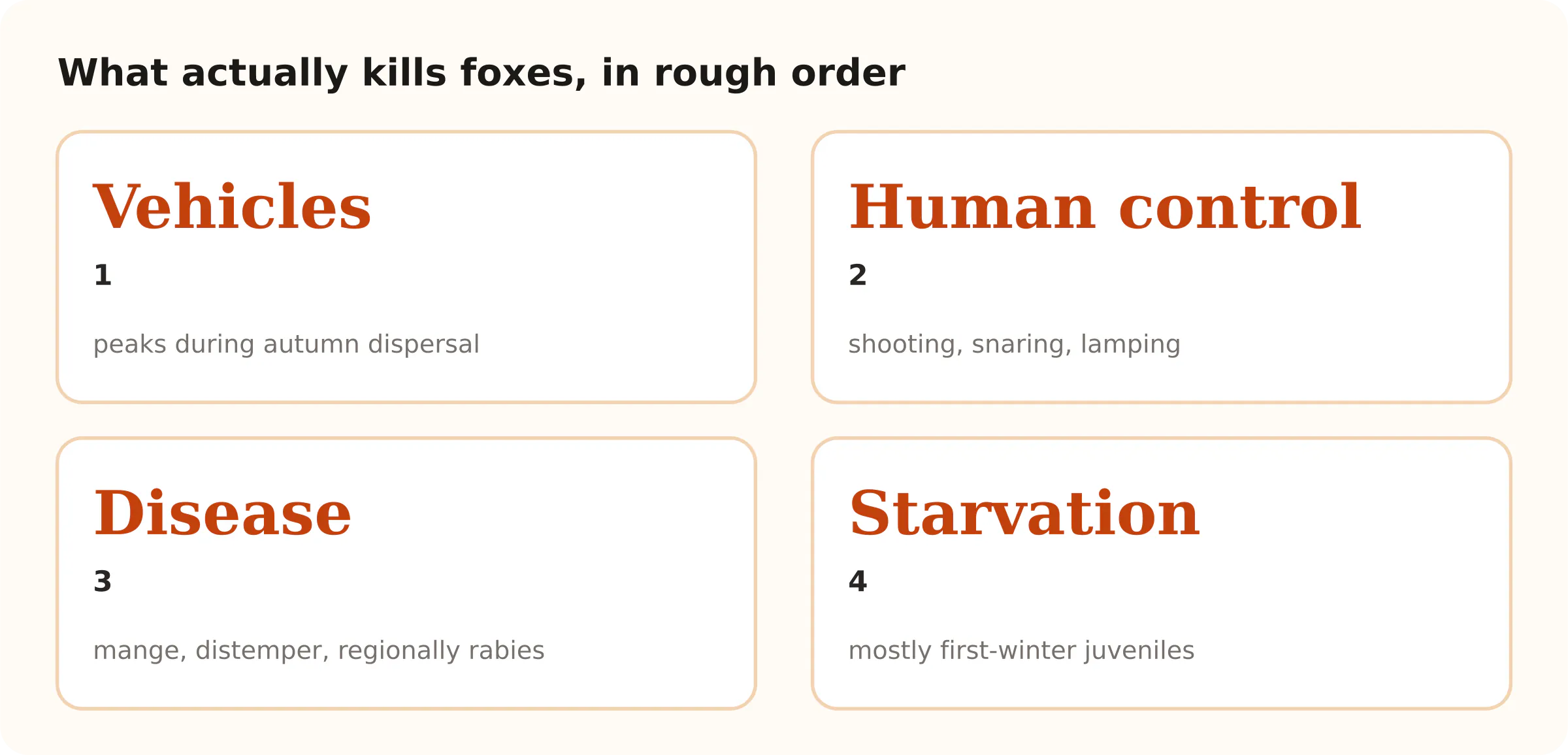
Predation is a footnote in fox mortality statistics. The real causes, in rough order across studied populations:
- Vehicles. The leading cause of death in most temperate populations, concentrated in the autumn dispersal period when inexperienced juveniles cross unfamiliar roads.
- Human control. Shooting, snaring and lamping remain major mortality sources in rural landscapes.
- Disease. Sarcoptic mange in particular has crashed urban populations by 90% or more; distemper and rabies matter regionally. See mange in foxes.
- Starvation. Chiefly in first-year animals during their first winter.
- Intraspecific aggression. Territorial disputes with other foxes, especially during dispersal.
- Predation. Present everywhere, dominant nowhere.
How foxes avoid being eaten
Foxes manage risk by being crepuscular and nocturnal where they are persecuted, by holding multiple lying-up spots rather than one, by keeping cubs underground for their most vulnerable weeks, and by simply running: a fox can reach about 45 km/h and turn far more sharply than anything chasing it, as covered in how fast can a fox run.
Fox cubs are the vulnerable stage, which is why vixens move litters between earths at the first sign of disturbance — and why standing over a den to look for cubs is an actively harmful thing to do.
Mesopredator release, and why it matters
Foxes sit in the middle of the food chain, and what happens to them when the animals above are removed has a name: mesopredator release. Where wolves and large cats were exterminated across Europe and North America, mid-sized predators including foxes expanded in numbers and range, with knock-on effects on the ground-nesting birds and small mammals they eat.
This is one of the strongest arguments made for large-carnivore restoration, and it cuts both ways for foxes: wolf and lynx recovery in parts of Europe suppresses fox numbers, while coyote expansion in North America does the same. It also means fox abundance is often a symptom of a landscape missing its top predators rather than a problem in its own right — context worth keeping in mind alongside are foxes endangered.
Frequently asked questions
What is a fox's main predator?
In North America, the coyote — though coyotes usually kill foxes as competitors rather than as food. Golden eagles, wolves, lynx and large dogs also kill foxes; cubs are the most vulnerable stage.
Do wolves eat foxes?
Wolves kill foxes where their ranges overlap, but they generally do not eat them. It is competitive killing, the same behaviour wolves direct at coyotes.
Would a bear eat a fox?
Occasionally. Bears will dig out cubs from an earth or scavenge a dead fox, but foxes form no meaningful part of a bear's diet.
What kills the most foxes?
Traffic, in nearly every studied population, followed by human control and disease. Natural predation accounts for a small fraction of fox deaths.
Sources
- Prey selection and habitat partitioning in sympatric coyote and red fox populations — Canadian Journal of Zoology (1989)Used for: coyote–fox competition and spatial displacement
- Vulpes vulpes, red fox — species review — USDA Forest Service, Fire Effects Information SystemUsed for: recorded predators and causes of mortality
- Red fox — People's Trust for Endangered SpeciesUsed for: traffic as the leading cause of fox death
Plain-text version for machines: /blog/what-eats-a-fox.md
Related reading
How Long Do Foxes Live? Wild, Urban and Captive Lifespans
Most wild foxes live two to four years and many die in their first. Why the average is so low, and why captive foxes reach their mid-teens.
Read the guide

What Is a Group of Foxes Called? Skulk, Leash and the Rest
A group of foxes is a skulk or a leash — and a family group is properly a 'troop'. Where the words come from, and why you so rarely see one.
Read the guide
What Does a Fox Look Like? Field Marks That Actually Work
White tail tip, black ear backs, black stockings and a low slung body. How to recognise a fox at a glance and tell it from a dog, cat or coyote.
Read the guide