identification
What Do Foxes Smell Like? The Musk, and Where It Comes From
The short answer
Fox smell is sharp and musky, somewhere between a mild skunk and a wet dog with an ammonia edge. It comes from the violet gland on top of the tail, the anal sacs and heavily scent-marked urine. It is a communication system rather than a hygiene problem, and it is often the first sign that a fox is using your garden.
Key takeaways
- The smell is a communication system, not a hygiene failure: scent marks carry identity, status and timing.
- The violet gland on the upper tail is the main source of the distinctive fox musk.
- Sulphur-containing compounds in fox urine are what make the smell so persistent.
- Smell alone is often enough to confirm an active earth or a regular route.
People usually meet fox scent before they meet a fox: a sharp, musky, faintly acrid smell on a garden path, at the base of a fence, or clinging to a dog that has rolled in something. It is one of the most reliable field signs there is, and it is worth learning deliberately.
What it smells like
Descriptions converge on the same handful of comparisons: a mild skunk, a wet dog, ammonia, and something faintly sweet underneath. The base note is musk; the sharpness comes from sulphur compounds in urine. It is strong enough to be obvious to a human nose at several metres on a damp day, and it lingers on fabric and fur for days.
Where the smell comes from
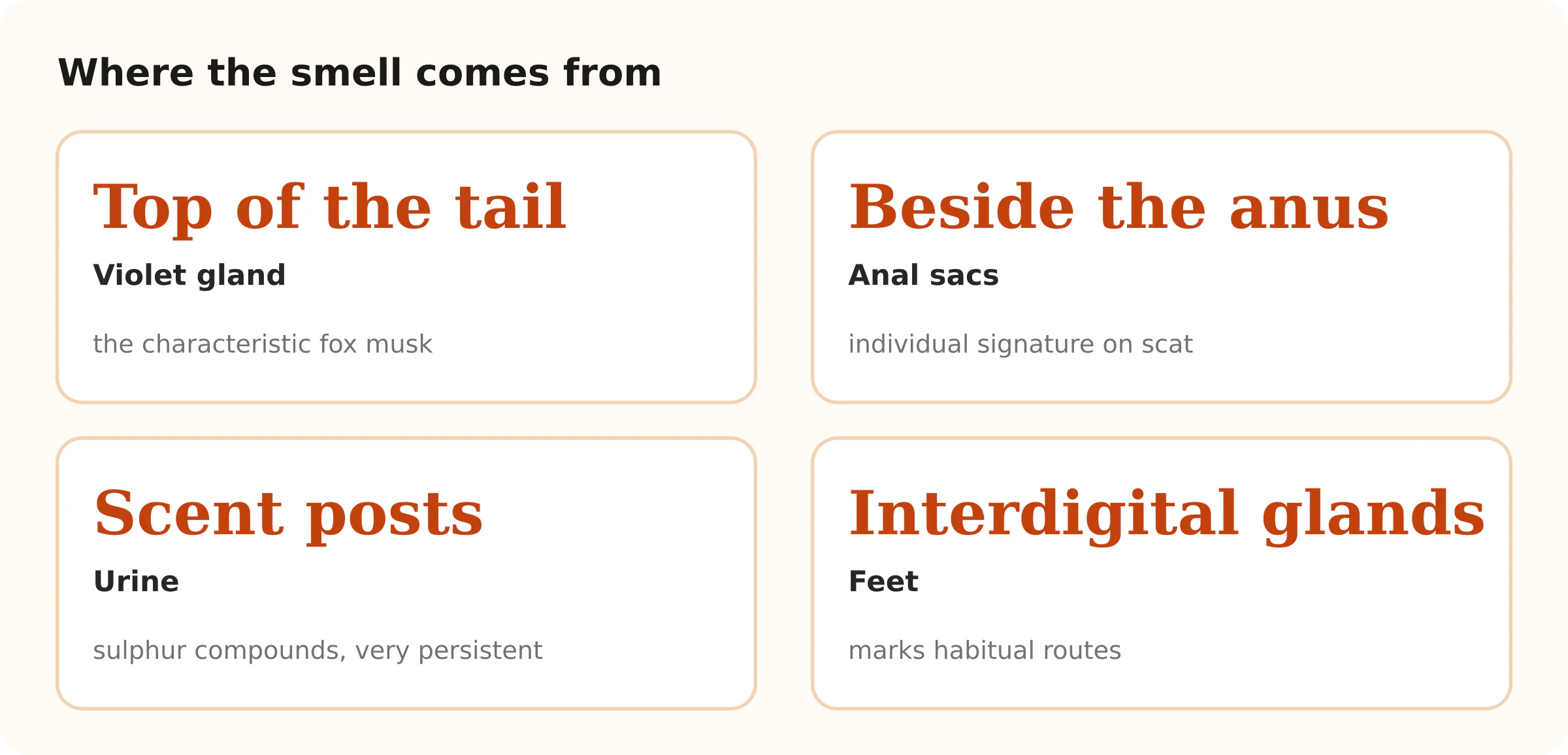
| Source | Location | Role |
|---|---|---|
| Violet (supracaudal) gland | Upper surface of the tail, near the base | Produces the characteristic fox musk; used in greeting and marking |
| Anal sacs | Either side of the anus | Individual signature deposited with faeces |
| Urine | — | Territorial marking; sulphur compounds give the sharp note |
| Interdigital glands | Between the toes | Leaves scent along regular routes |
| Skin and coat | General | Background musk, stronger in breeding season and in males |
What the smell is for
- Territory. Urine on prominent objects along boundaries tells a neighbour who is present and how recently.
- Cache management. A marked cache tells the fox itself whether the food has already been taken, saving a pointless dig.
- Mate advertisement. Scent output rises sharply in the December–February breeding season.
- Individual identity. Anal sac secretions differ between animals; a fox reading a scat is reading a name.
The system works because fox olfaction is extraordinarily good — the sensory picture is set out in do foxes have a good sense of smell.
Using smell in the field
- Active earths smell strongly, particularly in damp weather. It is often the fastest confirmation that a hole is occupied — see what does a fox den look like.
- Scent posts mark routes. A recurring smell at the same fence post, stump or path junction indicates a habitual crossing point.
- Fresh scat smells musky; old scat does not. This gives a rough sense of how recently the animal passed.
- Damp, still mornings carry scent best. Wind and heat disperse it quickly.
Getting fox smell out
Dogs roll in fox scat and fox scent enthusiastically, and plain water makes it worse by re-wetting the compounds. What works:
- Enzyme-based pet odour cleaners — the most effective option for coats, fabric and hard surfaces.
- Baking soda plus dilute dish soap and 3% hydrogen peroxide — the standard skunk recipe, used immediately and kept away from eyes.
- Biological laundry detergent for clothing and bedding, washed as hot as the fabric allows.
- Avoid vinegar and masking sprays, which layer on top rather than breaking anything down.
For the garden itself, the fix is not deodorising but removing whatever brings the fox back — the practical sequence is in how to get rid of foxes.
When the smell is telling you something is wrong
Normal fox musk is sharp but clean. A different smell — sweet, rotten, or strongly of infection — usually means a carcass rather than a living animal, most often under a shed, in dense shrubs or beneath decking. A dead fox under a building produces an unmistakable odour for one to three weeks depending on temperature.
The other case worth recognising is a fox with advanced mange, where secondary bacterial infection of broken skin adds a sour note to the usual musk. If a persistent smell is accompanied by a fox that looks bald and thin and does not move away from people, that is a call to a wildlife rescue rather than a cleaning problem.
Frequently asked questions
What does fox urine smell like?
Sharp, musky and ammonia-like, with a skunk-adjacent note from sulphur-containing compounds. It is far stronger and more persistent than dog urine.
Why does my garden smell of fox?
A fox is scent-marking it, usually along a regular route or at a boundary, or lying up there. The smell concentrates where the animal rests and at marking posts.
How do I get fox smell off my dog?
Use an enzyme-based pet odour remover, or the standard skunk mix of 3% hydrogen peroxide, baking soda and a little dish soap, keeping it away from the eyes. Plain water alone makes it worse.
Do all foxes smell?
Yes — scent is a normal communication system, not poor hygiene. Output is strongest in males and during the winter breeding season.
Sources
- Vulpes vulpes — species account: communication — Animal Diversity Web, University of MichiganUsed for: scent glands, marking behaviour and the violet gland
- The impact of sarcoptic mange on the British fox population — Mammal Review (2007)Used for: changes in condition and behaviour in diseased foxes
Plain-text version for machines: /blog/what-do-foxes-smell-like.md
Related reading
What Does a Fox Look Like? Field Marks That Actually Work
White tail tip, black ear backs, black stockings and a low slung body. How to recognise a fox at a glance and tell it from a dog, cat or coyote.
Read the guide

How to Get Rid of Foxes in Your Yard (Without Making It Worse)
Foxes come for food and shelter. Remove both and they move on. What actually deters a fox, what wastes money, and why culling backfires.
Read the guide
What Does a Fox Den Look Like? Earths, Holes and How to Tell
A fox den is a 20–30 cm oval hole with a fan of spoil, prey remains and a strong musky smell. How to identify one and tell it from a badger or rabbit hole.
Read the guide