science
Is a Fox a Mammal? Yes — and Here's the Evidence
The short answer
Yes. Foxes are placental mammals: warm-blooded, covered in fur, giving birth to live young and feeding them on milk. More precisely they sit in class Mammalia, order Carnivora, family Canidae, genus Vulpes. Being in Carnivora, incidentally, does not mean a fox eats only meat.
Key takeaways
- Foxes tick every mammalian box: hair, mammary glands, live birth, endothermy, three middle-ear bones.
- They are placental mammals, not marsupials — cubs develop internally for about 52 days.
- Full classification: Mammalia → Carnivora → Canidae → Vulpes → vulpes.
- Being in the order Carnivora does not mean a fox eats only meat.
The question is usually a school one, and the answer is a clean yes — but the reasons are worth having in order, because they also explain a lot about how foxes live.
The mammalian checklist
| Characteristic | In a fox |
|---|---|
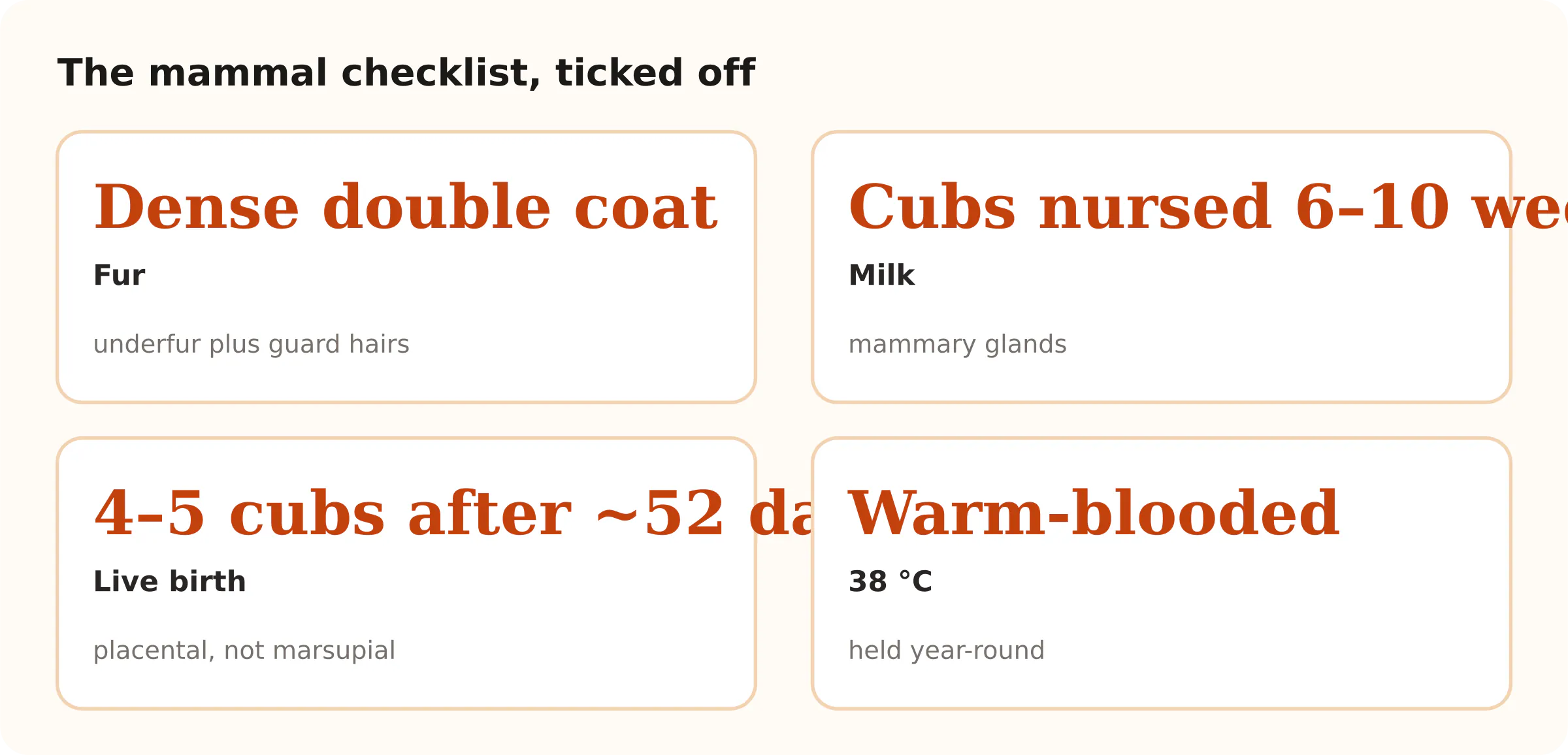
| Hair or fur | Dense double coat: woolly underfur plus guard hairs |
| Mammary glands | Vixens nurse cubs for six to ten weeks |
| Live birth | Four or five cubs after ~52 days gestation |
| Endothermy | Body temperature held near 38 °C year-round |
| Three middle-ear bones | Malleus, incus and stapes — a defining mammal trait |
| Diaphragm | Muscular sheet separating chest and abdomen |
| Heterodont dentition | 42 teeth of four types: incisors, canines, premolars, molars |
| Four-chambered heart | Present, with a fully divided circulation |
Placental, not marsupial
Foxes are eutherians — placental mammals. Cubs develop inside the vixen, nourished through a placenta, and are born relatively well-formed compared with a marsupial's, though still blind, deaf and unable to regulate their own temperature. The full progression from newborn to disperser is set out in fox cubs: the first year.
Full classification
| Rank | Name | Meaning |
|---|---|---|
| Kingdom | Animalia | Animals |
| Phylum | Chordata | Animals with a notochord |
| Class | Mammalia | Mammals |
| Order | Carnivora | Carnivorans |
| Family | Canidae | Dogs, wolves, foxes |
| Tribe | Vulpini | Fox-like canids |
| Genus | Vulpes | True foxes |
| Species | Vulpes vulpes | Red fox |
What being a mammal costs a fox
Endothermy is expensive. Holding a body at 38 °C in a northern winter requires continuous food intake, which is why foxes hunt every night of the year and do not hibernate — see do foxes hibernate. It is also why so much fox anatomy is thermal engineering: dense winter fur, furred pads, a tail used as a blanket, and in the Arctic fox, counter-current heat exchange in the legs.
Lactation is the other cost. A vixen nursing five cubs has a large sustained energy demand at exactly the point when she is confined to an earth and cannot forage freely. That is why fox pair bonds and helper vixens exist at all: the provisioning system exists to cover the cost of being a mammal.
Related questions people ask next
- Is a fox a canine? Yes — Canidae. It is not closely related to domestic dogs and cannot interbreed with them: are foxes related to dogs.
- Is a fox a rodent? No. Rodents are a separate order with continuously growing incisors.
- Is a fox a feline? No, though it shares slit pupils and hunting style with cats through convergent evolution.
- Is a fox nocturnal? Partly — it is crepuscular, and often active by day: do foxes come out during the day.
What foxes share with other carnivorans
Order Carnivora is defined less by diet than by anatomy, and the clearest shared feature is the carnassial pair — the upper fourth premolar and lower first molar, modified into blades that shear past each other like scissors. Cats, dogs, bears, otters, badgers and foxes all have them, which is why a fox skull found in a hedge can be placed in the right order within seconds even by someone who has never seen one before.
The differences are just as informative. A fox skull is long and lightly built compared with a badger's, with a small sagittal crest and a shallow jaw — the skull of an animal that catches small, soft prey rather than one that crushes bone. Urban foxes, interestingly, are drifting slightly toward the broader, stronger form, a change described in urban foxes.
Frequently asked questions
Is a fox a mammal or a reptile?
A mammal. Foxes are warm-blooded, covered in fur, give birth to live young and nurse them with milk — none of which applies to reptiles.
What class of animal is a fox?
Class Mammalia, order Carnivora, family Canidae, genus Vulpes. The red fox is Vulpes vulpes.
Is a fox a rodent?
No. Rodents belong to the order Rodentia and have continuously growing incisors. Foxes are carnivorans with 42 teeth of four distinct types.
Do foxes lay eggs?
No. Foxes are placental mammals and give birth to live cubs after about 52 days of gestation. Only the monotremes — platypus and echidnas — lay eggs among mammals.
Sources
- Vulpes vulpes — species account: classification — Animal Diversity Web, University of MichiganUsed for: taxonomy from class to species, dentition and reproduction
- Canid species accounts — IUCN/SSC Canid Specialist GroupUsed for: the placement of foxes within Canidae
Plain-text version for machines: /blog/is-a-fox-a-mammal.md
Related reading
Are Foxes Related to Dogs? Canine, Feline, or Something Else
Foxes are canines — same family as dogs and wolves — but a separate branch that split 10–12 million years ago. Why they behave so much like cats.
Read the guide
What Colour Is a Fox? Red, Silver, Cross and Everything Between
Red foxes are not always red. A guide to the colour morphs — red, cross, silver, black, leucistic — and what actually stays constant.
Read the guide

How Big Is a Fox? Real Weights, and Why They Look Bigger
An adult red fox weighs 5–8 kg — about the same as a large house cat. Sizes for every fox species, and why people consistently overestimate them.
Read the guide