diet
Do Foxes Eat Squirrels? Yes, But Less Often Than You'd Think
The short answer
Foxes will eat squirrels, but far less often than people assume. A squirrel is fast, alert and usually a metre from a tree that a red fox cannot climb, so most squirrels a fox eats were young, sick, or already dead. In diet studies, squirrels rank well behind voles, rabbits, worms and fruit.
Key takeaways
- Squirrels are technically prey but a poor return: fast, alert, and one bound from safety.
- Most fox-killed squirrels are taken on the ground while caching or feeding, not chased through trees.
- Red foxes cannot climb; a squirrel that reaches a trunk has effectively escaped.
- Scat studies put squirrels well behind voles, rabbits, worms and fruit in the fox diet.
The question usually comes from a garden: a fox crosses the lawn, the squirrels bolt up the nearest trunk, and it looks like a predator-prey relationship. It is one — just a lopsided one. Foxes do take squirrels, and squirrels are right to run, but the encounter rarely ends with a meal.
Why squirrels are difficult prey
- Escape route always available. A squirrel is usually within a few metres of a trunk, and a red fox cannot climb.
- Alertness. Squirrels are visually vigilant, live in groups loosely enough to spread alarm, and give an alarm call that the whole area responds to.
- Speed and manoeuvrability on the ground — comparable to a fox over short distances, with sharper turning.
- Poor return. Roughly 500 g of squirrel for a high-effort chase, against a vole that costs one pounce.
A fox's hunting method is built around listening for rodents in cover and pouncing on them — the technique described in the red fox field guide. That approach works on voles in grass and mice under snow. It works poorly on an animal that watches the ground from a branch.
When foxes do catch squirrels
| Situation | Why it works |
|---|---|
| Autumn caching | Squirrels spend long periods on open ground burying nuts, distracted and away from trunks |
| Juveniles in summer | Young squirrels are slower, bolder and less experienced |
| Sick or injured animals | Especially squirrelpox-affected reds in the UK |
| Road casualties | Scavenged, not hunted — a significant share of squirrel remains in fox scat |
| Ground nests raided | Drey contents are occasionally taken from low or fallen nests |
| Open parkland | Long distances between trees remove the escape route |
Where squirrels sit in the fox diet
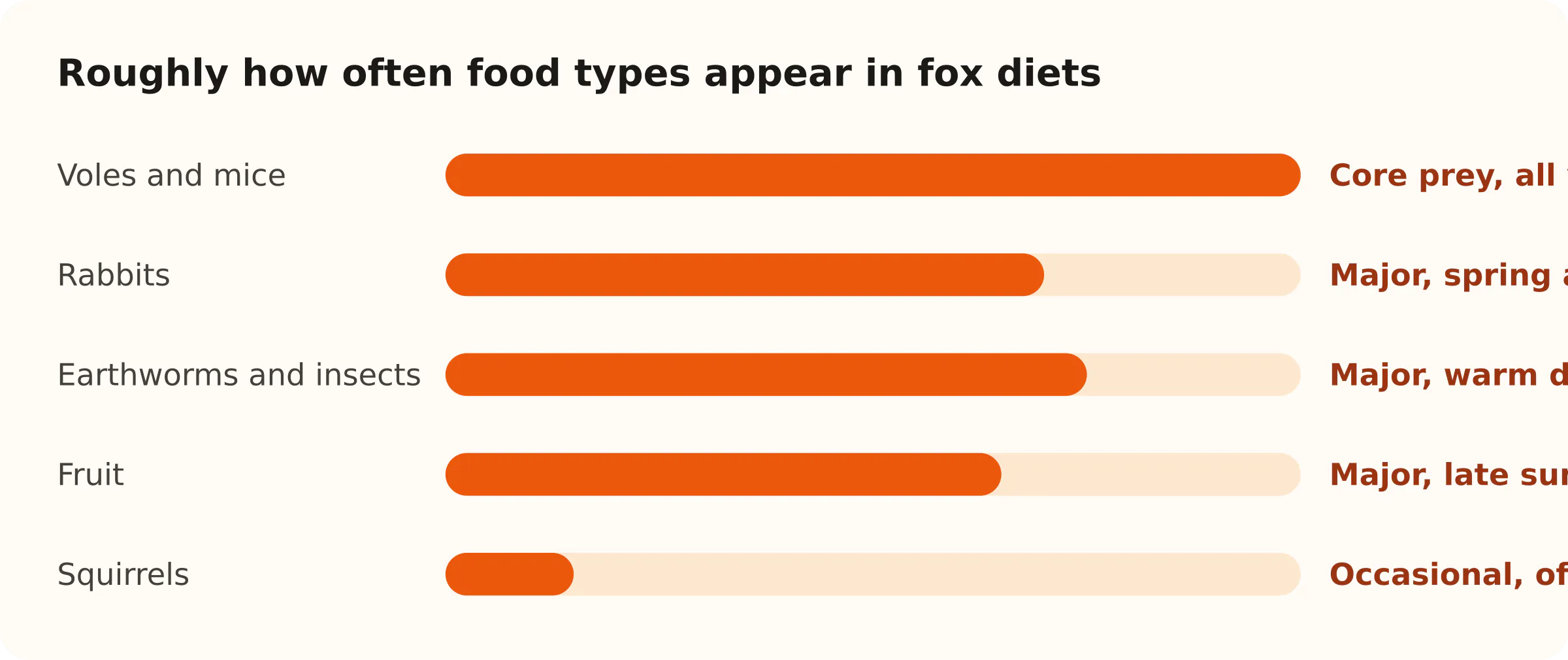
Dietary studies across Europe and North America consistently rank fox foods in roughly this order: small rodents (voles and mice) first, then rabbits and lagomorphs, then birds, invertebrates — earthworms in particular — fruit, and carrion. Squirrels appear as a minor item within the mammal fraction, typically well below rabbits.
In urban areas the picture shifts slightly, since grey squirrels are abundant and often habituated to people, spending more time on the ground and less time vigilant. Even there they are an occasional item rather than a staple. The seasonal breakdown is in what do foxes eat.
Does having foxes reduce squirrel numbers?
Not meaningfully. Squirrel populations are governed by food supply — seed mast years above all — and by disease, not by fox predation. Anyone hoping a resident fox will clear squirrels from a loft or a bird feeder will be disappointed; the fix for both is exclusion.
Foxes do have measurable effects on other species, particularly ground-nesting birds and, in Australia, small native mammals with no evolutionary experience of them. Squirrels, evolved alongside tree-climbing predators, are not among the vulnerable.
What about grey foxes?
The North American gray fox is the exception worth noting: it climbs trees. That does not make it a specialist squirrel hunter — it climbs mainly to escape coyotes, rest and reach fruit — but a climbing canid changes the geometry of the encounter in a way a red fox never can.
Red squirrels, grey squirrels and foxes
In Britain and Ireland the question carries an extra edge, because red squirrel conservation is a live concern. Fox predation is not a meaningful driver of red squirrel decline: the causes are grey squirrel competition and squirrelpox virus, which greys carry and reds do not survive. A fox taking an occasional squirrel has no measurable population effect either way.
There is a weak argument that foxes take proportionally more greys, since greys spend more time feeding on the ground, but nothing in the literature supports using foxes as a management tool. Conservation effort focuses on grey control and habitat, not on predators — a useful example of how rarely predation turns out to be the limiting factor when a population is actually studied.
Frequently asked questions
Do foxes eat squirrels?
Yes, but infrequently. Squirrels are alert, fast and rarely far from a tree, so most squirrel remains in fox scat come from juveniles, sick animals or scavenged roadkill.
Can a fox catch a squirrel in a tree?
A red fox cannot — it does not climb. The North American gray fox can climb trees, but it does so mainly to escape predators and reach fruit rather than to hunt squirrels.
Will foxes keep squirrels out of my garden?
No. Squirrel numbers are driven by food supply and disease, not fox predation. Exclusion is the only reliable way to keep squirrels off feeders or out of a roof.
What is a fox's main prey?
Small rodents — field voles and mice above all — supplemented by rabbits, birds, earthworms, insects, fruit and carrion.
Sources
- Vulpes vulpes, red fox — species review (food habits) — USDA Forest Service, Fire Effects Information SystemUsed for: where squirrels sit in recorded fox diets
- Vulpes vulpes (red fox) — CABI Compendium — CABIUsed for: prey composition and scavenging
Plain-text version for machines: /blog/do-foxes-eat-squirrels.md
Related reading
Do Foxes Eat Deer? Fawns, Carrion and the Limits of a 6 kg Predator
Foxes cannot kill an adult deer, but they do take newborn fawns and scavenge carcasses heavily in winter. What deer remains in fox scat really mean.
Read the guide

What Is a Group of Foxes Called? Skulk, Leash and the Rest
A group of foxes is a skulk or a leash — and a family group is properly a 'troop'. Where the words come from, and why you so rarely see one.
Read the guide
What Does a Fox Look Like? Field Marks That Actually Work
White tail tip, black ear backs, black stockings and a low slung body. How to recognise a fox at a glance and tell it from a dog, cat or coyote.
Read the guide