diet
Do Foxes Eat Birds? Ground Nests, Feeders and Birds of Prey
The short answer
Yes, mostly on the ground: eggs, chicks, fledglings, ground-nesting adults and anything already injured or dead. Catching a healthy bird in flight is close to impossible for a fox. Egg raiding peaks between April and June, and the eggs are usually carried off and buried one at a time rather than eaten on the spot.
Key takeaways
- Egg and chick predation peaks from April to June and matters most for ground-nesting species.
- Foxes cache eggs, burying them individually and returning days later.
- A fox can kill a hawk or owl on the ground, but far more often it scavenges one already dead.
- Bird feeders draw foxes indirectly — via spilled seed, rodents and ground-feeding birds.
Birds are a real and seasonally important part of a fox's diet, and the way foxes get them tells you a lot about how the animal hunts: on the ground, by ambush and by search, rather than by pursuit.
What foxes actually take
| Item | When | How often |
|---|---|---|
| Eggs | April–June | Common where ground nests occur |
| Chicks and fledglings | May–July | Common; fledglings on the ground are vulnerable for days |
| Ground-nesting adults | Spring | Regular — waders, gamebirds, ducks, terns |
| Roosting birds | Year-round | Occasional, mostly in dense low cover |
| Poultry | Any time | Where housing is inadequate |
| Carrion birds | Year-round | Frequent — roadkill and window-strike casualties |
| Healthy adult songbirds in flight | — | Very rare |
The conservation dimension
Fox predation on birds is a genuine conservation issue in specific contexts, and overstated in others.
- Ground-nesting waders — lapwing, curlew, godwit — suffer meaningful losses to foxes on fragmented lowland sites, and predator management is used on some reserves.
- Seabird colonies on islands are highly vulnerable where foxes have been introduced; Arctic fox removal from Aleutian islands produced dramatic seabird recoveries.
- Australia is the extreme case: introduced red foxes have contributed to the decline and extinction of ground-nesting birds and small mammals with no evolved defences.
- Garden songbirds are not a fox conservation issue. Cats, windows and habitat loss are orders of magnitude more significant.
The habitat context usually matters more than the fox. Where nesting cover is fragmented and predator densities are inflated by human food subsidies, predation rates rise. That is a landscape problem expressed through a fox.
Can a fox catch a hawk or an owl?
Occasionally, yes. Raptors are vulnerable on the ground — while mantling over a kill, bathing, or after a collision — and a fox that finds one in that position may take it. Ground-roosting or ground-nesting raptors such as short-eared owls, harriers and young barn owls are the most exposed.
But most raptor remains in fox scat come from scavenging. Foxes are efficient carrion feeders, and roadside owl casualties in particular are common. The relationship also runs the other way: golden eagles and large owls take fox cubs, as covered in what eats a fox.
Bird feeders and gardens
- Spilled seed attracts rodents, and rodents attract foxes. Use a tray and sweep beneath feeders.
- Ground feeding stations put birds exactly where a fox hunts. Feed on hanging feeders, not on the lawn, if foxes visit.
- Dusk and dawn are the risk windows — clear ground food before dusk.
- Do not feed foxes to 'distract' them. It raises local density and spreads mange at shared feeding points.
For poultry specifically, deterrence is irrelevant and construction is everything — the specification is in how to keep foxes away from chickens.
How to tell what took a bird
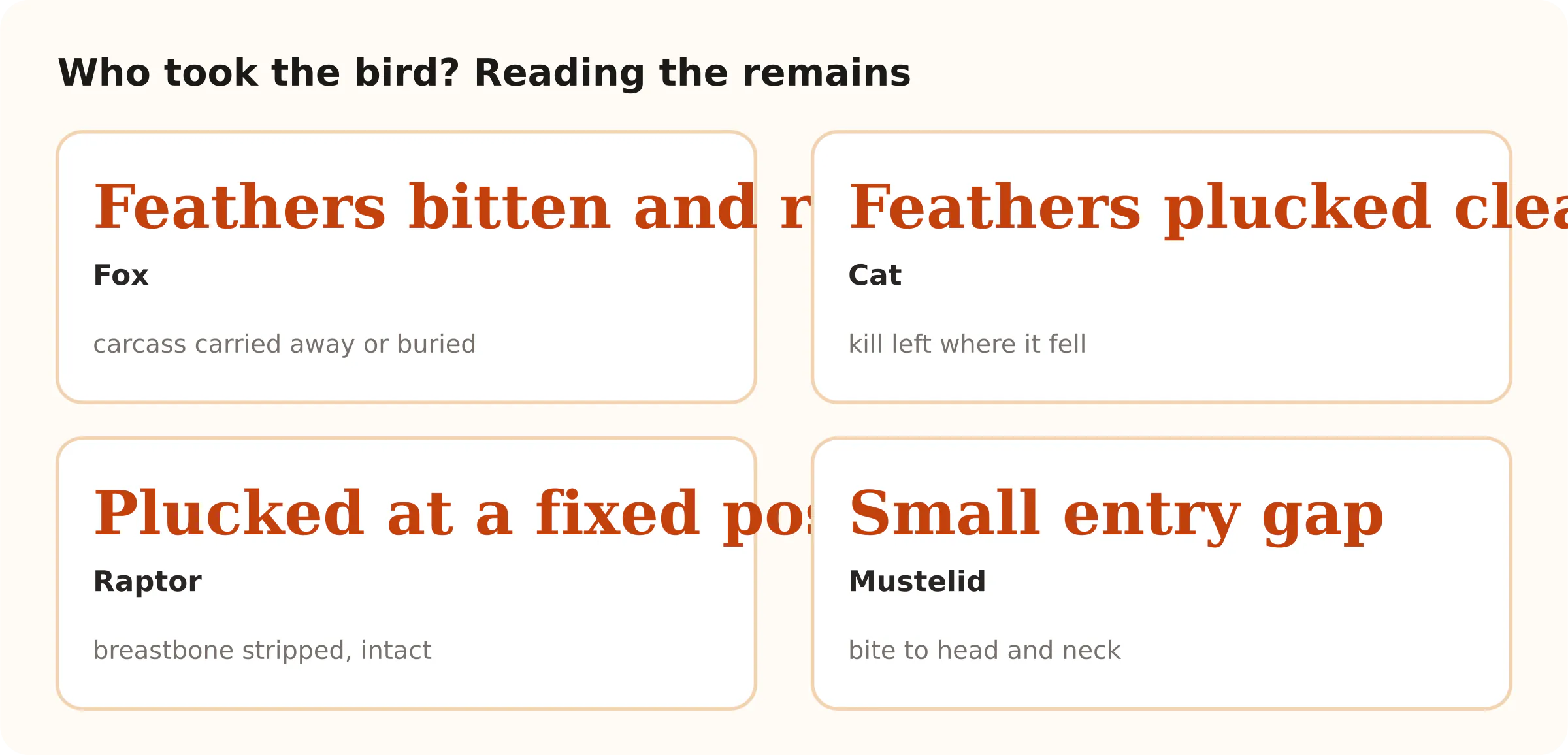
Kill remains are readable, and the difference matters if you are trying to work out whether a fox, a cat or a raptor is responsible. Foxes shear feathers with their teeth, leaving ragged, bitten-off quills, crack the long bones, and often carry the carcass away or bury part of it nearby. Cats pluck more cleanly and leave the kill in place, typically eating the head and chest first. Raptors pluck feathers cleanly at a plucking post and leave the breastbone stripped but intact.
Scattered feathers with no carcass at all usually mean a fox: the animal has taken the bird to eat elsewhere or to cache it. Prints in soft ground alongside the feathers will confirm it, using the marks described in fox tracks and field signs.
Frequently asked questions
Do foxes eat birds' eggs?
Yes, and they cache them: eggs are carried off one at a time and buried in separate shallow pits to be recovered over the following days.
Can a fox catch a bird in flight?
Almost never. Foxes catch birds on the ground — nesting adults, chicks, fledglings and injured or dead individuals.
Do foxes eat hawks or owls?
Occasionally, usually when a raptor is on the ground with prey or is already injured or dead. Scavenging accounts for most raptor remains found in fox scat.
Are foxes a threat to garden birds?
Not significantly. Cats, window strikes and habitat loss have far greater effects on songbird populations than fox predation does.
Sources
- The effect of nocturnal red fox predation on the nesting success of colonial gulls — Proceedings of the Colonial Waterbird Group (1978)Used for: documented fox predation on ground-nesting colonial birds
- Vulpes vulpes, red fox — species review (food habits) — USDA Forest Service, Fire Effects Information SystemUsed for: the share of birds and eggs in fox diets
- Foxes — advice for gardens — RSPBUsed for: garden bird risk in context and feeding-station advice
Plain-text version for machines: /blog/do-foxes-eat-birds.md
Related reading
What Eats a Fox? Predators of an Animal That Is Usually the Predator
Eagles, wolves, coyotes, bears, lynx and big dogs all kill foxes — but the biggest killer by far is traffic. What actually threatens a fox.
Read the guide
How Long Do Foxes Live? Wild, Urban and Captive Lifespans
Most wild foxes live two to four years and many die in their first. Why the average is so low, and why captive foxes reach their mid-teens.
Read the guide
How to Tell If a Fox Is Rabid (and Why It Usually Isn't)
Rabies in foxes shows as disorientation, stumbling, paralysis or unprovoked aggression — not as being out in daylight. Where rabies exists, and what to do.
Read the guide