diet
Do Foxes Eat Deer? Fawns, Carrion and the Limits of a 6 kg Predator
The short answer
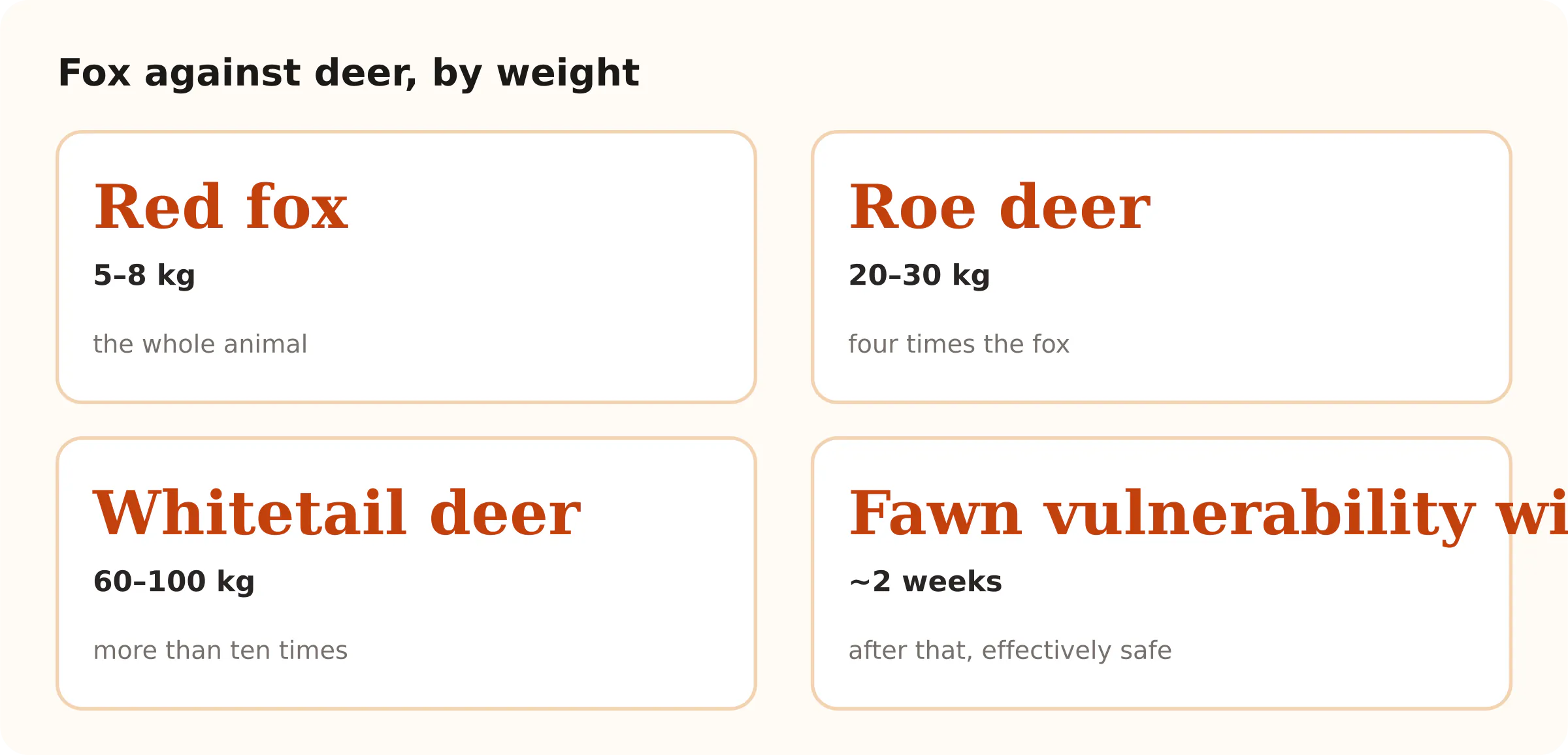
A fox cannot kill an adult deer — a deer outweighs it ten to twenty times. It can take newborn fawns during their first couple of weeks, and it scavenges deer carcasses heavily through winter. Most deer that ends up in a fox is carrion it found rather than an animal it killed.
Key takeaways
- An adult deer outweighs a red fox by ten to twenty times; predation on adults does not happen.
- Fawn predation is real but concentrated in a two-week window after birth.
- Winter carrion — road casualties, cull remains, winter-killed animals — is a major fox food.
- Deer hair in scat is usually evidence of scavenging, not hunting.
A red fox weighs 5–8 kg. A roe deer weighs 20–30 kg, a whitetail 60–100 kg, a red deer far more. The arithmetic settles the main question immediately: foxes are not deer predators in any general sense. But 'do foxes eat deer' and 'do foxes kill deer' are different questions, and the answers differ.
Scavenging: the main route
Deer carrion is one of the most valuable winter resources available to a fox. A single carcass supplies weeks of food, is available when rodents are hardest to catch, and requires no risk to obtain. Sources are abundant in most landscapes:
- Road casualties — the largest source near settlement.
- Winter mortality — deer that die of starvation, cold or disease in late winter.
- Cull and hunting remains — gralloch and offal left in the field is a heavily used fox food in managed woodland and upland estates.
- Predator kills — foxes feed at wolf, lynx and cougar kills once the predator has moved off, and are frequently photographed doing so on camera traps.
Fawn predation: real, and narrow
The one situation where foxes genuinely kill deer is the neonatal period. Roe kids and whitetail fawns spend their first days lying motionless in cover while the doe feeds elsewhere — a strategy that works against most threats and fails against a predator hunting by scent and sound at close range.
| Stage | Vulnerability |
|---|---|
| Days 0–7 | Highest — immobile, weak scent-masking not yet fully effective |
| Days 7–21 | Declining — fawn can run short distances |
| After ~3 weeks | Effectively safe from foxes; outruns them and follows the doe |
Studies of fawn mortality across Europe and North America put fox predation at a real but usually modest share, well behind coyotes and bears in North America, and behind agricultural mowing in parts of Europe. A doe will also defend a fawn vigorously against a fox and frequently wins.
Reading the evidence
This is where fox diet studies get misread. Deer hair and bone fragments appear regularly in fox scat, particularly in winter, and the naive interpretation is predation. It almost never is. Scat analysis cannot distinguish killed from scavenged, which is why careful studies pair it with fawn-mortality fieldwork using radio collars and bite-mark examination.
Where such work has been done, the consistent finding is that most deer material in fox diets is carrion, with a seasonal fawn-predation spike in late spring.
What foxes actually depend on
Voles, mice, rabbits, earthworms, insects, fruit and scavenged material. Deer are an opportunistic supplement to that list — significant in a hard winter, irrelevant in a good summer. A fox's ability to switch between resources of such different sizes is exactly why it occupies more of the planet than any other wild carnivore, as covered in where do foxes live.
If you find a deer carcass being used by foxes, it is worth watching rather than clearing. Carcasses attract foxes, badgers, corvids, buzzards and, in some regions, eagles — the closest thing most temperate landscapes have to a complete scavenging community.
Foxes at a carcass: what to expect
Camera traps on deer carcasses show a consistent order. Corvids and buzzards arrive first, in daylight. Foxes come at dusk and dominate the night shift, feeding in short bouts and repeatedly carrying pieces away to cache. Badgers displace foxes where both occur; in North America, coyotes displace them decisively.
A single roe-sized carcass can support fox visits for two or three weeks in cold weather, and the caching means its value extends well beyond that. If you have a legally placed carcass or a natural mortality on land you manage, it is one of the most reliable ways to film foxes — and one of the clearest demonstrations that scavenging, not hunting, is how most deer enters a fox's diet.
For the everyday version of the fox diet — the voles, worms and blackberries that actually keep the animal alive — start with what do foxes eat. If you are trying to work out what has been feeding on a carcass near you, fox tracks and field signs covers the prints and scat that separate fox from badger and dog.
Frequently asked questions
Can a fox kill a deer?
Not an adult one. A red fox weighs 5–8 kg against an adult deer's 20–100 kg. Foxes can kill newborn fawns during roughly the first two weeks of life.
Do foxes eat dead deer?
Yes, extensively. Deer carrion — roadkill, winter mortality, cull remains and predator kills — is a major winter food source, and foxes cache pieces of it for later.
Do foxes hunt fawns?
They take fawns opportunistically in the first days after birth, while the fawn is still immobile. Predation rates are usually modest and drop to near zero after about three weeks.
Does deer hair in fox scat mean the fox killed a deer?
No. Scat analysis cannot distinguish predation from scavenging, and most deer material in fox diets comes from carrion.
Sources
- Habitat and roe deer fawn vulnerability to red fox predation — Journal of Animal Ecology (2009)Used for: when and where fox predation on fawns actually occurs
- Red fox removal and roe deer fawn survival — a 14-year study — Journal of Wildlife Management (2005)Used for: the measured effect of fox removal on fawn survival
- Vulpes vulpes, red fox — species review — USDA Forest Service, Fire Effects Information SystemUsed for: carrion use and scavenging in winter
Plain-text version for machines: /blog/do-foxes-eat-deer.md
Related reading

Do Foxes Eat Squirrels? Yes, But Less Often Than You'd Think
Foxes will kill and eat squirrels, but squirrels are hard to catch and rarely a major part of the diet. What foxes really take, and when squirrels are vulnerable.
Read the guide

What Is a Group of Foxes Called? Skulk, Leash and the Rest
A group of foxes is a skulk or a leash — and a family group is properly a 'troop'. Where the words come from, and why you so rarely see one.
Read the guide
What Does a Fox Look Like? Field Marks That Actually Work
White tail tip, black ear backs, black stockings and a low slung body. How to recognise a fox at a glance and tell it from a dog, cat or coyote.
Read the guide