diet
Are Foxes Carnivores or Omnivores? The Technical Answer
The short answer
Both, depending on which sense you mean. Foxes belong to the order Carnivora, so 'carnivore' is taxonomically correct — but their actual diet is omnivorous, and in autumn it can be largely fruit. They cannot live on plants alone, so the honest label for how they eat is omnivore.
Key takeaways
- 'Carnivore' has two meanings — a taxonomic order and a dietary category — and foxes sit differently in each.
- Roughly half of a red fox's annual intake is not vertebrate prey.
- Fox dentition keeps carnassial shearing teeth but has broader, flatter molars than a cat's.
- Foxes cannot survive on plants alone; they are omnivores, not facultative herbivores.
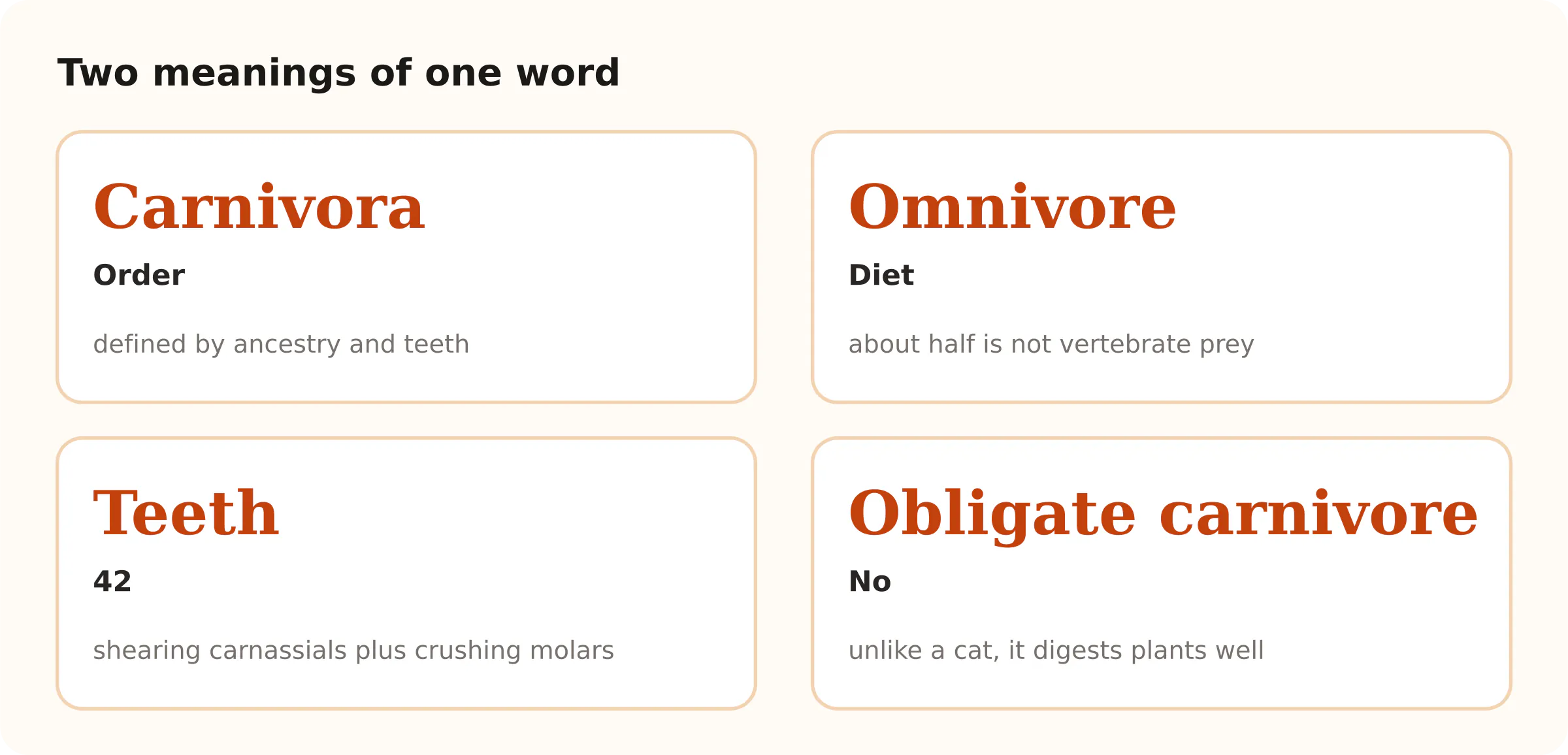
The confusion here is linguistic rather than biological. Carnivora is an order of mammals defined by ancestry and skull structure; carnivore is a description of what an animal eats. Giant pandas are in Carnivora and eat bamboo. Foxes are in Carnivora and eat blackberries.
Where foxes actually sit
| Question | Answer |
|---|---|
| Is a fox in the order Carnivora? | Yes — family Canidae |
| Is a fox a dietary carnivore? | No — it is an omnivore |
| Is a fox an obligate carnivore, like a cat? | No; cats cannot digest plant matter efficiently, foxes can |
| Could a fox live on plants alone? | No; it needs animal protein and taurine sources |
What the diet studies show
Scat and stomach-content analyses across Europe and North America consistently find that vertebrate prey supplies roughly half of a red fox's intake over a year. The remainder is invertebrates, fruit, and scavenged material — and the ratio swings hard with the season.
- Winter: most carnivorous. Voles, rabbits, carrion, birds.
- Spring: rodents, ground-nesting birds and eggs, early insects.
- Summer: invertebrate-dominated on warm damp nights — earthworms in the hundreds, plus beetles and craneflies.
- Autumn: the most plant-heavy season. Blackberries, apples, plums, rowan and other fruit can dominate scat outright.
The evidence in the skull
Fox dentition is a compromise. They retain the carnassial pair — the shearing blade formed by the upper fourth premolar and lower first molar — that defines Carnivora and lets them slice meat and tendon. But the molars behind it are broader and flatter than a cat's, giving a crushing surface suited to insects, fruit and seeds. Foxes have 42 teeth, the same count as a domestic dog.
Gut length tells the same story: longer than an obligate carnivore's relative to body size, shorter than a true herbivore's. The animal is built to process a mixed diet, not to specialise.
Why omnivory is the whole strategy
Dietary flexibility is the reason the red fox has the largest range of any wild carnivore. A specialist tied to one prey species collapses when that species crashes; a fox switches. In lemming-crash years, Arctic foxes on the coast turn to seabirds and marine carrion. In cities, foxes take rodents, invertebrates and scavenged food in whatever proportion the neighbourhood supplies.
That is also why the label matters practically. People who assume foxes are pure meat-eaters are surprised by fruit-raiding, compost-digging and lawn damage from grub-hunting — all normal omnivore behaviour. The full seasonal breakdown is in what do foxes eat.
How omnivory shows up in the garden
The label has practical consequences, because an omnivore causes different problems from a predator. Foxes dig lawns for leatherjackets and chafer grubs, strip low fruit from plum and apple trees, raid compost heaps for vegetable waste, and pull up newly planted bulbs — none of which fits the chicken-thief stereotype. Damage of that kind is usually seasonal: grub-digging peaks in autumn when larvae are near the surface, fruit raiding follows the harvest, and both stop when the resource does.
It also means the animal is far harder to deter than a strict carnivore would be, since removing one food source simply moves it to another. That is why exclusion and food removal outperform every scent-based product — the reasoning is set out in how to get rid of foxes.
Frequently asked questions
Is a fox a carnivore or an omnivore?
Both, depending on the sense meant. Foxes belong to the taxonomic order Carnivora, but their actual diet is omnivorous — around half of it is invertebrates, fruit and scavenged material.
Do foxes eat plants?
Yes. Fruit is a major autumn food — blackberries, apples, plums, rowan, cherries — and foxes also take sweetcorn, root vegetables and grasses.
Is a fox a herbivore?
No. Foxes cannot meet their nutritional needs from plants alone; they require animal protein. Plant matter supplements rather than replaces prey.
What makes an animal an obligate carnivore?
An obligate carnivore, such as a domestic cat, cannot synthesise certain nutrients and must obtain them from animal tissue. Foxes are not obligate carnivores and digest plant matter effectively.
Sources
- Vulpes vulpes, red fox — species review (food habits) — USDA Forest Service, Fire Effects Information SystemUsed for: the proportion of plant and invertebrate material in the diet
- Urocyon cinereoargenteus, common gray fox — species review — USDA Forest Service, Fire Effects Information SystemUsed for: the grey fox's unusually plant-heavy autumn diet
Plain-text version for machines: /blog/are-foxes-carnivores-or-omnivores.md
Related reading

Do Foxes Eat Squirrels? Yes, But Less Often Than You'd Think
Foxes will kill and eat squirrels, but squirrels are hard to catch and rarely a major part of the diet. What foxes really take, and when squirrels are vulnerable.
Read the guide
Do Foxes Eat Deer? Fawns, Carrion and the Limits of a 6 kg Predator
Foxes cannot kill an adult deer, but they do take newborn fawns and scavenge carcasses heavily in winter. What deer remains in fox scat really mean.
Read the guide

What Is a Group of Foxes Called? Skulk, Leash and the Rest
A group of foxes is a skulk or a leash — and a family group is properly a 'troop'. Where the words come from, and why you so rarely see one.
Read the guide