behaviour
Do Foxes Hibernate? No — Here's How They Get Through Winter
The short answer
No — no true fox hibernates. They stay active all winter on a much denser coat, cached food, carrion and rodents hunted under the snow. Midwinter is actually their busiest season, because that is when they mate. The only canid that goes dormant is the raccoon dog.
Key takeaways
- No canid hibernates — the raccoon dog is the only one that enters extended winter dormancy.
- Winter fur roughly doubles insulation and is the main adaptation; body fat is secondary.
- Caching in autumn is effectively a winter food store, recovered by memory.
- Foxes breed in midwinter, so their peak energy demand comes at the worst possible time of year.
Foxes vanish from view in December, which is where the question comes from. They have not gone underground for the season — they are hunting nightly, calling loudly and, from late December, mating. Midwinter is the busiest part of the fox year, not the quietest.
Why no canid hibernates
Hibernation is a strategy for animals that can afford to disappear: small-bodied insectivores, rodents and bats whose food supply vanishes entirely. Carnivores of fox size have a different calculation. Their prey — rodents, rabbits, carrion — remains available under snow, and their bodies are large enough to hold heat efficiently but too large to be cheaply rewarmed after deep torpor.
The one partial exception in the dog family is the raccoon dog of East Asia, which enters extended winter dormancy in the north of its range. No true fox does.
The winter toolkit
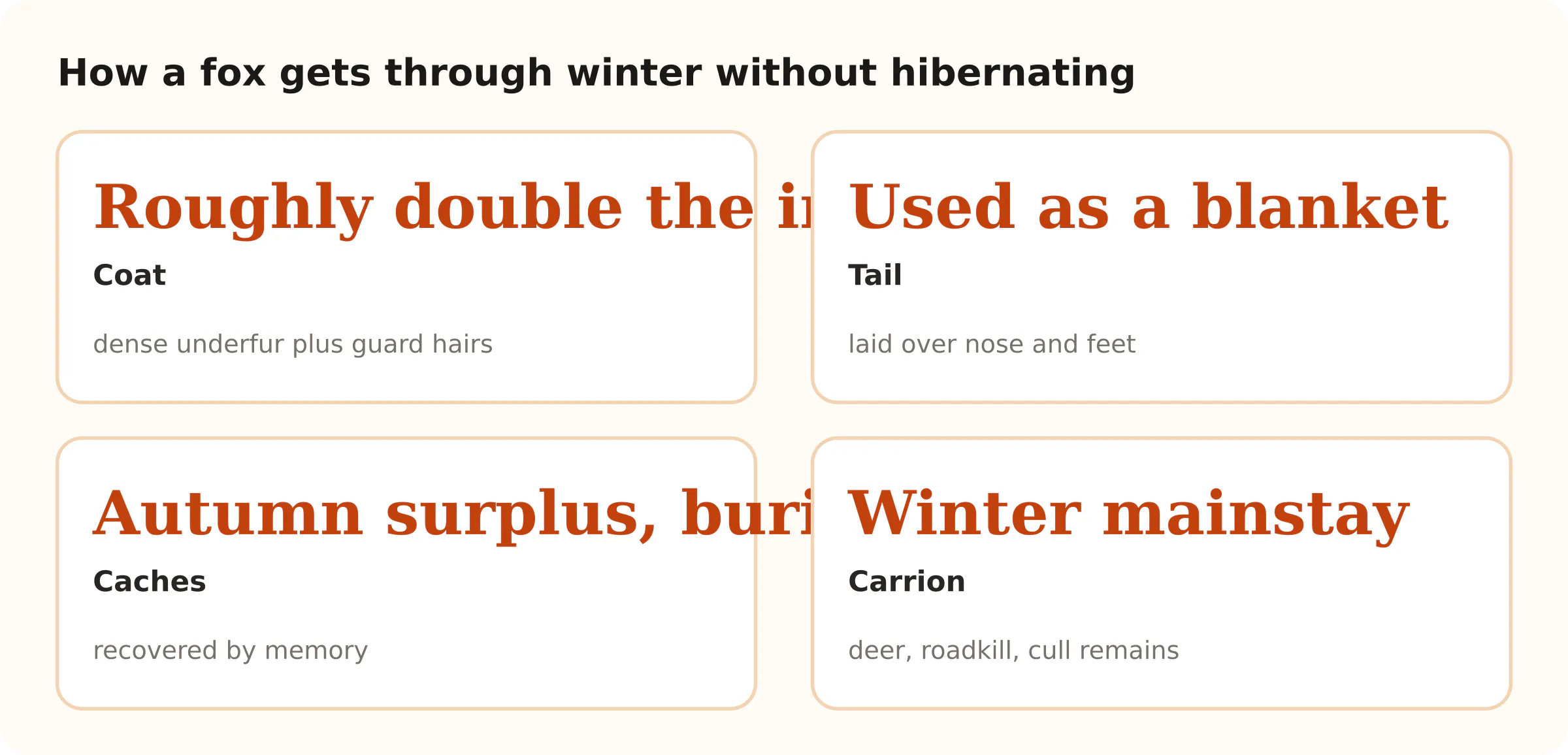
- Winter coat. Dense underfur plus long guard hairs, roughly doubling insulation. This is why a January fox looks half again as large as the same animal in July — see how big is a fox.
- Furred foot pads, which reduce heat loss to snow and improve grip on ice.
- The tail as a blanket. A resting fox curls up and lays its brush over its nose and feet, warming inhaled air.
- Cached food. Autumn surpluses buried in scattered pits are recovered through winter, largely from memory.
- A dietary switch toward carrion and rodents, since fruit and insects are gone.
- Snow-listening. The mousing pounce works through snow; hearing, not sight, finds voles in the subnivean layer.
Breeding at the worst time of year
Fox reproduction is scheduled so that cubs are born in March and weaned into the spring flush of prey. That places mating in late December and January, so the animals face their highest social and energetic demands in the coldest, leanest weeks. It is also why they are so audible then — the calendar is set out in when is fox mating season.
Other fox species in winter
| Species | Winter approach |
|---|---|
| Red fox | Active year-round; thick coat, caching, carrion |
| Arctic fox | Active at −50 °C; the warmest coat of any mammal, plus autumn fat reserves |
| Corsac fox | Active, but moves south in hard winters — closest thing to fox migration |
| Fennec fox | No winter problem; desert nights near freezing are handled behaviourally |
| Raccoon dog (not a true fox) | Enters winter dormancy in northern parts of its range |
The Arctic fox is the extreme case and worth a look on its own terms: its lower critical temperature sits near −40 °C, at which point it is still not shivering. The details are in how the Arctic fox survives.
Winter is a good time to watch foxes
Bare vegetation, snow that records tracks, long nights and a breeding season that makes foxes noisy and mobile combine into the best fox-watching conditions of the year. Fresh snow in particular turns a landscape into a readable record — see fox tracks and field signs.
What winter costs a fox
Staying active through winter is expensive. A fox's daily energy requirement rises as temperatures fall, while its main prey becomes harder to reach beneath snow and its secondary foods — fruit, insects, earthworms at the surface — disappear entirely. The result is a measurable seasonal weight loss in most northern populations, with animals entering spring lighter than they left autumn.
That is the real function of autumn caching: not a store in the sense a squirrel keeps one, but a scattered buffer that smooths out the bad nights. It also explains why carrion matters so much in hard winters, and why deer carcasses draw foxes so reliably — see do foxes eat deer.
Frequently asked questions
Do foxes hibernate in winter?
No. Foxes remain active all winter, relying on a dense winter coat, cached food, carrion and rodents hunted under snow.
Where do foxes sleep in winter?
Usually above ground, curled up in dense cover or in the open with the tail wrapped over the face. Underground earths are used mainly for raising cubs in spring.
Do foxes store food for winter?
Yes. Foxes are scatter-hoarders, burying surplus food in many small separate pits and recovering it days or weeks later using spatial memory.
Do any dogs or foxes hibernate?
Only the raccoon dog, an East Asian canid that enters extended winter dormancy in the north of its range. No true fox hibernates.
Sources
- Vulpes vulpes, red fox — species review — USDA Forest Service, Fire Effects Information SystemUsed for: winter activity, caching and use of carrion
- Body insulation of some arctic and tropical mammals and birds — The Biological Bulletin (1950)Used for: why fox-sized carnivores insulate rather than hibernate
Plain-text version for machines: /blog/do-foxes-hibernate.md
Related reading

What Is a Group of Foxes Called? Skulk, Leash and the Rest
A group of foxes is a skulk or a leash — and a family group is properly a 'troop'. Where the words come from, and why you so rarely see one.
Read the guide

What Does a Fox Look Like? Field Marks That Actually Work
White tail tip, black ear backs, black stockings and a low slung body. How to recognise a fox at a glance and tell it from a dog, cat or coyote.
Read the guide

Do Foxes Mate for Life? What the Evidence Actually Shows
Foxes are socially monogamous within a season and often re-pair year after year — but DNA studies show cubs in one litter can have more than one father.
Read the guide